Epicor kinetic and acumatica cater to manufacturing
Manufacturers have long recognized the need for a centralized system of record to manage operations from the shop floor to the board room. After all, manufacturing companies are far more likely to adopt ERP systems than any other industry sector—over 33% of manufacturers have an installed ERP instance.1
Two such systems are Acumatica Cloud ERP and Epicor Kinetic (formerly Epicor ERP). Both applications have specific capabilities to serve manufacturers who make to stock, make to order, configure to order, and perform mixed-mode manufacturing. There are solid inventory and warehousing features, strong accounting and financial management, robust sales order management, and even embedded CRM for managing the whole customer lifecycle.
A modern software platform underpinning an ERP is critical to compete in today’s global and digital economy. Acumatica and Epicor Kinetic are built on a cloud-based infrastructure, with deployment options for customers, consolidated reporting options, and visual dashboards for executives to manage their business by exception.
It can be challenging to wade through all the marketing materials and make sense of which ERP products are worthy of further due diligence. While deep functional comparisons can make it harder to differentiate between ERP offerings, there are selection criteria that matter to users, which clarify the more well-suited solution for small and mid-market businesses (SMBs). Look beyond granular features and functions to determine which system, vendor, and extended ecosystem are best for your organization.
This solution brief examines several factors to consider when evaluating Acumatica and Epicor Kinetic including vertical features, complexity, support options, integration strategies, partners, and business relationships. Read on to learn why Acumatica offers many strategic advantages over Epicor Kinetic for growing SMBs who want to modernize operations and evolve their digital transformation.
1 “Manufacturing ERP software: selection criteria and top vendors”, itransition.com, April 2021
Differentiation #1
The “Vertical Stack”
For manufacturers, vertical integration in today’s economy is becoming more common. Companies that produce goods also distribute them and sell them to end-users online in an omnichannel environment. Epicor Kinetic has capabilities around making and selling a product, but there are a few important gaps.
For example, Kinetic offers a Field Service module. However, the feature set is basic, and most customers require an add-on application to meet their needs—Service Pro. This add-on is one of several applications promoted on the same page as Kinetic’s core field service offering. Manufacturers who provide post-sales service will need an add-on application to meet most requirements. While integrated, Service Pro is built on a separate platform requiring additional licensing and investment for deeper integration.
Manufacturers are increasingly selling online, through distributors, and direct to consumers (D2C). They need tools to facilitate omnichannel sales, shipment tracking, and refunds & returns. Epicor Kinetic’s eCommerce functionality is not highly rated and only offers one connection to a marketplace platform (Magento). Again, businesses that want to sell in an omnichannel environment will need to buy external software to supplement Kinetic.
“When we talk about Acumatica, it’s not just about accounting but about where we do all our business. We work in Acumatica and don’t need to leave.”
Vertically-integrated manufacturers within the construction industry need support for producing and installing goods at the job site. Given that Kinetic does not have a module for Construction activities beyond nominal project accounting capabilities, these organizations are left to fill in the gaps outside Epicor, incurring added costs and managing yet another software component.
Acumatica, in contrast, offers manufacturers the ability to make, distribute, sell, and service on a single platform. Embedded field service features enable deliveries, installation, and remote service operations – with seamless integration to inventory, purchasing, and projects. Omnichannel sales can be aggregated into a single order management application with native connectors for multiple eCommerce platforms and marketplace. For manufacturers who also perform installations on-site or collaborate on construction projects, Acumatica’s Construction Edition supports all the needs of home builders, land developers, general contractors, property managers, heavy and civil construction, and specialty trade subcontractors.

Differentiation #2
Complexity
Catering to small and mid-sized manufacturers with limited IT staff means keeping things simple and manageable. Epicor Kinetic is a broad suite of applications that often overwhelms smaller companies.
As mentioned above, third-party add-on software bloats the Kinetic system, raising costs and incurring technical debt. Take note of how many presenters are needed for an Epicor demonstration to prospects – there’s one devoted to different disciplines of the solution (e.g., financials, manufacturing, order management, warehouse management, etc.)!
The complexity also applies to Kinetic’s implementation teams. Each implementation resource specializes in specific areas of the software. Implementation projects tend to run over time and budget without a clear understanding of the overall installation. Further, coordination of multiple implementation resources requires significantly more project oversight and planning.
Conversely, Acumatica has a robust yet concise set of modules that are easily demonstrated and implemented with a much smaller team with a collaborative view of the project. Acumatica’s logical workflows, intuitive data views, and modern process navigation promote user adoption, reducing employee training and onboarding for new employees.
How easy is Acumatica to use? CLICK HERE to let our customers tell you what it’s like.
Differentiation #3
Service and Support
Customer service and support are critical components of an ERP system’s lifetime value. Disappointing support services can frustrate users, delay operations, and incur off-system workarounds – causing inflated costs, lack of ERP usage, and data integrity issues.
Epicor Kinetic relies on direct employees to provide customer support. Epicor’s support department has a reputation of being a bottleneck with thousands of customers to serve and not enough staff to keep up with call volumes. Calls and support tickets experience long wait times, as stated in user forums. Inexperienced support staff struggle to address issues related to the complex nature of the application resulting in delays for case escalation to senior technicians and developers.
Additionally, users complain about the product’s long history of buggy code when new upgrades are released, compounding wait times and escalations.
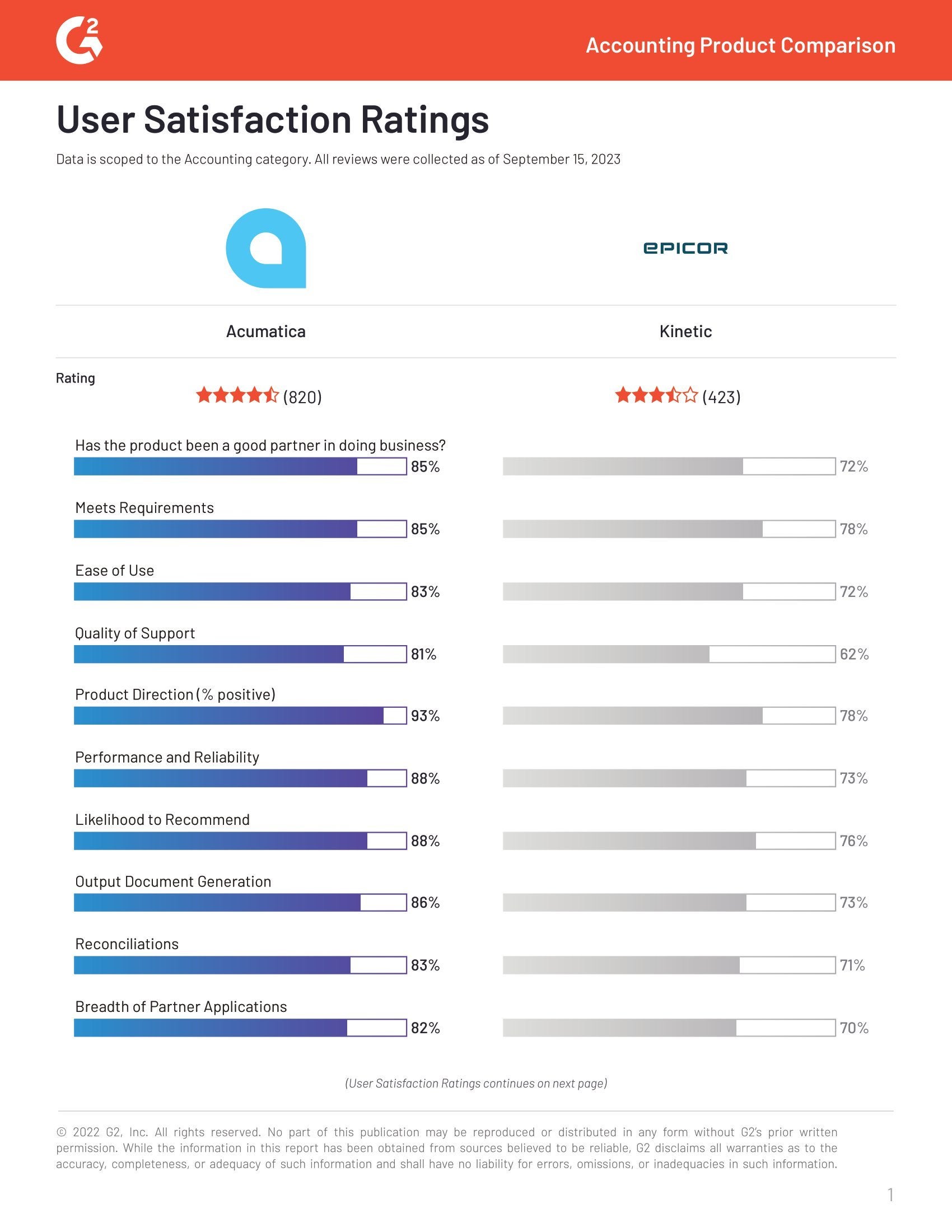
Alternatively, Acumatica provides all customers with a two-pronged customer support policy through certified reseller partners backed by Acumatica’s fully-staffed support department. Most issues never get to Acumatica, since certified VARs are knowledgeable and provide frontline support directly to the customers they helped implement. This is incredibly advantageous as the company supporting your mission-critical ERP system is the same company that implemented the software with access to consultants and developers who worked directly on your system. Customer satisfaction metrics are factored into each Acumatica VAR’s total compensation on software sales. As such, Acumatica users rate their support MUCH higher than Epicor users, per G2.com.
Differentiation #4
3rd Party Integration
No single ERP software suite can meet all needs of all users. It is inevitable that additional add-on applications will be required for a customer to optimize its competitive differentiation. Hence, an ERP system must be open and easy to integrate with other software.
Epicor Kinetic does not offer easy integration due to its proprietary platform. Gartner has cited Kinetic as difficult to integrate with other software applications. Epicor users themselves have complained that integration with third-party tools and recent acquisitions are challenges. Epicor offers only a handful of ISV solutions. Often, customers find themselves with only one option for extended solutions, such as for EDI and shipping. Conversely, Acumatica’s marketplace contains hundreds of certified applications providing customers with many options to meet their specific business needs.
Acumatica’s SOAP and REST APIs connect people, information, processes, equipment, and ideas across disparate software. Acumatica is a core member of the OpenAPI Initiative (a standards governing body). Epicor is not a member.
G2.com reviewers have also spoken about the difference in integration capabilities between Acumatica and Epicor Kinetic—with much stronger ratings for Acumatica.
Why are integrations so critical to today’s business? CLICK HERE to let our customers tell you why.
Differentiation #5
Partner Ecosystem
A strong user community and a growing ecosystem of partners can accelerate the value that customers receive from their ERP implementation. From consulting partners who help deploy, train, and support the application to independent software vendors who add complementary capabilities to the core ERP suite, partners fulfill many “last-mile” requirements for the user base.
There is a glaring difference in the partner ecosystem between Acumatica and Epicor Kinetic.
Kinetic’s implementation and consulting partners are limited in number and skillsets, since most customers must engage with Epicor directly, making resources scarce and costly. As listed on Epicor’s website, there are only 12 VARs and 24 Service partners in the USA. Globally, there are 207 VARs and 50 Service partners as of May 2022. Independent ERP analyst firm, Third-Stage Consulting, noted that Epicor has neglected its channel and consulting partners for years and is behind in re-building it.
Contrast that with Acumatica’s thriving ecosystem. Partners are flocking to Acumatica; many Acumatica partners have switched away from selling legacy ERP to hasten their growth. May 2022 figures show 350 VARs and 270 ISVs, with both showing double-digit growth in the last year. There is a vital marketplace of ISV solutions—271+ applications across 43 functional categories. Moreover, Acumatica relies on its value-added reseller partners for sales to customers. There is never a channel conflict between partners and Acumatica!
How does Acumatica’s Partner Ecosystem drive success? CLICK HERE to let our customers tell you why.
Differentiation #6
Ease of Doing Business
How a software vendor engages with its customers provides another source of competitive advantage for companies. True partnerships between publishers and end-users keep costs predictable, deliver new functionality prioritized by customers, and maximize use of the system by all employees.
Acumatica LIVES by its mission to be the most customer-friendly ERP provider, as evidenced by:
- A formal “customer bill of rights” manifesto, guaranteeing every user fair and friendly treatment.
- An Acumatica customer portal to facilitate collaboration with trading partners such as vendors, customers, and outside consultants.
- A steadfast focus on developing and supporting a singular ERP product with significant R&D investment (75% of Acumatica resources help develop and test the software).
- Free online training for ALL employees via Acumatica Open University.
- Award-winning usability and satisfaction ratings from industry sources G2, IDC, Nucleus Research, and Gartner. Winner of the coveted CODIE award for the best software product in 2021.


“It’s all about how they listen to you and how quickly Acumatica responds. They really do want to hear from users, understand our business processes and how we use the software so they can begin incorporating new features and enhancements to make things even easier. We’ve had no problems at all with Acumatica support, and our partner.”
Acumatica is THE Choice for Small and Mid-Sized Manufacturers
SMB manufacturers selecting an ERP platform to support their production systems and overall business operations have many choices, Acumatica and Epicor Kinetic, being two of the most popular. Aside from relative functional parity between the two systems, several other critical criteria must be considered.
To get the most from an organization’s ERP system of record, look at each vendor’s:
- Vertical Stack
Acumatica better supports manufacturers who also distribute and sell goods in an omnichannel model. - Product Complexity
Acumatica’s compact product portfolio reduces software bloat and streamlines business processes. - Customer Support
Acumatica provides dual layers of customer support: certified resellers, and Acumatica’s fully-staffed support department. - Application Integrations
Acumatica’s marketplace contains hundreds of certified applications to meet customers’ business needs. - Partner Ecosystem
Partners are flocking to Acumatica; many partners have switched away from selling legacy ERP to hasten their growth. - Ease of Doing Business
Acumatica LIVES by its mission to be the most customer-friendly ERP provider in the industry. Read our customer bill-of-rights!
The best choice for your next ERP system is rooted in critical factors beyond feature-function comparisons, and towards true technology partnerships.
“Acumatica has allowed OFSi to increase sales 100 percent year over year . . . Acumatica’s flexible and full-featured software probably saved OFSi about $250,000 in consulting fees needed to modify software to OFSi practices with other ERP solutions.”