 Canada (English)
 Colombia
 Caribbean and Puerto Rico
 Ecuador
 India
India
 Indonesia
 Ireland
 Malaysia
 Mexico
 Panama
 Peru
Peru
 Philippines
 Singapore
 South Africa
 Sri Lanka
 Thailand
 United Kingdom
 United States

A N A L Y S T
Isaac Gould
Overview
Small to mid-sized businesses (SMBs) face a number of challenges in today’s marketplace. Under pressure to remain competitive while cutting costs, SMBs adopt ERP systems to diversify their business models, enable descriptive and predictive analytics, and improve supply chain operations. Furthermore, SMBs have less tolerance for drawn-out implementation projects and continuous ERP consulting spend to configure and adapt their systems. To address these challenges, ERP vendors invest in industry-specific ERP packages, self-service tooling for extensibility and analytics, and solutions to support HR and Sales. As the footprint of an ERP system within an organization grows, so too does the potential value and risk. SMBs must consider the hidden costs of an ERP system as part of their evaluation, such as data storage, customization, training, and maintenance.
Small to mid-sized businesses (SMBs) are coping with the shifting market by diversifying their business models; manufacturers pivot to distribution and retail, distributors perform light assembly and packaging, and service organizations add subscription or consumption pricing models. Legacy ERPs or lightweight accounting systems lack the functionality and flexibility to support these initiatives; therefore, organizations turn towards ERP modernization. Another factor driving ERP adoption is to enable descriptive and predictive analytics. ERP systems touch many areas of a business where a fast-growing company may not have implemented a software system to manage and collect data. By deploying an ERP, companies will have a central repository for financial, operational, workforce, and sales data to leverage for analytics. Organizations also purchase ERP to assist supply chain operations.
As the business models of SMBs diversify, the complexity of their supply chains has increased to where they can no longer solely rely on spreadsheets, swivel chair operations, and best-guess decision-making. Where supply chain management technology vendors typically cater to the mid-market and above, businesses under $100M in annual revenue regularly turn to their ERPs for planning and execution functionality.
Regarding catering to the needs of the SMB market, ERP vendors have focused on shortening time-to-value and lowering the total cost of ownership through industry-specific offerings and self-service analytics, extensibility, and configuration tools. Virtually all ERP vendors will claim to offer industry-focused packages with workflows, reports, and dashboards pre-configured for specific use cases to remove much of the grunt work during the implementation. Customers will be bombarded during the selection process about these out-of-the-box capabilities; therefore, they must investigate how in-depth and wellmatched the pre-packaged systems are and how much configuration work must be done.
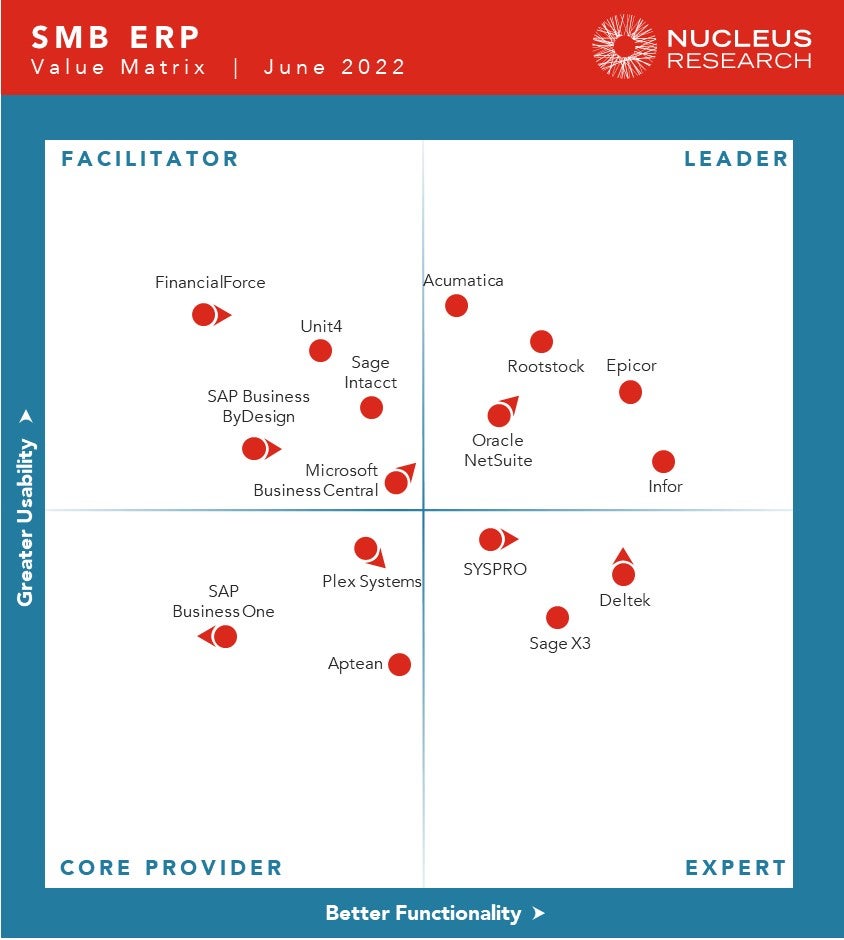
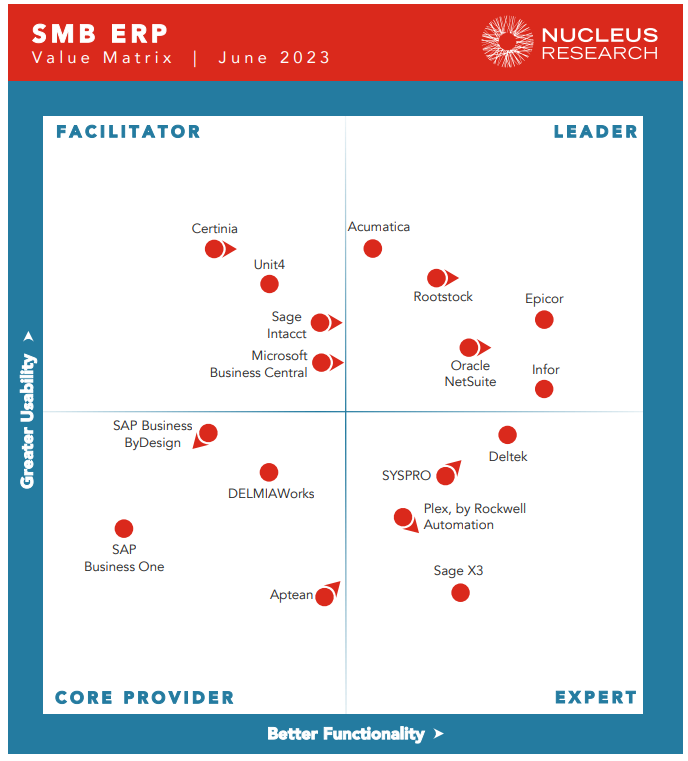
Many vendors have added self-service analytics designed for business users to help organizations access advanced analytics without data scientists. These tools allow users to select, clean, and transform data with a wizard-like approach to slice and dice data as needed, select the best-fit model, collaborate with stakeholders, and generate visuals and reports. As customers evaluate the analytic functionality of their ERPs, they must consider the platform’s ability to integrate with other systems and govern data across the ecosystem because the analysis users perform regularly requires data from multiple departments with disparate solutions. For example, an ERP system only capable of overnight batch processing will not support real-time dashboards. Self-service extensibility and configuration tooling are essential to customers that want to limit their ERP consulting spend. No-code functionality enables tech-savvy business users to construct workflows, automation, and reports that span multiple departments or source data from systems outside their ERP. In this Technology Value Matrix, Nucleus assesses the SMB-focused ERP market based on the value customers realize from the product usability and functionality that vendors are delivering with their solutions (Nucleus Research V67 – Understanding the Value Matrix, April 2021). The Matrix is a snapshot of the market designed to help customers and prospects understand where vendors are differentiating in how they deliver value and where vendors are making significant product investments.
LEADERS
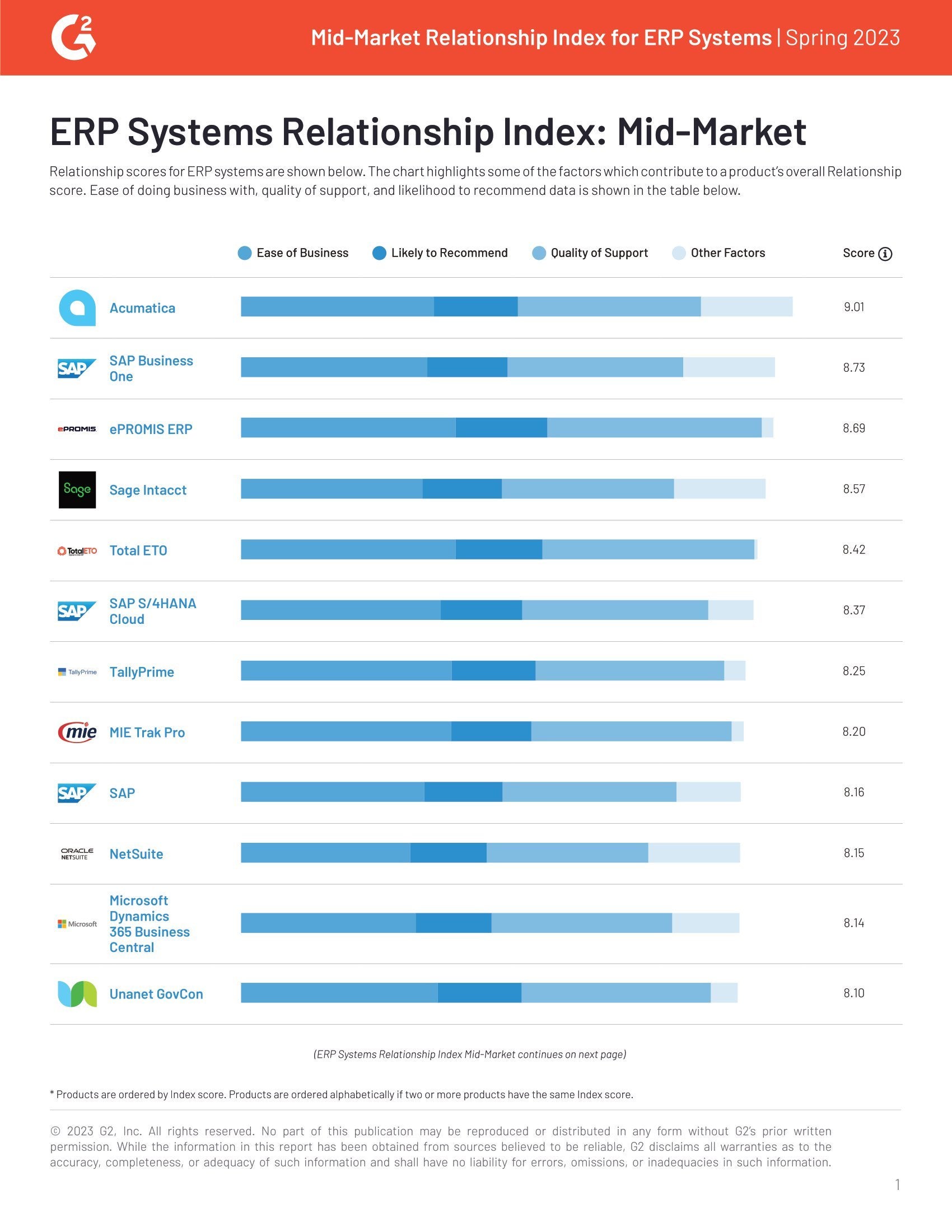
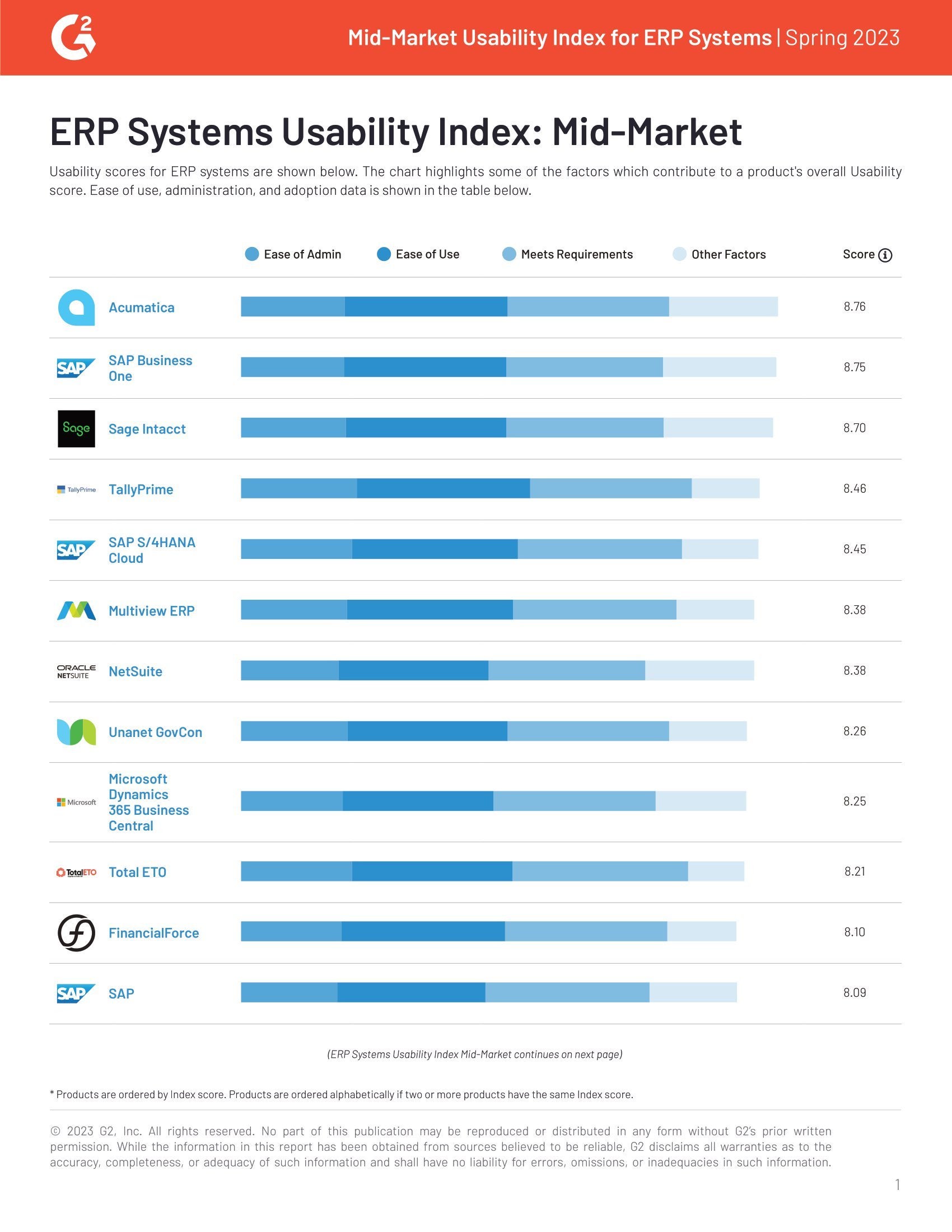
Leaders in the ERP Technology Value Matrix include Acumatica, Epicor, Infor, Oracle NetSuite, and Rootstock.
ACUMATICA
Acumatica is recognized as a leader in this year’s SMB ERP Technology Value Matrix. Acumatica’s cloud ERP solution is engineered to be easy to deploy, with a large ecosystem of ISVs to meet the needs of the mid-market. Its ERP platform includes accounting, sales, inventory, warehouse management, project management, customer management, and shopfloor applications, built on an open and secure cloud architecture. This provides users with constant availability, seamless remote collaboration, and enterprise-grade security. Acumatica customers have the freedom to switch between public and private cloud deployments as their business needs evolve. The vendor’s licensing policy further drives flexibility and scalability by providing users with an unlimited, consumption-based license, free of user-constraints. Acumatica has a single code base which can be delivered in specialized Industry Editions that cater to the Manufacturing, Distribution, Construction, and Retail sectors, offering bespoke features to address challenges specific to the respective vertical. These versions incorporate compliance requirements, sector-specific features, and cross-module workflows, providing an uninterrupted operational experience.
Acumatica delivered major product updates through its biannual releases; 2022 R2 and 2023 R1.
Acumatica delivered usability enhancements, including wiki-based info tips, mobile signature capture, mobile workspace configuration enhancements predefined dashboards and side panels for CRM, manufacturing, and distribution. Notifications
now include the prior document owner, and the delegation and reassignment of approvals have been streamlined.
▪ Technological advancements include contract-based API enhancements, including payroll distribution and mobile signature capture, commerce connector and more. Acumatica also enhanced business event-triggered actions, site preference-based
logout timeout, and OData support for translated fields boost efficiency and convenience.
▪ Financial management features have also received improvements. Approval processes for journal entries have been fine-tuned, alongside enhancements to dunning letters and personalization. Additional enhancements include syncing fixed assets and GL periods, auto-assigning tax zones based on addresses, improved ACH configuration, and simplified batch payment processing.
▪ In payroll management, employees can access paystubs on their mobile devices. Opportunity pipeline reporting, Canadian payroll processing, and task management have also been improved.
▪ Distribution and Retail-Commerce updates include advanced inventory cost layers, stock to non-stock inventory conversion, and bidirectional order syncing with Shopify. Enhancements such as counter sale order entry for purchase and return, predefined user roles, and limited variant matrix items improve operational efficiency. Inventory availability in Amazon FBM and Shopify hierarchy for B2B customers has also been enhanced.
▪ Manufacturing capabilities delivered include an engineering workbench, MRP with transfer demand, and time entry across production orders. New features delivered include over-completion quantity verification on operations, multiple base currency
support, and pre-configured side panels on profile forms to further enhance visibility.
▪ In the Construction, Project, and Field Service domains, Acumatica released unitbased project progress tracking, mobile-enabled drawing logs and submittals, and change order workflow enhancements improve project management capabilities.
The vendor also released features like skill inclusion in appointment scheduling optimization, construction reporting improvements, joint check processing enhancements, and lien waiver workflow improvements as well as mobile annotations, drawing logs, submittals, and progress worksheets.
EPICOR
In this year’s SMB ERP Technology Value Matrix, Epicor has been positioned as a leader. Its primary customer base lies within the mid-market, spanning sectors such as automotive, distribution, construction supplies, manufacturing, and retail. The Epicor Industry ERP Cloud platform unifies diverse capabilities like finance, supply chain management, planning, CRM, product management, project management, business intelligence, and analytics into a single integrated system. Epicor presents a varied portfolio of industry-specific ERP systems, including Epicor Kinetic for discrete manufacturing, Epicor Prophet 21 for distribution
capabilities, and Epicor Propello for retail management. With its flexible infrastructure, incorporating no/low-code customization options, ready-made API connectors, and an extensive selection of add-on modules, Epicor enables businesses to configure their ERP system to fit unique business requirements.
Recent product updates and enhancements include:
▪ Epicor released Kinetic 2022.2 and 2023.1, offering enhanced traceability, improved financial controls, and visualization across manufacturing solutions.
Prophet 21 release 2022.2 introduced efficiencies to front counter operations, a redesigned Warehouse Management System (WMS) interface with a more intuitive UX, and an in-app Stored Procedure Executor window for data error correction.
▪ Prophet 21 2023.1 included the release of Epicor Project Hub – a real-time, webbased solution with a modern API structure that allows distributors to manage complex projects. Also included was the availability of dynamic pricing based on location, promotional pricing and ‘lowest of’ pricing across libraries and full integration with Automation Studio to orchestrate workflow automation and intelligent integration with external systems for establishing a connected business.
▪ Automation Studio was embedded within Kinetic and Prophet 21 in July 2022, enabling automated workflows and seamless data integration across various applications. Automation Studio provides access to over 1,000 connectors to many popular Cloud applications like Salesforce, HubSpot, ADP, Shopify, and Slack
▪ Epicor made strategic acquisitions, including Grow, a business analytics and reporting solution integrated with Epicor Kinetic and Prophet 21 in 2023.
▪ Epicor acquired Evron to integrate field service management capabilities into both Kinetic and Prophet 21 in February 2023.
▪ Epicor acquired DSPanel in March 2023, the developer of Epicor Financial Planner (EFP), which was rebranded as Epicor Financial Planning & Analysis (FP&A) in May 2023.
▪ Epicor acquired EFlex in October 2022, a cloud-based Manufacturing Execution System (MES) technology, now rebranded as Epicor Connected Process Control.
▪ Epicor invested in continued compliance with global and regional policies, including SOC 1 and 2, GDPR, CCPA, Cybersecurity Maturity Model Certification (CMMC), International Traffic in Arms Regulations (ITAR), and other regional requirements.
INFOR
Infor is recognized as a leader in this year’s SMB ERP Technology Value Matrix. At the core of Infor’s products and technologies are solutions with industry-specific capabilities, integrated into the CloudSuite platform for accelerated deployment and continuous updates. The vendor targets industries including healthcare, industrial machinery, heavy equipment, automotive, fashion, wholesale distribution, manufacturing, aerospace and defense, food and beverage, and public services. By concentrating on select industries, Infor ensures that innovations are dedicated to fulfilling targeted customers’ needs without having to search outside the Infor ecosystem. For all industries, Infor’s modular CloudSuite platform offers supply chain management (SCM), customer relationship management (CRM), human resources planning, product lifecycle management, warehouse management, and asset management capabilities in addition to financial and accounting functionality. Infor’s solutions are deployable on-premises or in multi-tenant SaaS environments, ensuring that customers have access to the most current solution innovations and up-to-date technologies. The vendor also delivers enterprise-grade security and scalability, featuring partnerships with AWS.
Infor delivered major product updates throughout the past year:
▪ Infor achieved the AWS manufacturing and Industrial competency designation for Infor CloudSuite Industrial and other SaaS solutions. This designation recognizes Infor for its expertise in providing customers with professional services and software
solutions for an end-to-end industrial manufacturing software toolchain.
▪ Infor partnered with Foresight Retail, a leader in delivering merchandise and assortment planning to help fashion brands and retailers improve inventory management and better balance supply to demand, and thereby avoid stock outs, markdowns, obsolete inventory and potentially landfill.
▪ Infor introduced the Augmented Intelligence Service which makes AI/ML accessible to organizations of any size with pre-packaged industry specific AI/ML use cases that deliver prescriptive business outcomes. The combination of the Infor OS platform
that covers integration, automation, extensibility, data management and insights with proven AI/ML models for anomaly detection, asset intelligence, product/pricing recommendations, demand forecasting and people intelligence with dedicated data
science support services is a unique offering in the market. Infor has customers across multiple industries rapidly utilizing AI/ML with this new service, including Combilift, Zeelandia, Camatic Seating, Confluence Health and more.
ORACLE NETSUITE
Oracle NetSuite is placed as a leader in this year’s SMB ERP Technology Value Matrix as recognized for its comprehensive offering capable of handling the operational and financial processes critical to various service and product-centric businesses. NetSuite sets itself apart with its suite of enterprise applications built on a unified data model that incorporates billing, revenue recognition, accounting, planning and budgeting, PSA, SCM, MES, WMS, HCM, CRM, and commerce capabilities (B2B, B2C, POS), and BI. Users can also access a range of “Built for NetSuite” applications from partners to further enrich the platform.
Although NetSuite targets organizations with revenues up to $250M, the vendor regularly attracts enterprise customers who value the solutions scalability and industry-specific capabilities for advertising and digital marketing, education, financial services, nonprofit, hospitality, high-tech manufacturing, retail, and wholesale distribution. NetSuite is also strongly considered among international organizations with capabilities for currency conversion, and tax compliance, as well as support for financial reporting standards in 27 languages, 190 currencies, and over 217 countries and territories.
Recent product updates and enhancements include:
▪ NetSuite Account Reconciliation, allowing accounting teams to automate and better manage the account reconciliation and transaction matching processes.
▪ NetSuite CPQ, enabling sales teams to quickly configure, price, and quote products directly in NetSuite. NetSuite CPQ accelerates sales processes and integrated with
NetSuite ERP, CRM, and ecommerce solutions using NetSuite pricing, inventory, and profitability data as well as connected workflows that automate the transition from sales to delivery, generating bill of materials (BOM), routings and work orders.
▪ NetSuite SuitePeople Workforce Management, delivering a single solution to streamline shift scheduling, easily capture time and attendance across an organization’s workforce, and calculate wages.
▪ NetSuite Ship Central, enhancing the packing-to-delivery process to expedite shipments and minimize costs.
▪ NetSuite Smart Count streamlines the management of inventory by automating count tasks, improving the efficiency and accuracy of cycle counting. Users can also perform concurrent, real-time counts, eliminating the need to freeze a transaction
during a count.
▪ NetSuite Item 360, providing users with a real-time and concise overview of an item’s current status in a consolidated dashboard. It enables visibility into item transactions for all locations and subsidiaries by default across multiple portlets, each
relating to a different transaction type or inventory view.
ROOTSTOCK
Rootstock is a leader in the 2023 SMB ERP Technology Value Matrix. Rootstock, an ERP vendor in the manufacturing industry, primarily serves mid-sized companies operating in aerospace & defense, canna-business, high-tech & electronics, industrial equipment, medical device, and project manufacturing verticals. Rootstocks ERP platform provides a comprehensive suite of functionalities, including sales, engineering, supply chain management, production, inventory, financials, analytics, collaboration, and customer service capabilities. Rootstock is developed directly on the Salesforce Platform, providing organizations with a cohesive data model and user experience that seamlessly integrates CRM, ERP, and other business applications. Rootstock provides organizations with end-to- end business visibility from marketing, sales, operations, finance, and service to help them
manage operations efficiently, and become more customer-centric and agile.
Updates in the last 12 months:
▪ In May 2023, Rootstock’s Spring ’23 Release will include enhancements to Rootstock Financials. Rootstock’s enhancements in the Financial module provide CFOs the flexibility to drive revenue by enabling different payment options, such as credit card
payments and subscriptions while supporting budget tracking and transparency through features like corporate budget management. These improvements address CFOs’ challenges, including reducing costs, adhering to budgets, and meeting
decision support and transparency demands.
▪ In May 2023, Rootstock will release Enterprise Insights, which consists of five analytics modules to provide end-to-end business intelligence for manufacturers built on the Rootstock data foundation. The Sales Analytics module identifies sales trends, sets goals, and improves revenue by assessing profitability and making strategic investments. Spend Analytics helps track spending patterns, enhance supplier sourcing, and reduce procurement costs by streamlining processes and fostering collaboration. Inventory Analytics provides insights into inventory performance, minimizing risks like stockouts and excess inventory while improving customer satisfaction and profitability. Manufacturing Analytics focuses on optimizing shop floor performance through metrics such as production, scrap rates, and lead times. Financial Analytics offers increased visibility into assets, liabilities, income, and expenses, enabling better revenue monitoring, costs, and overall financial health. By leveraging these modules, manufacturers gain valuable insights to make data-driven decisions, adapt to market fluctuations, and drive continuous improvement.
▪ In the fall of 2022, Rootstock released its Digital Supplier Collaboration capabilities to offer streamlined processes for sourcing, supply chain monitoring, and real-time collaboration. The automated Digital Sourcing feature enables manufacturers to post
requirements and receive quotes from potential suppliers, facilitating cost-effective and reliable procurement decisions. Supply Chain Dashboards provide a consolidated view of key metrics, allowing manufacturers to track supplier performance and identify any issues that require attention. Additionally, Rootstock facilitates real-time communication and data sharing between manufacturers and suppliers, reducing delays and improving overall collaboration through platforms like Slack. Rootstock’s online portal and platform tools enable manufacturers and suppliers to collaborate on risk mitigation strategies, troubleshoot issues, and prevent shortages, enhancing relationships and reducing supply risk.
EXPERTS
Experts in the ERP Technology Value Matrix include Deltek, Plex, by Rockwell Automation, Sage X3, and SYSPRO.
DELTEK
Deltek is an expert in this year’s SMB ERP Technology Value Matrix. Deltek is a provider of software and solutions that serve various sectors such as accounting, architecture, engineering, construction, consulting, energy, IT, aerospace, defense, and government contracting. Key solutions in their portfolio include Costpoint, Vantagepoint, Maconomy, Ajera, WorkBook, and ComputerEase. Deltek Costpoint, a central product from the vendor, is an ERP solution used by US federal government contractors, including both larger enterprises and small-to-medium-sized businesses. Its functionality encompasses project accounting, business intelligence, contract management, human capital management, manufacturing, procurement, project
management, time and expense tracking, and subcontractor management. Unique to Costpoint is its strong security and compliance capabilities, designed specifically to meet the requirements of government contracting, with adherence to regulations such as FAR, DFARS, CAS, GAAP, ASC, NIST 800-171, CMMC, ITAR, and FedRAMP.
Other solutions by Deltek, like Vantagepoint, Maconomy, Ajera, WorkBook, and ComputerEase, provide a variety of functionalities covering business intelligence, contract management, human capital management, procurement, accounting, manufacturing, and project management. Deltek’s products have a modular structure, and offer customization options that allow organizations to tailor these solutions to their specific needs and to scale their operations as required.
Recent product updates and announcements include:
▪ Deltek launched Unionpoint iPaaS in partnership with Workato to automate business processes. This is expected to enhance efficiency in project management for customers.
▪ The vendor acquired TIP Technologies, extending its capabilities to the aerospace & defense and government contracting sectors. As a result, customers in these sectors are expected to experience a broader range of services.
▪ Deltek created the Deltek Pro Bookkeepers program to connect clients with accounting professionals familiar with Deltek’s Costpoint ERP. This is expected to streamline financial management for small businesses using Deltek. Deltek set up the Ideas Portal to gather customer feedback effectively. This initiative is expected to refine product development to better reflect customer needs.
▪ Deltek released Costpoint 8.1 and has plans for Costpoint 8.2 release. These enhancements are expected to provide customers with improved project accounting and resource planning capabilities. Costpoint 8.2 – released in June – included streamlined capabilities, specifically focused on small and mid-sized firms, providing them an offering with only the essential capabilities that small and mid-sized firms need to move to a compliant ERP quickly.
▪ Deltek introduced Vantagepoint 6.0 with a focus on usability, accessibility, and collaboration. This upgrade is expected to improve project visibility and collaboration for users.
▪ Deltek integrated a new accounts payable automation feature, Deltek Payments, into Vantagepoint. This addition is expected to streamline accounts payable management for customers.
▪ Deltek marked the first anniversary of ArchiSnapper’s launch, expanding its reach into North America. This expansion is expected to increase accessibility to Deltek’s services for clients in this region.
▪ Deltek released ComputerEase 22.2 with modernized processes and improved visibility into profits. This upgrade is expected to save time and provide better profit visibility for customers.
PLEX, BY ROCKWELL AUTOMATION
Plex, by Rockwell Automation is ranked as an expert in this year’s SMB ERP Technology Value Matrix. The company primarily serves SMBs in the automotive, food and beverage, precision metal forming, plastics & rubber, industrial manufacturing, high tech & electronics, and aerospace industries. Accounting & consolidation, financial management, human capital management, and supplier & purchasing management are all part of their cloud-based ERP solution. Plex’s ERP platform, designed with a manufacturing focus, includes industryspecific compliance templates, pre-configured workflow automation capabilities, and IoT
integrations. With advanced manufacturing capabilities such as MES and QMS, customers often choose Plex for its ability to manage complex manufacturing operations without a heavy IT footprint.
Recent product updates and enhancements include:
▪ Plex has aligned its packaging and pricing to SMB market with improved packaging that offers unlimited user, user-based, and consumption-based options.
Plex provides built-in EDI mapping and processing and has expanded its library of APIs for integrations.
▪ Rockwell has realigned its software sales, product, engineering, and marketing teams under the leadership of four industry veterans acquired through the Plex acquisition: Fred Hehl (VP, Enterprise Software Sales), Nathan Pieri Chief Product Officer &VP, Applications), Richard Murray (Chief Engineering Officer, Product Operations), and Robin Saitz (VP, Global Marketing & Chief Marketing Officer).
▪ To assist global manufacturers with shifting business and regulatory requirements, Plex has delivered consistent innovations including enhancements in finance and accounting, expanded language support, new mobile applications, modern APIs for
third-party system integration, deeper traceability and material genealogy, and increased flexibility in supply chain and manufacturing processes.
▪ Plex’s continuous innovations eliminate the need for third-party software while still offering the option for customers with existing corporate tools.
SAGE X3
Sage X3 is an expert in the 2023 SMB ERP Technology Value Matrix. The ERP system primarily caters to organizations operating in the discrete manufacturing, food and beverage, chemical, process manufacturing, wholesale distribution, and business service
sectors. Sage X3 is Sage’s dedicated complex manufacturing solution, combining financial management, CRM, supply chain management, and product management capabilities into a unified solution. Sage X3’s key strength lies in its pre-configured industry-specific features, allowing customers to implement the system and accelerate time-to-value rapidly.
Sage X3’s financial management module offers comprehensive financial management features to manage finances across multiple sites and countries effectively. It covers various aspects such as finance, personnel, cost, budget accounting, commitments, and fixed assets. Budget models, commitments, fixed asset tracking, and depreciation planning functionalities are included. Sage X3’s production management module offers a range of features to streamline and optimize production processes. It includes comprehensive bill of materials (BOM) management for maintaining product consistency and quality. The module
supports multi-level BOMs, enables mass maintenance, and provides change management capabilities. Sage X3’s supply chain management module enhances supply chain efficiency and meets customer demand. It integrates sales, inventory, purchasing, financing, and manufacturing to provide comprehensive functionalities. The purchasing capabilities of Sage X3 support the entire procurement process, including managing requests for quotes (RFQs), supplier and product category management, pricing and discounts, purchase planning and ordering, purchase orders and delivery, budget accounting, and supplier invoice entry.
Notable updates in the last 12 months include:
▪ On October 12th, 2022, Sage acquired Spherics, a carbon accounting solution. This move reinforces Sage’s commitment to sustainability, supporting SMBs in understanding and reducing their environmental impact. Spherics automates emissions calculations, helps refine carbon footprint estimates, and provides spendbased analysis aligned with global standards for measuring carbon emissions.
SYSPRO
SYSPRO is recognized as an expert in this year’s SMB ERP Technology Value Matrix. The vendor predominantly caters to the needs of small and medium-sized businesses (SMBs) in the manufacturing and distribution sectors. Its solution, that can be deployed on-premise, in the cloud, or through private hosting, encompasses an expansive array of features, including order orchestration, supply chain administration, production regulation, inventory control, cost management, business operations, fiscal governance, procurement handling, warehouse supervision, and process enhancement solutions. At the heart of SYSPRO’s value proposition is its industry expertise, which is embodied in its offerings for the manufacturing and distribution industries. These include workflow automation tools and ready-made standard performance metrics that serve to optimize operations. This focus of industryspecific tools and capabilities helps SYSPRO deliver comprehensive solutions that align with the unique needs and challenges of SMBs in these verticals.
SYSPRO delivered various product updates throughout the past year.
▪ SYSPRO announced the release of SYSPRO 8 2022 in February 2023. The newest version of the SYSPRO ERP platform introduces several new capabilities for manufacturing, distribution, and finance. Most notable was the announcement of
Embedded Analytics, a drag and drop analytics and dashboard deployment tool to enable non-technical users to construct their own queries and visualizations (Nucleus Research X38 – SYSPRO introduces embedded analytics, February 2023).
▪ In November 2022, Syspro announced the expansion of its independent software vendor (ISV) offering with the launch of a global program. This new program gives customers a suite of certified and vertically integrated ISV solutions that complement
and augment SYSPRO in specific enterprise business processes.
FACILITATORS
Facilitators in the ERP Technology Value Matrix include Certinia, Microsoft Dynamics 365 Business Central, Sage Intacct, and Unit4.
CERTINIA
Certinia (formerly FinancialForce) is a facilitator in the 2023 SMB ERP Technology Value Matrix. The ERP specialist serves small and medium-sized businesses (SMBs) in various sectors, including business services, health and lifestyle sciences, media and digital communications, professional services and consulting software, high-tech and IT services, and telecommunications. The cloud ERP provider offers a comprehensive suite of capabilities, including accounting, finance, subscription and usage billing, revenue management, financial planning and analysis, procurement, order and inventory management, and analytics. Certinia, built on the Salesforce platform, stands out with its native connectivity to Salesforce applications, enabling users to create workflows and automations that span across ERP, sales, marketing, and analytics. Certinia customers can extract additional value from products such as Salesforce CPQ, Report Builder, and CRM. This seamless integration enables streamlined accounting, billing, and project management workflows, enhancing process efficiency and employee productivity.
Product updates in the last 12 months:
▪ In the 2023 ERP Cloud release of FinancialForce, product enhancements include revenue recognition for revenue schedules with filter criteria, improved ERP accounting features for compatibility with local general ledger account structures, payment and collections user journeys, cash matching, and procurement launches. Advanced versioning and snapshots for budgets, updates with actuals for closed months, running financial statements directly from group hierarchy visualization, and greater data ingest into analytic features were announced. FinancialForce introduced advanced procurement to deliver high-quality MVP for spend management and endto-end automation through the opportunity to renew flow, summarization of fixed asset journals with auto-posting, and schedulable period and close.
▪ During the ERP Cloud Winter 2023, product enhancements include completing all core financial transactional flows in Lightning, end-to-end back transaction reconciliation process with automated transaction creation capabilities, dateeffectively for general ledger, and year-end-close enhancements for Multi-X. Support for multiple tax statuses when trading different companies with the same account was introduced, and users can reduce implementation time for multi-X organizations by providing templates for charts of accounts and tax codes. There were updates to purchase contracts, procurement workspaces, revenue recognition, chart amortization, and updated prices on active subscription billing contracts. Users can now leverage Salesforce to convert dataflows to recipes, utilize deferred revenue waterfall for services, and create accurate reports with column-level formatting. Additionally, enhancements to multi-currency support, headcount planning by role, enhanced rules to define budget creation, and budget holding for sensitive data for headcount planning were released.
▪ The ERP Cloud Summer 2022 release of FinancialForce included a requisition to renew end-to-end user journey in Lightning and complete Lightning UI in revenue management. It advanced quoting user journals, year-end processing, intelligent
bank reconciliation, and the ability to disable accounting dimensions. Enhancements to purchase contracts, outbound payments, and revenue schedules allow for early termination of contracts to the applicable credit processing, formatting capabilities
for PDF reporting, planning workspace, and enhanced user experiences.
MICROSOFT DYNAMICS 365 BUSINESS CENTRAL
Microsoft is placed as a facilitator in this year’s SMB ERP Technology Value Matrix as recognized for its solution, Dynamics 365 Business Central. Business Central is designed to cater to the needs of small and mid-sized organizations across various industries. It offers an integrated platform that allows companies to manage a comprehensive set of business processes from finances, supply chain, manufacturing, and shipping, to project management and services. The ERP platform integrates customer relations, accounting, finance, sales, inventory, supply chain, service, and project management functions. Furthermore, Business
Central features extensive pre-configured compliance features, including financial reporting standards, local functionality, and GDPR, to meet global compliance mandates in over 25 languages. It also provides on-premises, cloud, or hybrid deployment options, catering to organizations with various infrastructures or regulatory requirements. Microsoft has also introduced Microsoft 365 Copilot, which is integrated into Microsoft 365 apps, allowing users to benefit from GPT assistance in various work scenarios, including preparing for a meeting, analyzing profitable products, and creating budget proposals (Nucleus Research
X63 – Demystifying the value of Microsoft’s GPT-powered Copilot, March 2023).
In its 2022 wave 2 release, Microsoft brought multiple updates and enhancements to its Business Central platform.
▪ Business Central’s 2022 release wave 2 enhances user onboarding with easy access to necessary apps, improved tooltips, enhanced menu navigation, and improved productivity through Power Automate integration. Updates include a more reliable service platform for SMBs, improved environmental health communication features, application improvements including a Shopify integration, optimizations to finance and supply chain capabilities, and increased efficiency of business processes in Microsoft Teams, including pinning cards and Excel add-in for delegated admins. Microsoft also brought multiple updates with its Wave 1 2023 release.
▪ The wave 1 release included support for managing multiple companies with extended intercompany features, seamless customer onboarding experiences supported by Microsoft and partners’ quality content, automation of regulatory tasks for regulatory compliance, improved usability, and non-deductible VAT support in the W1 version. This release also increases productivity for developers and consultants through Visual Studio Code AL Explorer which allows ISVs to perform transactions via AppSource marketplace, and boosts efficiency when handling lists of records.
▪ Wave 1 also included improvements to the platform’s integration with the Microsoft Power Platform for setting up approval workflows and delivering sample apps. It also includes modernized permissions systems, improved in-app guidance and user
assistance, and enhanced collaborative business processes within Microsoft Teams.
▪ Furthermore, the vendor focused on governance and administration is with additional self-service features for administrators, support for non-deductible VAT, enhanced onboarding experiences for organizations, and continual investment in service fundamentals, prioritizing performance, stability, resource governance, security, and compliance.
SAGE INTACCT
Sage Intacct is a facilitator in the 2023 SMB ERP Technology Value Matrix. Sage Intacct is tailored to meet the specific needs of professional services, construction, manufacturing, and real estate verticals. With a strong focus on project-based accounting requirements,
Sage Intacct provides comprehensive financial management capabilities, including accounts payable and receivable, billing, cash management, general ledger, order management, and purchasing. With Sage Intacct’s data mesh, users can integrate data from various sources to support automation, reporting, and analytics. Customers often choose Sage Intacct for its accounting and FP&A functionality. Financial statements can be pre-populated, automatically convert currencies, and slice and dice data to the desired granularity, simplifying the monthly closing process and ensuring accurate financial information. Intacct’s platform goes beyond core ERP functionality, offering real-time dashboards and reporting technology. Users can easily analyze project-specific revenue and expenses, saving time and improving performance evaluation.
Product updates in the last 12 months:
▪ On April 5th, 2023, Sage launched Sage Intacct on Microsoft Azure in the US, enabling small and mid-sized businesses to access Sage’s cloud financials solution within Microsoft’s secure cloud environment. This partnership demonstrates Sage’s commitment to providing scalable solutions to SMBs while leveraging the userfriendly capabilities of Microsoft Azure.
▪ On February 22nd, 2023, Sage announced the 2023 Intacct Release 1 product enhancements. Sage Intacct product enhancements in the 2023 release include AIpowered bill automation for accounts payable, expanded functionality for the Mateo
Savings and Loan solution, and automated usage billing for subscriptions. Sage Intacct Planning and Sage Intelligent Time are now available in South Africa and Australia, with plans to expand to the United Kingdom. The early adopter program
for Sage Intacct in France is open, offering improved business visibility and automation on a modern cloud-native platform.
▪ On October 12th, 2022, Sage Intacct announced increased internationalization, with plans to expand into continental Europe, starting with France, and the availability of Sage Intacct Manufacturing for customers in the US. Sage Intacct has expanded its
construction and real estate capabilities and introduced inventory automation, lease accounting functionality, and accounts payable automation. Integrating 1099 e-filing powered by TaxBandits simplifies the tax filing process for US customers, ensuring
compliance and reducing errors.
▪ On October 12th, 2022, Sage announced new product integration with Microsoft. Users will be able to integrate Microsoft Teams with Sage Intacct and Sage People to streamline workflows such as form submissions and approvals.
▪ On October 12th, 2022, Sage announced several acquisitions. The Lockstep acquisition brings workflow automation tools to the platform, enabling users to build their own automations across accounting and operational use cases. By acquiring Spherics, Sage introduces carbon accounting functionality to support ESG tracking and reporting.
UNIT4
Unit4 is a facilitator in the 2023 SMB ERP Technology Value Matrix. The ERP vendor offers a range of solutions specifically designed to meet the needs of organizations in professional services, the public sector, nonprofit, and higher education. These tailored solutions empower businesses to streamline operations, optimize performance, and drive successful outcomes. The vendor’s ERPx platform integrates essential functionalities such as finance, procurement, project management, operations, HR, and payroll, delivering a cohesive and intuitive user experience for customers. This comprehensive platform empowers
organizations to manage their key business processes effectively, enhance collaboration, and drive operational efficiency. Unit4 differentiates itself with a modular micro-service architecture that allows organizations to customize and extend their ERP system. This unique approach efficiently integrates additional functional modules like FP&A and HCM without needing external consultants. By leveraging this architecture, businesses can tailor their ERP system according to their specific requirements, optimizing processes, boosting productivity, and adapting to changing business needs more efficiently.
Product updates in the last 12 months:
▪ In January 2023, Unit4 launched the Unit4 Marketplace, a platform where its ISV, Reseller, and Service partners can showcase their industry-specific apps that integrate with Unit4’s ERP solutions. The Marketplace allows customers to discover partner innovations, explore additional functionality, and benefit from ready-made integrations, saving on in-house development efforts. The launch of Unit4 Marketplace compliments, Developer4U program to provide Apppartners with an opportunity to showcase their extension apps and create value for customers while generating new revenue streams. Through Developer4U, partners can access development resources and support to build applications that enhance Unit4’s offerings.
▪ In June 2022, Unit4 acquired global Source-to-Contract vendor, Scanmarket. With this acquisition, Unit4 expands its offerings to provide organizations with a comprehensive Source-to-Pay journey. Scanmarket’s suite of solutions enhances Unit4’s transactional procurement functionality by adding strategic procurement capabilities such as sourcing, spend analytics, supplier management, eRFX, eauctions and contract lifecycle management.
▪ By end of Q2 2023, Unit4 plans to release its new UX. The upgrade includes a personalized design to fit persona and task needs, emphasizing cognitive and visual simplicity and progressively disclosing function and content while providing contextual guidance and help. It incorporates consumer-grade UX, with automation and AI-powered recommendations, to improve the efficiency and productivity of users.
CORE PROVIDERS
Core Providers in the ERP Technology Value Matrix include Aptean, DELMIAWorks, SAP Business ByDesign, and SAP Business One.
APTEAN
Aptean is a core provider in the 2023 SMB ERP Technology Value Matrix. Aptean provides industry-specific cloud ERP solutions to address the functional gaps of generic ERP systems.
Industries served by Aptean include biotech and life sciences, food and beverage, process manufacturing, industrial manufacturing, distribution, retail, and financial services. By offering tailored solutions for different industries, Aptean enables customers to optimize their mission-critical operations, ensuring that their ERP system aligns with industry requirements. In addition to its core offerings, Aptean provides complementary solutions for Manufacturing Execution, Transport Management, Enterprise Asset Management, Product Lifecycle Management, and Warehouse Management. These adjacent solutions empower
customers with last-mile functionality without leaving the Aptean ecosystem for streamlined implementation. By leveraging these additional capabilities, organizations can drive their businesses, improve employee productivity, and gain deeper insights into their overall performance.
Product updates in the last 12 months:
▪ On February 9th, 2023, Aptean acquired Drink-IT, a provider of enterprise resource planning (ERP) software tailored for the beverage industry. Drink-IT’s cloud-native solution supports beverage companies worldwide with production, quality
management, sales, compliance, warehouse management, and more applications. The acquisition will enhance Aptean’s Food & Beverage ERP offerings, expanding its capabilities and expertise in serving beverage producers and distributors.
▪ On December 1st, 2022, Aptean acquired Mistral Group, a French provider of enterprise resource planning (ERP) solutions for dealers and distributors of agricultural and construction equipment. Mistral’s ERP solution is used by over 500 equipment dealers, distributors, repair shops, and rental specialists in the industry. The acquisition expands Aptean’s industry-specific ERP offerings in France and allows them to accelerate the adoption of Mistral’s cloud-based solutions.
▪ On November 9th, 2022, Aptean acquired ImPuls AG, an enterprise resource planning (ERP) solutions provider for fashion, apparel, footwear, accessories, and textile brands and manufacturers. ImPuls ERP is used by over 150 companies in the fashion industry to streamline critical activities such as production planning, order management, accounting, and retail support. The acquisition expands Aptean’s presence in the DACH region and strengthens its commitment to serving the fashion and apparel industries with tailored solutions.
▪ On October 24th, 2022, Aptean acquired Merlin Business Software Ltd., a provider of enterprise business solutions designed for wholesalers and distributors, focusing on industrial supply, building supply, and food and beverage industries. Merlin’s configurable and modular ERP solution offers end-to-end business process functionality, allowing customers to improve efficiency and reduce costs. The acquisition strengthens Aptean’s ability to support wholesalers and distributors in the UK, and both companies are committed to delivering tailored solutions and exceptional customer service.
▪ On August 24th, 2022, Aptean acquired Frontix BV, a leading cloud-based OEE and energy management solutions provider for process manufacturers. The acquisition strengthens Aptean’s offerings in the Benelux region, particularly in the food and
beverage, consumer packaged goods, and chemicals manufacturing industries. With Frontix’s solutions, Aptean can provide real-time insights and drive continuous customer improvement, expanding its range of purpose-built software solutions.
▪ In July 2022, Aptean partnered with TechVolution GmbH, an IT service provider specializing in medical technology, to bring Aptean’s solutions to medical technology companies in Switzerland. This expansion allows Aptean to fully support
companies in the DACH region with ERP and MES solutions, focusing initially on the Oxaion ERP brand and the medical technology market. The partnership with TechVolution brings regional proximity and industry-specific expertise, enabling
Aptean better to serve Swiss customers in the medical technology industry.
▪ On July 7th, 2022, Aptean acquired Produce Pro Software, specializing in technology solutions for the fresh produce and perishables industries. The acquisition expands Aptean’s Food & Beverage ERP offerings and strengthens its ability to serve the food distribution segment. Produce Pro’s ERP solution addresses the unique operational challenges of fresh food producers and distributors, enhancing traceability, visibility, and supply chain efficiencies. This acquisition enables Aptean to deliver industryspecific solutions and support customers in operating more efficiently and profitably.
DELMIAWORKS
DELMIAWorks is recognized as a core provider in the 2023 SMB ERP Technology Value Matrix. The vendor offers a manufacturing ERP that caters to the SMB and mid-market with a strong focus on shopfloor functionality. The typical customer is involved in discrete manufacturing within the automotive, medical device, industrial, consumer, packaging, and electronic verticals, and generates annual revenues between $10M to $700M. DELMIAWorks predominantly serves the North American market and has a contingent of customers in Europe and APAC that grows consistently year-over-year. As part of the
Dassault ecosystem, DELMIAWorks is either sold directly or through Dassault’s partner channels as a standalone product or in conjunction with SOLIDWORKS, a market leading 3D CAD design software.
The platform offers core ERP, shopfloor and production management, and supply chain management functionality through its modules that can be deployed on-premises or cloudhosted on AWS or Dassault 3DS OUTSCALE. DELMIAWorks is differentiated by its Real- Time MES module that provides real-time visibility to machinery, production, inventory, and quality, and its deep industry expertise with repetitive manufacturing operations. Users often attribute their selection of DELMIAWorks to its ability to quickly deploy and onboard manufacturing locations to consolidate the financials and operational data of multi-plant
organizations.
Notable updates from the past year include:
▪ A new Shopworks solution is being developed. Users can expect a UI/UX overhaul to the shopfloor management tool with a self-configurable interface that allows managers to curate specific role views to improve intuitiveness and security.
▪ With Dassault Systemes, DELMIAWorks can sell, implement, and service its ERP offerings to a global audience. The vendor has expanded localizations to include Central, Western, and Southern Europe and the Asia Pacific South region.
▪ DELMIAWorks now supports OPC-UA that gives users device independence on the shopfloor, improving software-hardware compatibility.
SAP BUSINESS BYDESIGN
SAP Business ByDesign is ranked as a core provider in this year’s SMB ERP Technology Value Matrix. The ERP system primarily serves mid-market companies in the energy and natural resources, service, consumer, discrete manufacturing, financial services, and public services industries. The cloud ERP provider provides a wide range of capabilities, from finance to product management. One of its core value propositions is its integrated infrastructure, which includes over 40 built-in business processes such as embedded analytics, allowing organizations to streamline workflows and collaborate across functional departments. From the second quarter of 2023 onwards, SAP will not develop additional updates for SAP Business ByDesign.
Notable updates from the past year include:
▪ In 2022, SAP introduced new processes, enhanced Microsoft Teams integration, and expanded localizations in Business ByDesign.
▪ The company also launched Product Footprint Management for Cleaner Operations, a custom application built on Business Technology Platform (BTP) and integrated with Business ByDesign Project Management.
▪ SAP’s strategy for 2023 is focused on delivering innovations via BTP, aimed at building applications that can be deployed across all SAP solutions, including Business ByDesign, Business One, and S/4HANA.
▪ SAP showcased the first major application built using this strategy: the Product Footprint Management application. This application provides insights into the environmental impacts of products across their entire lifecycle.
▪ An example application developed on BTP was demonstrated, showing the inherited look, feel, security, and behaviors from the SAP suite. The demo included a drilldown to Business ByDesign Project Management, allowing for allocation of effort, materials, and other costs within the core application.
SAP BUSINESS ONE
In this year’s SMB ERP Technology Value Matrix, SAP Business One is recognized as a core provider. The platform primarily caters to small businesses spanning healthcare, financial services, manufacturing, higher education, agriculture, and professional services sectors. SAP Business One merges functionalities like accounting, financial management, inventory control, sales, CRM, and business intelligence into a single comprehensive platform. A central selling point of Business One is its universal design, offering extensive compliance capabilities including automated multi-currency conversion, local tax regulation audits, and
cross-border tax compliance features in over 50 countries. Notably, SAP Business One provides deployment support for on-premises, private cloud, or SAP’s public cloud environments in over 170 countries, ensuring flexibility in deployment to meet unique business needs. The latest version of the ERP, SAP Business One 10.0, was released in 2021.