 Canada (English)
 Colombia
 Caribbean and Puerto Rico
 Ecuador
 India
India
 Indonesia
 Ireland
 Malaysia
 Mexico
 Panama
 Peru
Peru
 Philippines
 Singapore
 South Africa
 Sri Lanka
 Thailand
 United Kingdom
 United States


Why Moving from Basic Accounting or Legacy Software to Cloud ERP Is Essential in the Age of AI
The Inflection Point for Modern Business Growth
Many small and medium businesses (SMBs) eventually realize that entry-level accounting tools can no
longer keep pace with their needs. The same holds true for outdated, on-premises legacy software. As
transaction volumes rise and business models become more complex, businesses often find it difficult
to maintain accurate, real-time visibility into performance. Managing multi-entity, multi-currency,
inventory-based, or subscription operations becomes especially challenging. These limitations slow
down decision making and increase the risk of errors.
Today’s customers expect speed, accuracy, and personalization at every touchpoint, placing
pressure on businesses to operate efficiently despite tight margins and rapid change. Technology
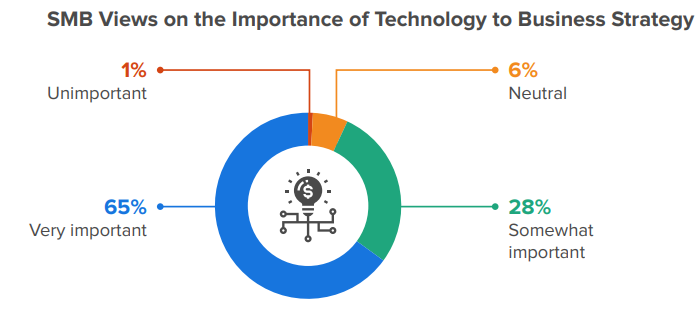
is increasingly central to meeting these expectations. About two-thirds of SMBs say technology is
very important to business growth, more than one-quarter say it is somewhat important, and only 1%
consider it unimportant.
As business demands intensify, relying on “good enough” business software is often no longer sustainable. Manual processes and data silos limit productivity, complicate GAAP/IFRS compliance, and make multi-entity operations difficult.
As a result, more businesses are turning to comprehensive ERP (Enterprise Resource Planning)
solutions for the data integration, scalability, and AI-enabled capabilities needed to compete and grow.
Moving Beyond Accounting with ERP Technology
Basic accounting tools handle core financial tasks, such as bookkeeping, invoicing, and payroll, but were never designed to manage the full scope and complexity of a growing business. In contrast, modern ERP systems unify and streamline a range of business functions, including supply chain management,
order-to-cash processes, inventory management, CRM, human resources, intercompany accounting, and project accounting. Unlike entry-level accounting solutions, ERP platforms are built to scale. As a business grows and adds new users, branches, entities, data, or operational requirements, the system expands without compromising performance.
“Before Acumatica, we probably had six different software between pictures, CRM, insurance, budgeting, QuickBooks, all the different aspects of running a business. And it was all in different spots. So, six different licenses, six different ways of doing things. It was a nightmare. It really was.”
Over the years, ERP systems have also evolved and become more accessible, giving SMBs capabilities once reserved for large enterprises. Integrated workflows, real-time visibility, and AI-driven insights empower smaller businesses to compete effectively and innovate at scale. Key ERP software benefits include:
- Comprehensive functionality and real-time insights. ERP systems integrate workflows and data across departments, creating a single source of truth. This enables seamless coordination and more informed, data-driven decisions. While basic accounting tools often rely on static, outdated reports, or manual consolidation of reports in spreadsheets, ERP systems deliver real-time dashboards, analytics, and shared workflows that keep teams aligned.
- ERP automates routine tasks such as data entry, invoice generation, and financial
reconciliation. By connecting finance, production, inventory, projects, and sales, automation spans multiple departments, improving visibility, speeding decision making, and increasing productivity. Employees have more time to focus on higher-value analysis and customer engagement. - Improved regulatory compliance. As businesses grow, compliance needs become more demanding. ERP software includes built-in controls to help organizations meet tax, reporting, and industry-specific requirements. Standardized processes and centralized data ensure accuracy, auditability,
and confidence in proper controls.
“Before Acumatica we didn’t know our costs accurately. We didn’t have part numbers and most of the visibility on sales orders was via Excel files. It was very task oriented and really hard to keep track of the status of orders.”
Cloud vs. On-Premises ERP: Why the Cloud Wins
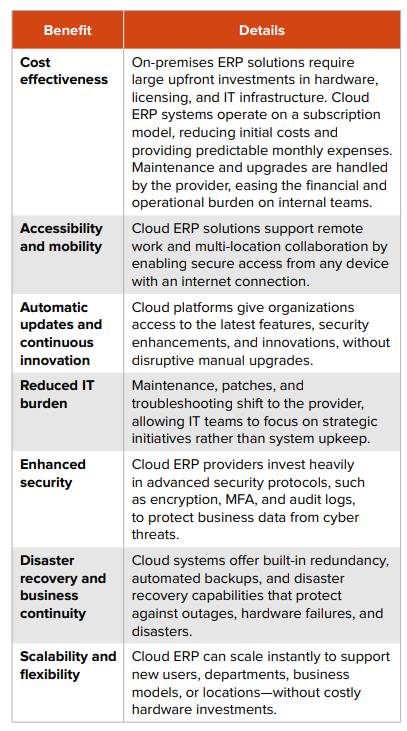
Cloud ERP is more than a technology choice—it’s a strategic enabler. Unlike traditional on-premises
systems, cloud ERP solutions eliminate heavy upfront investments and ongoing maintenance
headaches to reduce capital expenses, enable remote access, and deliver continuous innovation with
built-in enterprise-grade security. The result is faster growth, greater agility, and a resilient foundation
for staying competitive in today’s fast-paced business world.
“Cloud-based was paramount. When you’re small, you just don’t have the infrastructure in human capital to have a full server set up and all the things that have to go with it. One of the things that I really like about Acumatica is that it was built from the ground up cloud-based. They didn’t start in a traditional client-server base and then convert it.”
AI’s Transformational Value Across SMB Operations
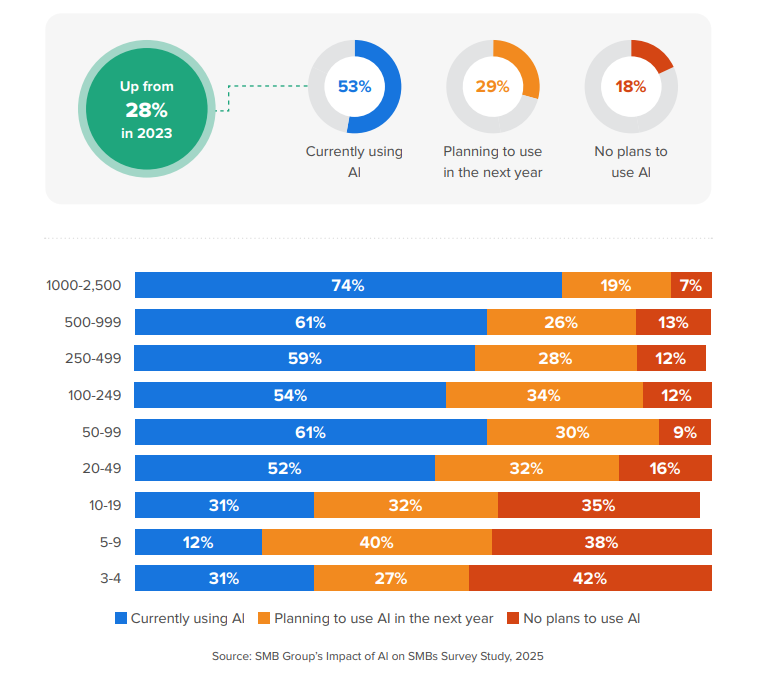
AI is quickly reshaping how SMBs operate, compete, and grow. SMB adoption has been rising rapidly
over the last few years. Currently, 53% of SMBs indicate that they already use AI, up from 28% in 2023.
Adoption increases dramatically with company size.
SMB AI Adoption (2025)
AI adoption among SMBs is already significant across several business functions, with sales and
marketing leading the way. Plans to use AI in the next 12 months are strong across all functions.
Overall, the data suggests that SMBs recognize AI’s potential to enhance both customer-facing and
operational processes.
SMB AI Adoption, Plans, and Value of Al Across Business Functions
SMB Use and Plans for Al
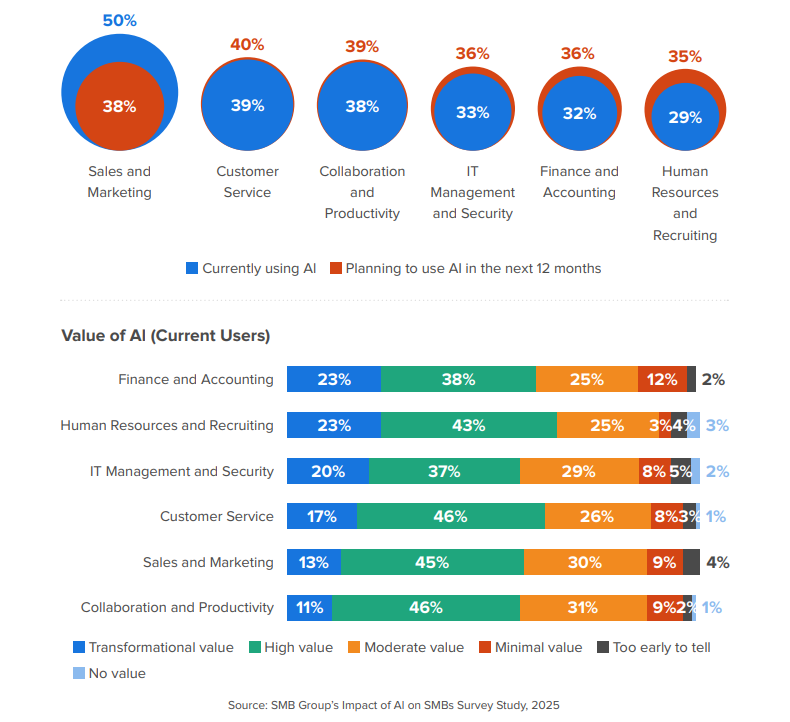
50%+ of current AI users report that Al provides transformational or high value across all business functions
Most importantly, over half of SMBs using AI report that it delivers high or transformational value across all major business functions. Respondents see the most transformational impact in IT management and security, finance and accounting, and HR and recruiting—areas rich with structured data and standardized processes. SMBs are most likely to rate customer service, collaboration and productivity, and sales and marketing as delivering high value.
These findings validate the business case for adopting AI across a wide spectrum of functions—not just customer-facing, but also operational and administrative. Finance, HR, and IT may be slower to adopt, but these functions involve many repetitive tasks, and solutions are rapidly maturing. In addition to
improving operational efficiency, AI can reveal anomalies in financial data, flag potential compliance risks, and enable smarter, faster decision-making.
How Cloud ERP Enables Business Outcomes
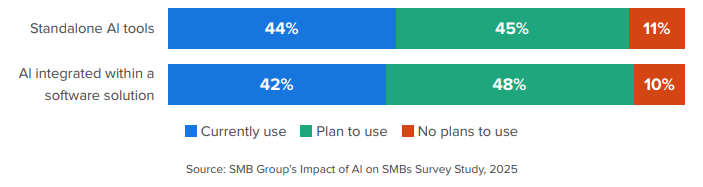
Many SMBs currently use both standalone AI tools and AI integrated within business applications.
Overall, most SMBs not currently using one or both of these modes plan to use them in the future.
SMB Use of Standalone Al Tools and Al Integrated Within Business Applications
- Both options are valuable. Standalone tools (for example, OpenAI’s ChatGPT, Google Gemini, Anthropic’s Claude, etc.) are great for individual creative tasks, such as brainstorming, content creation, or customer service scripts. Since they don’t need to be integrated with existing systems, SMBs can begin using them instantly through a browser or mobile app.
- Most business applications vendors now embed AI capabilities within their solutions, making them ideal for supporting more structured business processes and workflows. With this approach, vendors integrate AI into their systems and workflows. No separate logins, APIs, or manual data entry are needed. The
AI uses company-specific data from CRM, ERP, or productivity tools (alone or in tandem with public LLMs) to deliver more relevant and accurate results. Security and privacy risks are lower because data is kept within the existing platform’s security and compliance framework. It’s also easier to track AI-driven efficiency or cost savings within the context of business metrics and KPIs.
“Acumatica has been quite impactful for our business.... We’ve seen marked process improvements and better control over our operations ... making it an excellent choice for small to midsized companies like ours.”
- In comparison, entry-level accounting systems offer more limited AI functionality for
tasks such as transaction categorization, reminders, or anomaly detection. But because
operational, sales, inventory, customer, and service data live in disconnected systems, there is
no unified dataset for deeper insights. Without shared workflows or cross-functional context,
AI cannot optimize processes across the business. Inconsistent or siloed data also prevents
AI from delivering real-time alerts, forecasting, or automation beyond basic accounting. - Cloud ERP systems consolidate financial, operational, and customer data into a single
system, allowing AI to access the clean, connected, and real-time information necessary to
produce comprehensive results. Embedded AI capabilities within business applications
help automate manual tasks, surface insights, personalize experiences, and reveal new
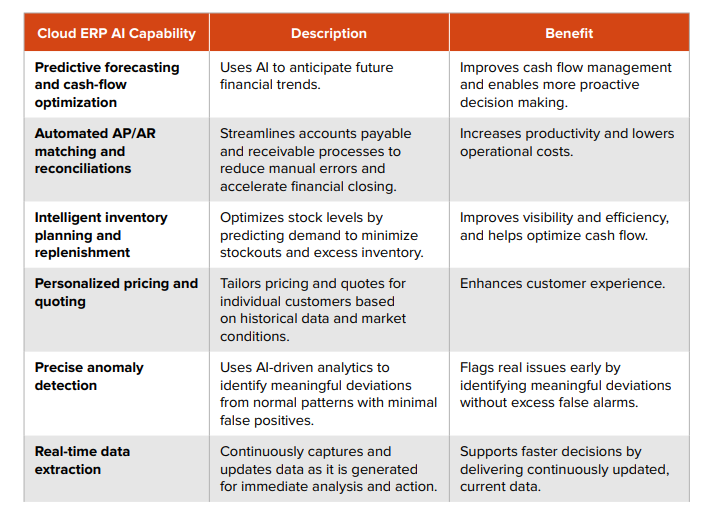
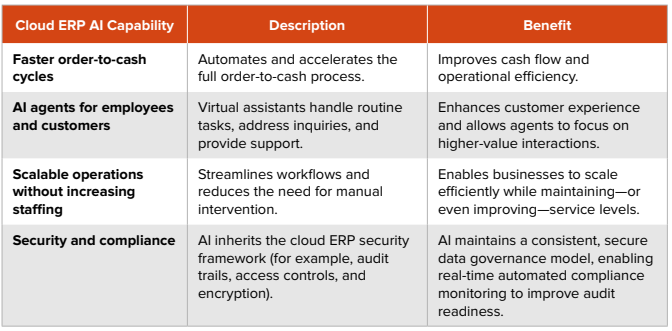
growth opportunities. - By combining unified data with AI, cloud-based ERP solutions deliver advanced capabilities
that enhance decision-making, operational efficiency, and scalability. The table below
highlights key AI-driven features and the benefits they provide across the organization.
“With the type of work we do for F1 teams, we need to have full traceability of material certs and all those sorts of things. Trying to do that on a spreadsheet we needed to employ eight people just to do that. Acumatica has completely transformed the business and allowed us to concentrate on what we need to be concentrating on, instead of spending time filling out spreadsheets.”
Preparation for Moving to Cloud ERP
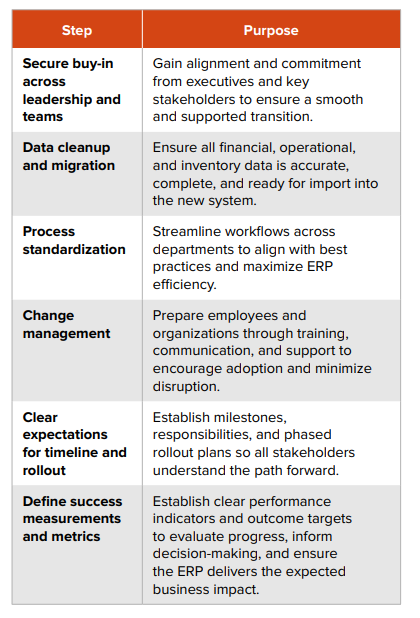
Successful cloud ERP adoption starts with a well-structured plan. While every organization’s path is
unique, the steps below outline the foundational activities necessary to support a smooth, efficient, and
well-managed implementation.
“One of the biggest things I say to people when they are about to take on Acumatica as a project is to get buy-in. Make sure people are comfortable using it. Make sure that multiple users are involved in the implementation and training. Once everybody starts using it the results start to speak for themselves.”
Even the best-laid plans can encounter obstacles that impede adoption, delay benefits, or reduce ROI. Recognizing these common pitfalls early allows organizations to take proactive measures and achieve more successful outcomes.
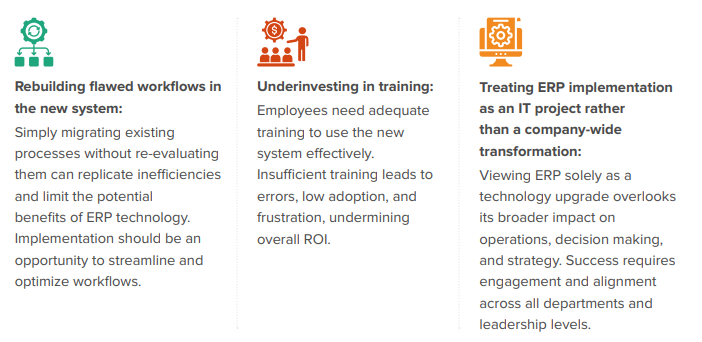
Effective cloud ERP migration is as much about people and processes as it is about technology. By
securing leadership buy-in, rethinking workflows, preparing employees, and defining clear success
metrics, organizations can minimize risks and realize the full value of their ERP investment.
Choosing the Right Cloud ERP
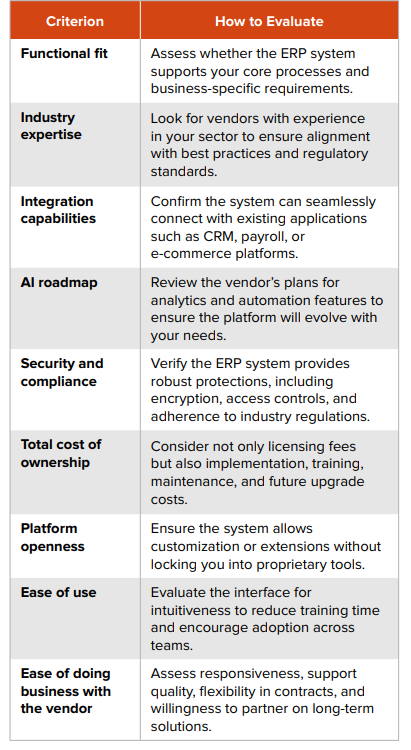
Selecting the right cloud ERP solution is a critical decision that can shape an organization’s operations
and growth for years to come. A thorough evaluation of key criteria, such as those discussed below,
helps reduce risk and ensures the chosen system can scale with the business.
“Nothing we were being shown was a true 360-degree ERP system that had the ability to be customized to any degree needed. What impressed us about Acumatica was its cloud-based and the manufacturing module and inventory control functions have a lot of customization features. Charging by the user would be a deal breaker for us. Not everybody is using the system at the same degree of power, but we would be very turned off by a user -based licensing model. ”
Successful ERP selection involves balancing functionality, scalability, and practical factors such as ease
of use and total cost of ownership. Systematically evaluating each criterion helps organizations to
choose a platform that meets today’s operational needs while supporting long-term growth, innovation,
and adaptability in a dynamic business environment.
The Future: AI-Enabled, Data-Driven, Cloud-First Operations
In today’s rapidly changing environment, the key question is: Can your business afford inaction? Delays compound inefficiencies, slow decision-making, and risk falling behind competitors already leveraging cloud ERP technology and innovative AI capabilities. Inaction carries hidden costs that can constrain growth, profitability, and long-term resilience. Basic accounting tools such as QuickBooks offer a strong starting point, but they cannot support the speed, complexity, and intelligence required for modern growth. Legacy systems are simply outdated and don’t provide the flexibility or capacity needed to help scale operations. If operational bottlenecks, inaccurate reporting, or scalability challenges are impacting performance, cloud ERP provides the visibility, control, and agility needed to drive the next phase of growth.
Cloud ERP is more than a system upgrade. It is the foundation for innovation, scalability,
and AI-powered competitiveness. As AI and ERP technology evolve together, we will see increasing automation across finance and operations, AI agents orchestrating cross departmental workflows, and continuous optimization powered by real-time data.
Forward-thinking leaders recognize that proactive investment in cloud ERP technology and AI is essential for future-ready, resilient, and scalable operations. By embracing these technologies now, organizations position themselves to seize new opportunities, adapt quickly to market shifts, and build a competitive advantage that grows over time.