
 Canada (English)
 Colombia
 Caribbean and Puerto Rico
 Ecuador
 India
India
 Indonesia
 Ireland
 Malaysia
 Mexico
 Panama
 Peru
Peru
 Philippines
 Singapore
 South Africa
 Sri Lanka
 Thailand
 United Kingdom
 United States
Overview
Today, in what many are calling “the new now,” distributors are challenged like never before: Supply chain networks remain exceptionally complex and unpredictable, competition is tougher every day, and customer expectations are escalating. And, most important (and concerning), margins are slim (and getting slimmer).
It’s critically important to do everything that can be done to shave costs, increase revenue and boost profitability. The challenge is identifying the processes and functions where new efficiencies, a couple of pennies and a tenth of a percentage point of improvement can be found.
How can your organization get more efficient? The answer: By driving change in virtually every function.
Fix broken business processes. Eliminate workarounds and manual make-dos. Integrate core systems. Optimize purchasing. Maximize warehouse efficiency. Streamline logistics and shipping. Shorten the order cycle. Improve supply chain management. Accelerate invoicing. Enhance cashflow. Upgrade analytics. Enhance transparency and visibility into operations. To do these things, you need the right ERP solution. But what is the best solution for your organization?
That’s a difficult question. Because every company is different. Because no company handles any phase of operations the same way. Because business processes are built around the unique requirements of each organization.
Start by asking a different set of questions: What new capabilities does your organization need and want? What problems are you trying to solve? What do you want your core processes to look like? How can new tools enable your organization’s digital transformation?
5 BEST PRACTICES FOR ERP VENDOR SELECTION
Whether your company is implementing an ERP system for the first time, or replacing a legacy implementation, it’s critically important to make the right choice.
We asked our expert consultants to give us their thoughts on best practices in ERP
selection for distribution organizations, and this is what they told us:
1. Emphasize Industry Experience
Focus on distribution industry experience when choosing an ERP vendor, including (and especially) your particular segment.
Here’s why this expertise is important: An ERP vendor may have broad distribution
experience but may not have deep knowledge of the unique needs of your segment. Look at its overall presence in distribution, too. Is its toolset widely used
by companies like yours?
Ask your potential vendors to tell you how they plan to be a leading solution in your marketspace. Evaluate its features and functions to see how well they align with the industry’s challenges. Read the case studies and success stories provided by the vendor – they are a good source of insight into how they build solutions for companies like yours. Ask for the product roadmap for your industry segment.
2. Assess the Total Cost of Ownership
Establish a budget in terms of implementation and total cost of ownership (TCO), then ask potential vendors if your budget and their solution are a fit. A solution quote usually includes software (subscription or license), first-year support and implementation consulting. (Additional sites and add-on modules will be extra.)
TCO, however, is broader, and takes into consideration per-user license costs,
training, maintenance, customizations, upgrades, internal costs and other fees.
If the system is cloud or software as a service (SaaS), take a hard look at the
Service Level Agreement (SLA) for any hidden costs, such as system enhancements
and upgrades.
The scale and complexity of most ERP projects make it difficult to get, and stick
to, a fixed price. Be aware that ERP vendors that offer a fixed price might exclude
necessary work and training. Identify and note all inclusions and exclusions.
3. Consider Technology Strategy
Know that an ERP solution must fit the overall IT strategy of your organization.
And because the IT department plays a key role in deciding whether an ERP system is
feasible, it should determine and provide any technology requirements at the outset.
If on-premises ERP systems are a consideration, the IT department will need
to have the resources to maintain and upgrade the software, as well as be able
to provide the necessary infrastructure, servers, databases and security.
If the company is going with a cloudbased system, it’s still essential to have
the IT department involved in the ERP vendor selection process. There may be
connectivity and integration issues with existing systems, particularly legacy onpremises systems.
4. Put the Vendor Under a Microscope
Where will the vendor be in the next five or 10 years? Many niche players have been
acquired or merged with other ERP vendors – with both positive and negative results.
What’s important to your company? The major ERP vendors offer big, broad
solutions that will meet most of your needs, but come with greater complexity,
risk and investment. Specialized vendors offer “smaller” solutions that will meet your
industry-specific requirements but may not be as strong in some core functions.
5. Speak with Real Customers
Don’t let your ERP vendor get away with giving you a list of hand-picked customer
references in a variety of industries. To get the best idea of how a solution
will perform for you, ask for references that have been on the solution for at least
a year, are in the same industry as your company, are roughly the same size, and have similar requirements. Then make the effort to speak with these customers (particularly their ERP professionals) to get their insight, opinion and feedback.
Choose one for an on-site visit.
By applying these best practices, your company will better understand the strengths and weaknesses of potential ERP vendors. And it will be easier to narrow down the list and choose a software solution that will deliver greater efficiency, improved visibility and a competitive advantage.
LESSONS LEARNED FROM THE PANDEMIC – AND SMART CHANGES TO MAKE
Many distributors struggled amid the uncertainty of the COVID-19 pandemic. But
that is old news. What’s interesting – and important – now is to look closely at how distributors reacted and adapted to a suddenly (and fundamentally) changed business
environment, determine the lessons learned from the unprecedented disruption, and
identify the changes forward-looking companies should make to their business,
strategies, processes and technologies to prepare for the (inevitable) disruptions to
come.
We asked one of Ultra’s experienced distribution consultants, David Saunders,
for insight into the effects and after-effects of the pandemic from the distributor’s point of view – and the transformations smart organizations are making to ensure they’re ready to handle the unexpected. Here is an edited version of the conversation:
Let’s start by setting the stage for our conversation. What were the most significant pandemic-related disruptions for distributors?
David Saunders (DS): The biggest problem distributors encountered was major disruptions to their supply chains.
Distributors couldn’t get product from their vendors and suppliers, and if they were importing anything, some countries were shut down for a period, and manufacturers and suppliers in those countries were unable to provide items that were ordered.
Obviously, that was a big challenge. Even though U.S. distributors were back at work, they experienced significant supply disruptions domestically and internationally, and then ran into secondary problems like manufacturing shutdowns, driver shortages, travel restrictions and lockdowns. At some points it was impossible to get resupplied.
And there was another disruption, too, which was not any less significant: Because of lockdowns, people were unable or afraid to go anywhere – including the office. Most distributors rely on their sales team to sell products, but salespeople were unable to go out and sell. So, for a lot of distributors, their sales model was disrupted. And, on top of that, if they had an on-premises ERP solution, they couldn’t access it to get orders into the system.
All of this was, well, not at all optimal. Distributors were challenged getting sales orders, and when they could, they struggled getting product to fulfill them.
How did distributors adapt to those difficult circumstances?
DS: There’s only so much you can do if you can’t get product from overseas. For a distributor, the next option is to source what we need locally and domestically and go with a multi-vendor strategy. But that presents its own problem: Are we set up to find and utilize multiple sources for the same or similar product?
Not all ERP systems, especially older ones, are designed to handle an item with multiple suppliers associated with it. As a result, you end up having to manage things manually, including manually overriding orders. Again, that’s not optimal.
Setting old-technology issues aside, the pandemic pushed distributors to reduce their risk by finding additional and backup sources, and by establishing new supplier relationships.
The pandemic also created an opportunity for their purchasing team to step back and revisit the products they’re sourcing, where they’re sourcing them from, and look at alternatives. Their most important questions: How can we create an effective supplier strategy and evaluate vendors, so that we know we can always get the product we need? Which products are critical to our business?
As a workaround to lockdowns, and to combat manufacturers bypassing them with direct sales, smart distributors shifted their focus to ecommerce – a change that brought in critical revenue and a renewed emphasis on their value-add.
The value-add can be speed, product offering, product knowledge, customer service, customer support, single-source. Sure, customers could go to the manufacturer to get the product. But if they go to their distributor, they can choose from a broader offering, they can pay one invoice, they can access deep product knowledge and, if they have an issue, the distributor is there to resolve it. A distributor is a one-stop shop. And they’ll take care of you.
What are distributors doing to accommodate B2B customers’ increasing preference to buy online?
DS: That’s a challenge. The trend is that B2B buyers are becoming more like B2C buyers. It’s the “Amazon effect.” Many of today’s B2B buyers want the Amazon
experience. They don’t want to talk to or interact with a sales rep. They want to go online, see all the options, know what’s in-stock, place an order, get an email
confirmation, and know when it’s going to show up on the dock. That’s what they’re used to as consumers, and that’s what their expectation is when dealing with a distributor in B2B.
It doesn’t mean there isn’t a role for salespeople going forward. In fact, there is a critical role for them. But what they do needs to be redefined. And companies need to transform the service they’re providing through their sales team, and need to change their focus from being
order-takers to becoming true partners and product experts who help their customers’ businesses be successful.
With the worst of the pandemic behind us, what are the lessons distributors learned, and how are they adapting their businesses to the new now?
DS: One of the things we’re seeing is that distributors are wondering what they want to be from a strategic perspective. The world’s changed, and this is not going to be the last disruption.
What can they do to prepare their organizations to be proactive and be able to respond and quickly adapt to changes as they come? Do they have the right people, processes and systems in place?
How do they compensate for labor shortages going forward? Who’s going to fill their open positions? Or are we looking at a new dynamic in the marketplace where we rely more on systems to process basic sales orders?
Is their ERP solution current enough to enable more automation, leverage advanced technologies and accommodate change? And is their ecommerce solution integrated enough to be efficient, effective and successful? Can they utilize sales order processing technologies to automate the intake of emailed, PDF and printed orders, and handle invoice and payment, with minimal human interaction?
There are a lot of technologies available to drive sales, mitigate disruption and eliminate basic, manual, non-value-added activities, processes and decisions. But you’ve got to have a modern ERP to take advantage of them.
Many distributors are moving to a cloud-based ERP solution to enable their people to work remotely. We had a client that went live on a cloud solution right before the pandemic hit, which was fortunate. Their first comment was, “I don’t know what we would have done if we hadn’t migrated to a new solution.” Their old ERP was a stuck-together, very manual, on-premises solution. And now they’re on a modern, cloud-based solution. And they didn’t miss a beat in the pandemic. They were lucky and smart, with our help.
What should distributors do to prepare for future disruptions? Or how can they change their business so disruptions are not disruptive to their business?
DS: There is always going to be some sort of disruption. Are you prepared? Are you thinking strategically about how to react to them?
It’s all about evaluating the three core pieces: people, processes and systems. Do you have flexible processes in place, and will your technology enable greater agility? Are you able to quickly react to unforeseen circumstances?
And labor shortages will only get worse as the Baby Boomers continue to leave the workforce. Who’s filling their jobs? Maybe no one. The answer may be increased automation, artificial intelligence (AI) and machine learning.
It’s important to remember, too, that disruptions can be something other than a pandemic. Tomorrow’s disruptions may be technological – artificial intelligence, the Internet of Things (IoT), machine learning, etc. These are potentially tremendously disruptive technologies.
And for distributors, success may depend on whether they are ready to leverage the advantages and opportunities they offer.
Today, it’s important for distributors to have the right systems to manage effectively, operate efficiently and thrive in the future – no matter what happens. It’s necessary to have the right processes in place to quickly adapt to marketplace changes. And it’s critical to be able to take advantage of advanced technologies.
David Saunders is a Senior Consultant for Ultra Consultants, with more than 25 years of experience helping wholesale distribution companies and
manufacturing organizations leverage modern ERP technologies, optimize their operations and accelerate their business processes.
Acumatica
Ultra’s Insight: Distribution-Specific and Unique Pricing Acumatica is one of the newer players in the distribution ERP space, and it offers a cloud solution designed for distribution. Acumatica is hosted using Amazon Web Services (AWS), a leader in the industry. Acumatica was first released in 2008 and has been growing rapidly ever since.
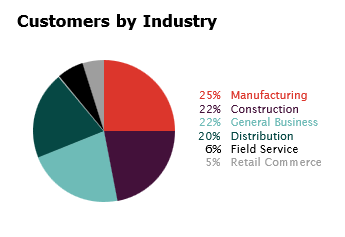
Acumatica focuses on companies with revenues that range between $20 million and $200 million, with some existing customers that have significantly higher revenues. The number of employees at companies that are good fits for Acumatica is around 200. Many of Acumatica’s most satisfied customers have come from an on-premises software that did not have the ability to have multiple functions supported.
A competitive advantage that Acumatica has is that its architecture is engineered to support cross-functionality. Another advantage is the ability to allow third parties to develop and modify business logic. The design of the ERP allows this because the core logic is protected but the business logic is available above the core logic to be modified.
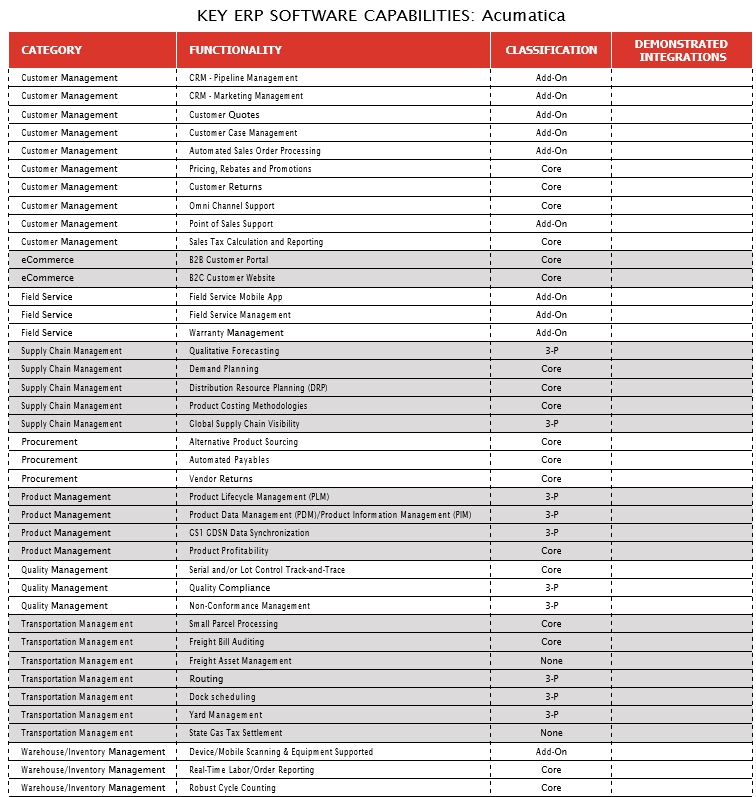
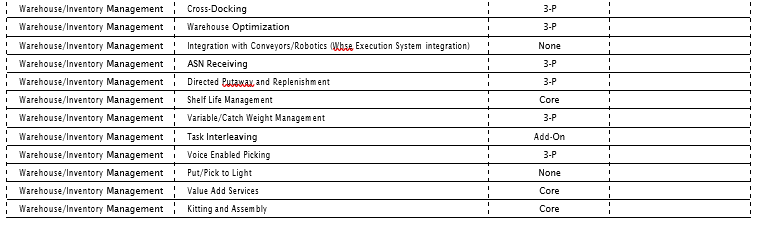
The warehouse management capability of Acumatica is one of the functionalities that drives companies to select it. Customers can use mobile devices for warehouse operations such as receiving, put-away, picking/packing and shipping, as well as inventory management activities like cycle counting or transfers.
Acumatica’s customers are extremely loyal – it claims a 95% retention rate. And most customers that leave are due to acquisitions. Acumatica does not price on a user license or revenue basis – it prices based on transaction volume, which is unique to the industry. It does have flexibility, however, to do user-based pricing if a customer insists on it.
The majority of Acumatica’s customers are based in North America, but it has large customers in Southeast Asia, as well as some in the United Kingdom, Mexico and South Africa.
Targeted Distribution Verticals
• Auto Parts
• Cosmetics
• Electronics and Computer Systems
• Industrial Parts
• Medical Supplies
• Packaging and Packaging Supplies
Distribution Customers
• AFF Group
• Bluefin Collectibles
• Consolidated West
• Korpack
• Tayse Rugs
Acumatica’s Pitch
Acumatica provides a complete suite of distribution applications to boost sales, automate warehouse operations, optimize inventory and streamline purchasing.
Last-mile features such as matrix items, inventory allocations, warehouse management, advanced wave and batch picking, up-sell, cross-sell, item substitutions, paperless directed picking, lot and serial tracking, kitting, and requisitions simplify item and inventory management.
Acumatica Cloud ERP provides the best business and industry management solution for transforming your distribution business to thrive in the new digital economy. Built on a future-proof platform with an open architecture for modern technologies, rapid integrations, scalability and ease of use, Acumatica delivers unparalleled value to small and midmarket distributors.