Canada (English)
 Colombia
 Caribbean and Puerto Rico
 Ecuador
 India
 Indonesia
 Ireland
 Malaysia
 Mexico
 Panama
 Peru
 Philippines
 Singapore
 South Africa
 Sri Lanka
 Thailand
 United Kingdom
 United States

SMB Directions for the Future of Work
In the two years since the COVID-19 pandemic began, small and medium businesses (SMBs) have been faced with change, challenge, and opportunity. These shifts have dramatically impacted the SMB
workplace and workforce, where the power dynamic has tipped from employers to employees.
SMB Group’s SMB Directions for the Future of Work survey study examines this topic in detail. In
November, 2021, we surveyed 736 decision makers and influencers in SMB (1-1,000 employees) and
mid-market (1,000-2,500 employees) organizations to understand how SMBs are reshaping workplace
and workforce practices to meet these challenges, and how technology factors into their plans.
In this eBook, we share key highlights from the study about how key SMB business, technology,
workplace, staffing, human resources, and collaboration trends are unfolding.
For the sake of brevity, we refer to the entire sample as “SMBs” in this eBook.
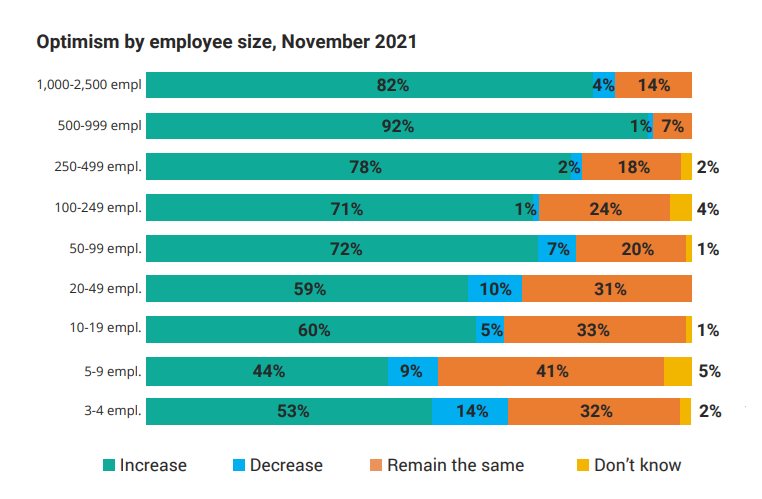
SMB Optimism Has Been Rising Since the Pandemic Struck
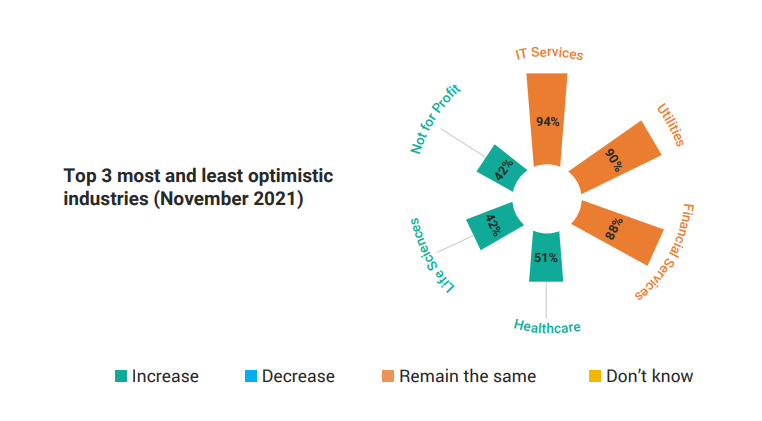
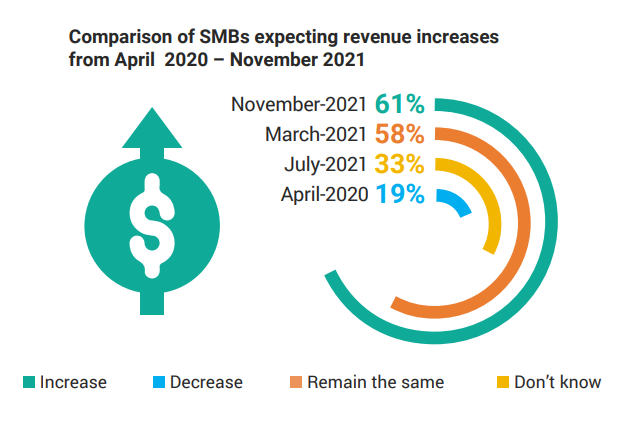
SMB optimism plummeted at the outset of the pandemic, but has risen steadily through 2020 to November 2021, when this survey was fielded.
In this latest study, optimism generally rose with company size, and there were substantial differences in future prospects by industry.
During the pandemic, about three quarters of SMBs made changes to their business and technology strategies to adapt to new market conditions. This helped many to rebound from initial downturns, gave them more flexibility to deal with new challenges, and supplied them with more confidence about the future.
Strong Headwinds Temper SMB Optimism
As we enter 2022, SMBs face some strong headwinds that are largely out of their control.
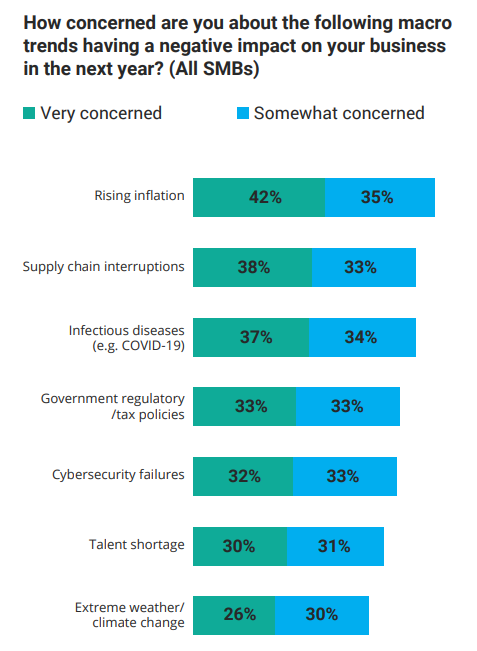
Roughly three quarters of respondents indicated that they were very or somewhat concerned that rising inflation, supply chain interruptions, and continuing uncertainty surrounding COVID-19 will negatively impact their businesses.
About two thirds said they feared that cybersecurity failures, government regulations and tax policies, and talent shortages could adversely impact their businesses, while more than half said they were worried that extreme weather and climate change would potentially harm their businesses.
Since November 2021, when this survey was fielded, many of these trends have come to the forefront. The Omicron variant surge, record levels of inflation, prominent cybersecurity breaches, and catastrophic weather disasters have likely elevated SMB concerns about business outcomes for 2022.
The changes that many SMBs have already made to business operations over the past year should boost resilience against these challenges. However, SMBs will need to continue to hone innovation, agility, and resiliency skills as they deal with ongoing uncertainty.
Concerns Vary Significantly by Industry
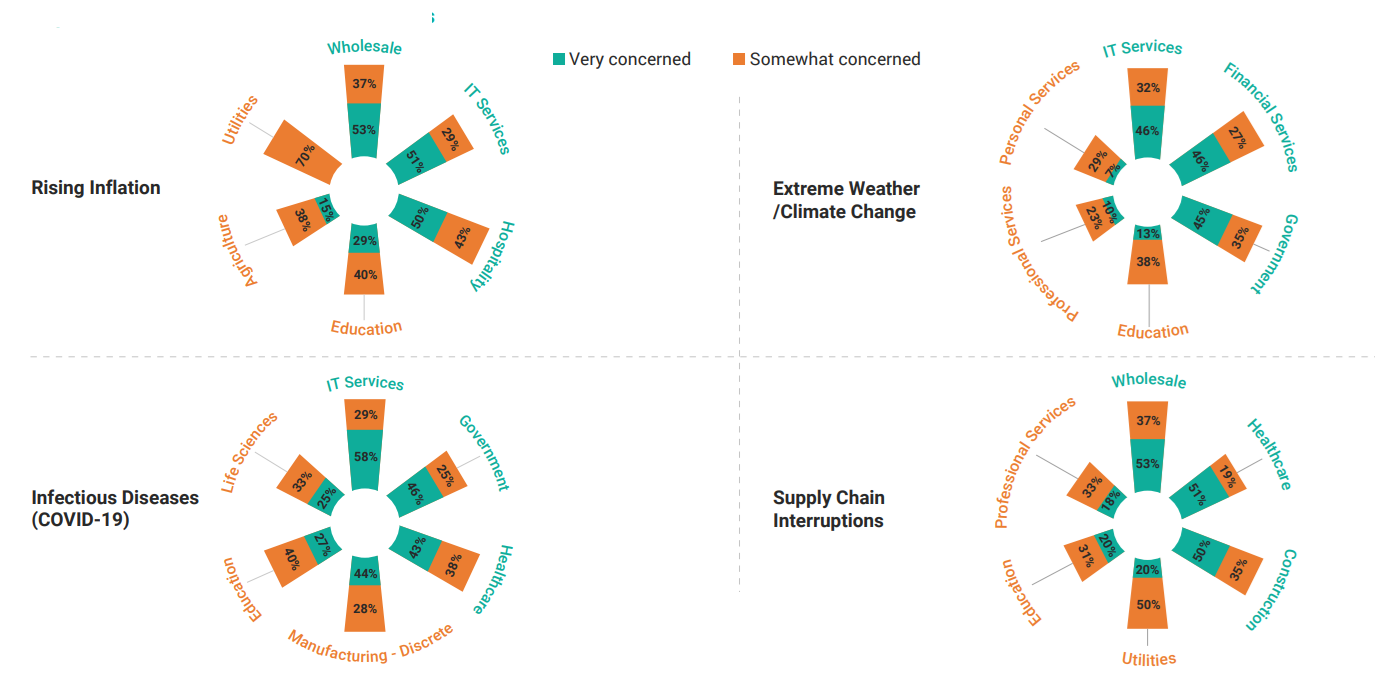
While there were minor differences in concerns about these macro trends based on company size, industry differences were more substantial, as shown below.
Remote Work Is Here to Stay—But Challenges Persist
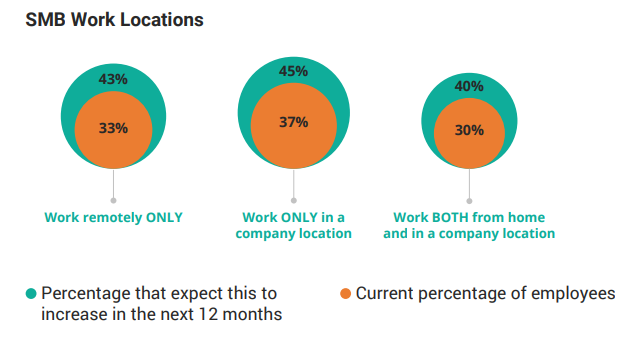
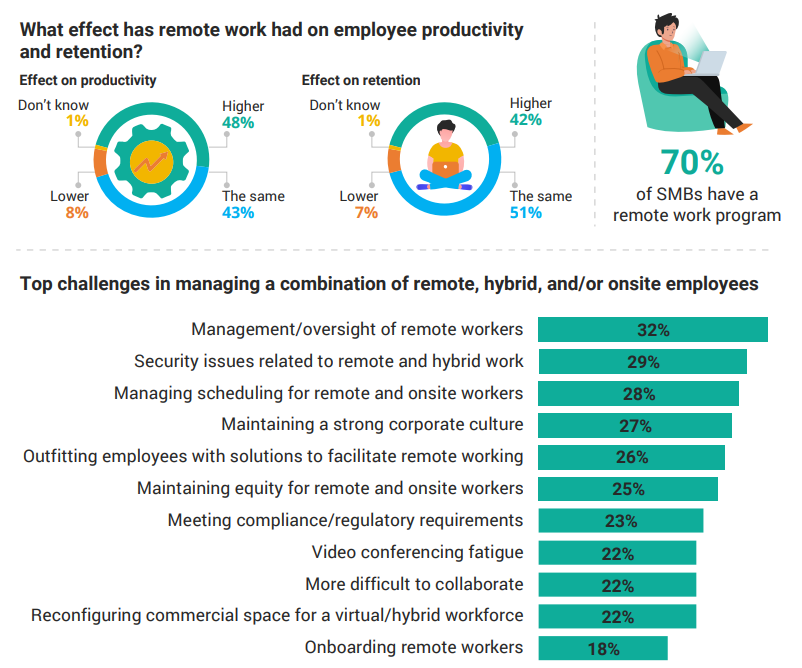
SMBs said that they have a higher percentage of employees working remotely or working in a hybrid situation than employees working strictly at a company location. Many SMBs have created or expanded remote and hybrid work alternatives since the pandemic began, and the overwhelming majority of SMBs indicate that remote work has had a positive or neutral effect on retention and productivity. So, it’s not surprising that SMBs also said that they are more likely to increase remote and hybrid work options than
they are to pull back.
However, many are still figuring out how to manage this more complex environment through conditions that are still in flux—driving interest in finding better solutions to manage and nurture employees in a fluid environment.
SMBs Are More Likely to Be Opening Commercial Locations Than Closing Them
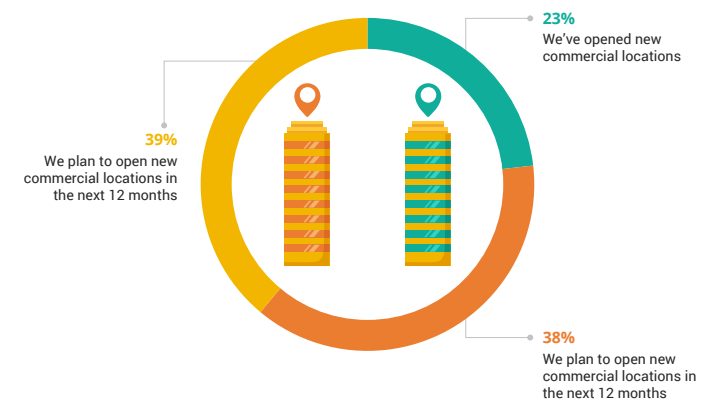
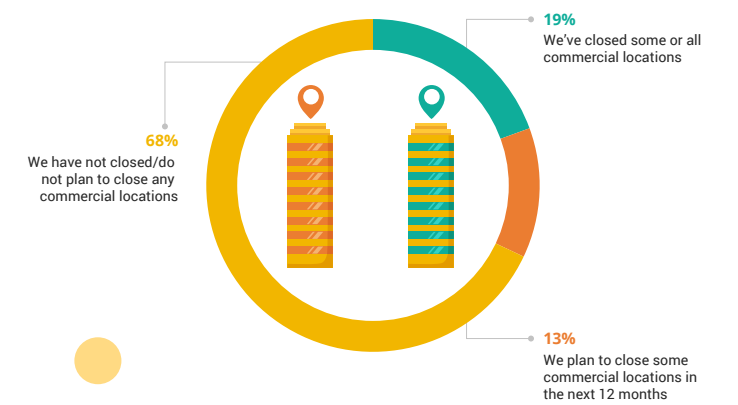
The boom in remote work doesn’t mitigate the need to maintain commercial and corporate locations. In fact, 38% of SMBs said they have opened or plan to open new commercial locations, compared to just 13% that indicated they have closed or plan to close them.
In general, both openings and closures tracked closely to company size, with larger companies more likely to be opening and closing facilities than smaller ones. The most active segment on both fronts is companies with 500-999 employees: 61% said they plan to open new locations, while 43% plan to close them.
Rates for both openings and closures also vary significantly by industry. For instance, process manufacturing, federal government, and IT services are most likely to have already opened new locations, while professional services, personal services, and non-profit/NGOs are least likely to have or have plans to open them.
Most SMBs Use Several Collaboration Apps—With Varying Levels of Integration
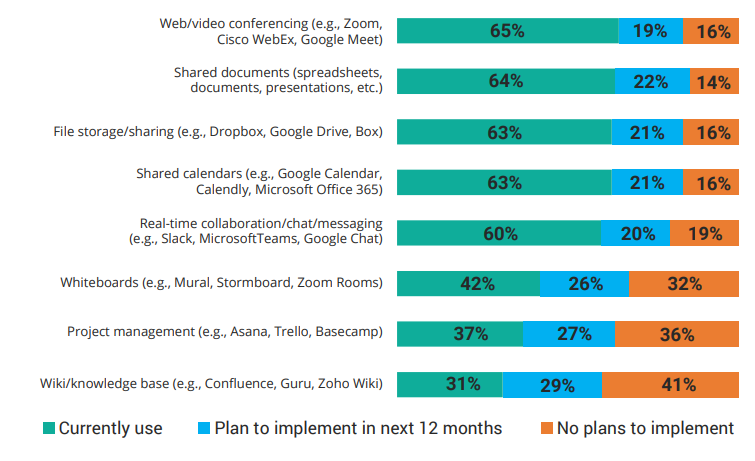
Collaboration solutions have been critical to helping SMBs get work done regardless of location. Roughly two-thirds of SMBs said that they currently use web/video conferencing solutions, shared documents, file sharing, shared calendars, and real-time collaboration chat and messaging applications. They are less likely to be using whiteboards, project management, and knowledge bases.
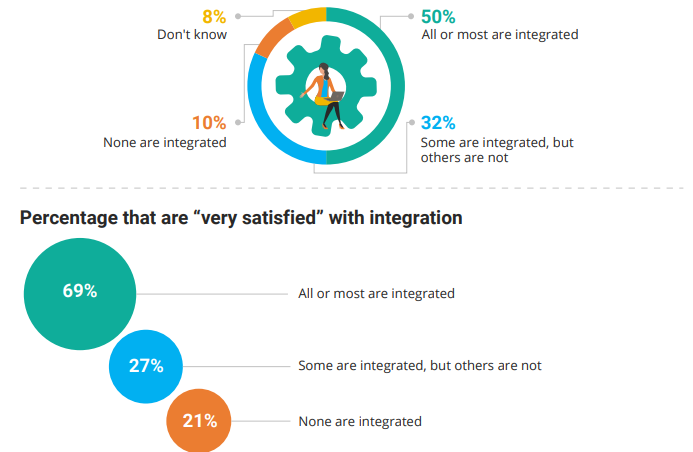
Half of SMBs said that they’ve integrated all or most of the collaboration applications they use. Almost half say they’re satisfied with the level of integration they have. But the level of integration matters: SMBs that have integrated all or most of their applications are more than twice as likely to be very satisfied with the level of integration than those with some integration, and more than three times more likely to be very satisfied than those that said none are integrated.
Hardware Purchases and Plans Reflect Ongoing Support for Remote Work
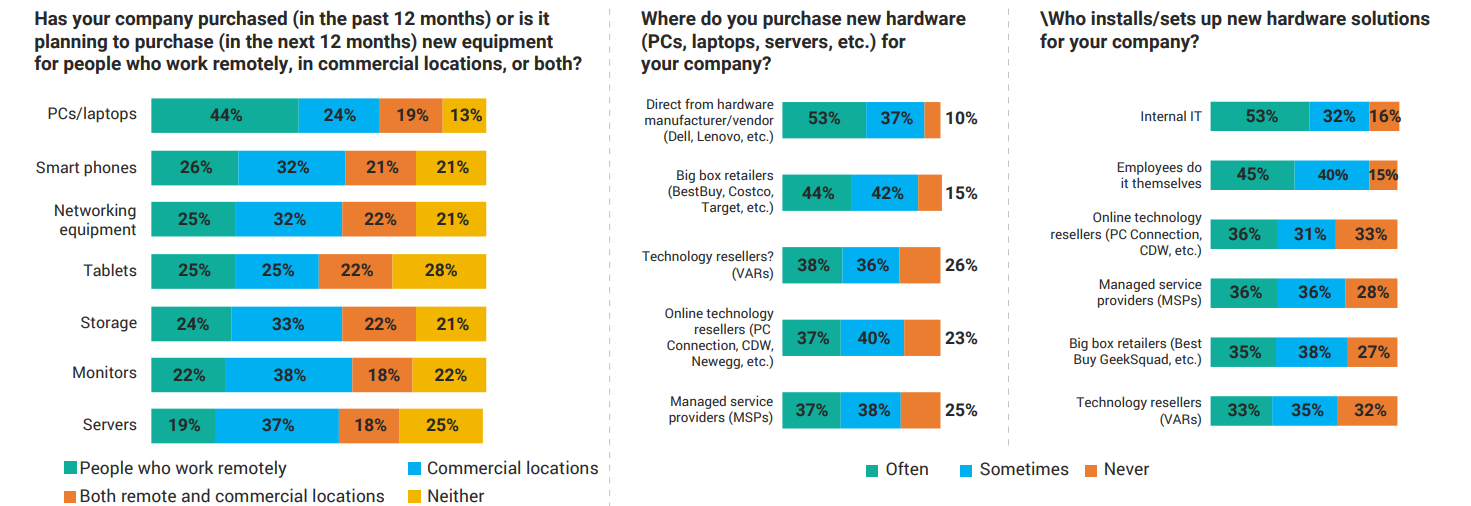
SMBs are directing a substantial portion of their hardware spending to support remote and hybrid employees. This is especially the case when it comes to PCs and laptops, where 68% of recent and planned purchases are earmarked for remote and hybrid workers. However, this trend extends into other areas as well, underscoring SMB efforts to better support remote workers.
SMBs are most likely to say they often purchase hardware direct from vendors, followed by big box retailers—channels that are often more accessible and convenient for employees.
As remote work becomes more prevalent, employees are also often responsible for setting up new hardware on their own—a job that not all are ready, willing, or able to do. As vendors build more implementation, management, and security services into their hardware products, they can help alleviate these problems for SMBs.
SMBs Need More Safeguards to Protect Against Cyber Threats in the Remote Workplace
SMBs frequently cite security as their top technology challenge. The rise of the remote workplace, increased dependence on digital operations, and the growing threat landscape amplify these concerns.
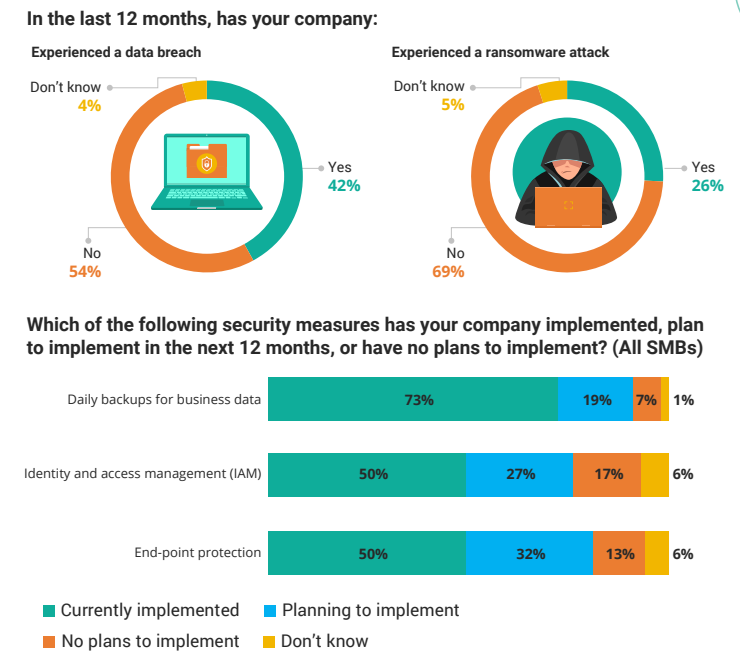
And for good reason: In the last twelve months, 42% of SMBs said their company has experienced a data breach and 26% have experienced a ransomware attack.
Larger SMBs have borne the brunt of these strikes. Financial services, life sciences, federal government, IT services, and state and local government are the most likely to have reported breaches and ransomware attacks.
However, no business, no matter how small, is immune, and many SMBs need to do more to protect their
businesses: While 73% of SMBs back up their data regularly, half have yet to deploy identity access and
management and end-point protection solutions. About one third of SMBs said they plan to address this
by implementing end-point protection measures; and about one quarter said they plan to deploy identity
access and management solutions.
With limited in-house expertise, many SMBs will turn to managed service security providers (MSSPs) and other third-party providers for new threat protection services.
Two Thirds of SMBs Plan to Hire Employees in the Next Twelve Months
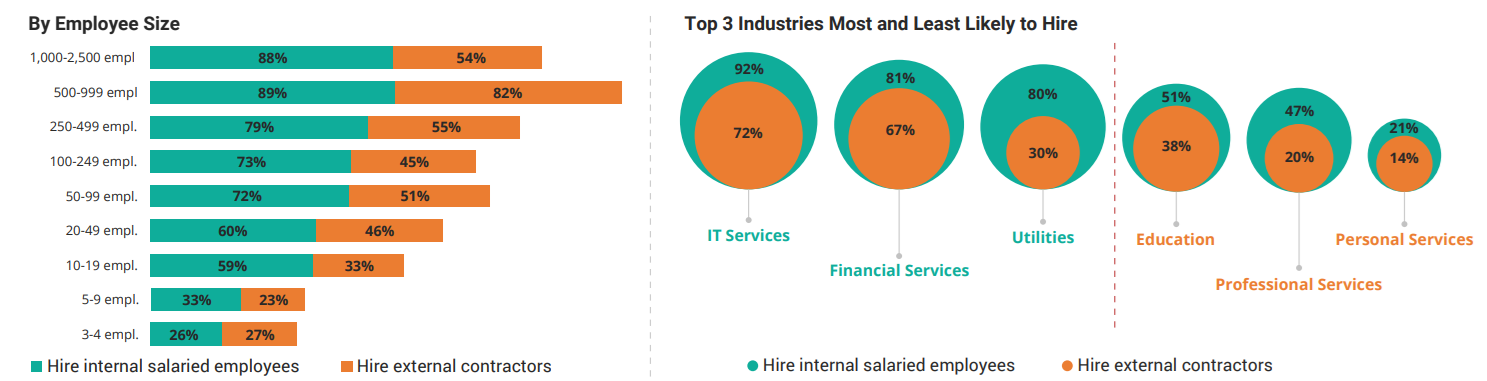
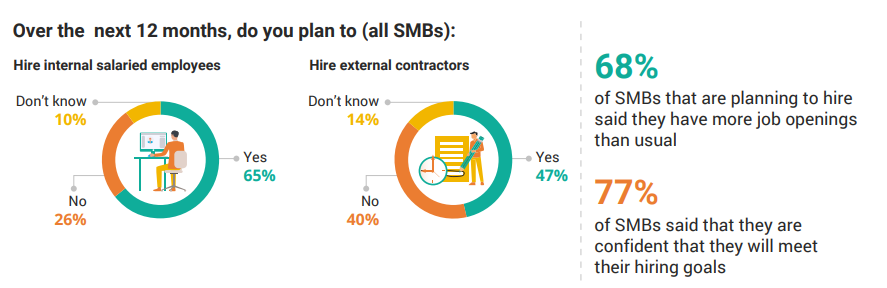
Amidst a strengthening economy, two thirds of SMBs said they plan to hire internal employees in the next twelve months, and almost half plan to hire external contractors.
Among those with plans to hire, about two thirds also said they have more job openings than usual.
Larger companies are more likely to be hiring and are also more likely to have more job openings than usual than smaller ones.
Plans also differ significantly by industry. Somewhat surprisingly, given the current talent crunch, 77% said that they were confident that they would meet their hiring goals.
SMBs Flex to Boost Employee Recruitment and Retention
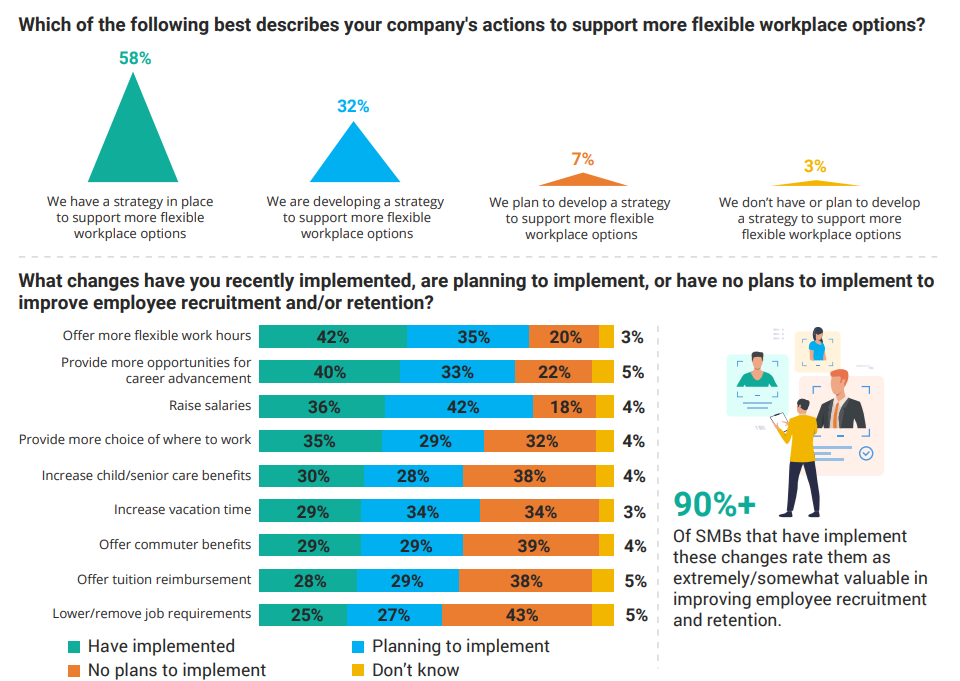
The #1 ask from job seekers is flexibility. In this study, 82% of employees said they’d be more loyal and less likely to leave if they had more flexible jobs. SMBs appear to be taking this to heart: 58% said that
they have a strategy to support a more flexible workplace, and 32% said they are developing one.
Offering employees more choice regarding workplace locations has already become the norm. But flexibility goes beyond this. For instance:
- SMBs see this added flexibility as paying off: 90% or more that have deployed these changes indicated that they have been extremely/very valuable.
- 77% of SMBs have recently begun or plan to offer employees more flexible work hours. 52% have already or plan to lower or remove some job requirements.
- A majority have added or plan to add new benefits—such as raises, more vacation time, new opportunities for career advancement, and perks for commuting, childcare, and tuition reimbursement.
SMBs see this added flexibility as paying off: 90% or more that have deployed these changes indicated that they have been extremely/very valuable.
SMBs Give HR Applications Strong Ratings for Value
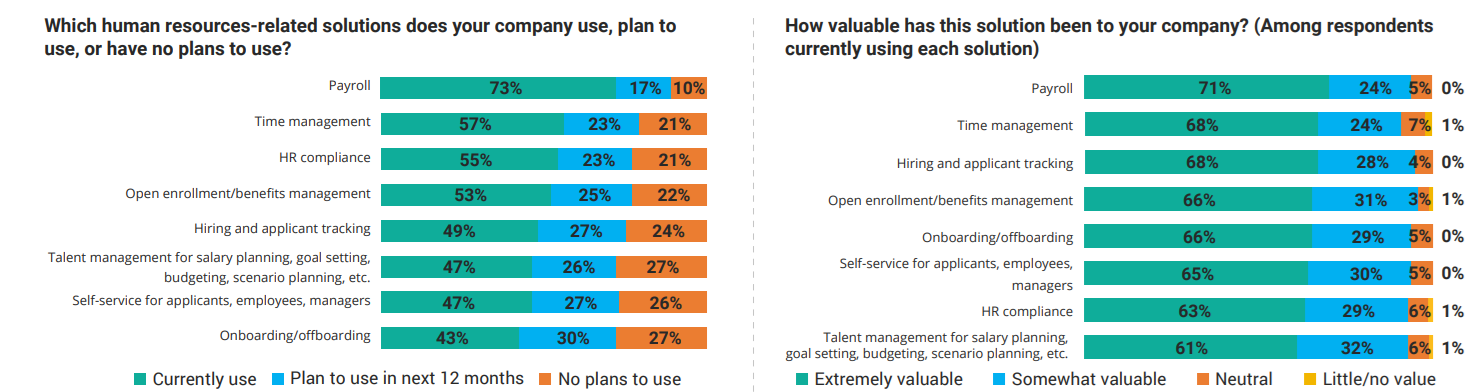
As businesses grow, they turn to technology solutions to automate different HR functions. Adoption of HR-related applications correlates roughly with company size, with larger SMBs more likely to be using HR applications than their smaller counterparts. Notably, once SMBs start using these solutions, they generally give them high marks. About two thirds or more of respondents rated each solution as being extremely valuable to their companies.
There are some clear break points in terms of employee size where adoption takes a big jump. For example:
- Use of self-service applications grows from 21% in the 3-4 employee size band to 41% in the 10-19 band; and from 53% in the 250-400 band to 64% in the 500-999 band.
- Use of talent management solutions rises from 35% in the 10-20 employee size band to 57% in the 50-99 band; and from 59% in the 250-400 band to 69% in the 500-999 band.
- Use of compliance solutions climbs from 47% in the 20-49 band to 61% in the 50-99 band.
Once SMBs start using these solutions, they generally give them high marks—with about two-thirds or more rating each as extremely valuable.
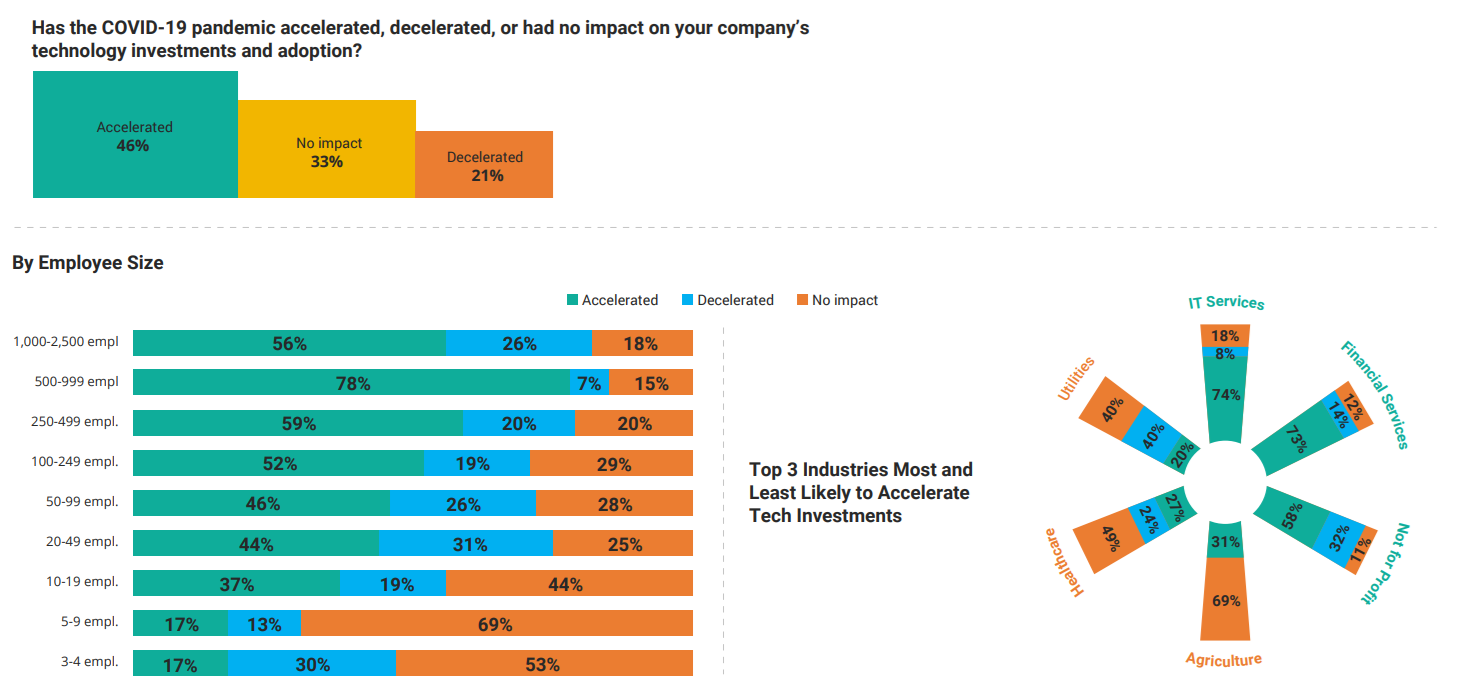
COVID-19 Impact on SMB Tech Investments and Adoption Has Been Mixed
Just under half of SMBs said that they accelerated tech adoption due to COVID-19. Smaller SMBs were much less likely to increase investments than larger ones, and industry differences were also substantial.
Accelerated Tech Adoption Correlates With Better Business Outcomes
The link between technology investments and business outcomes continues to become increasingly
evident. SMBs that put modern, flexible technology solutions to work are better prepared to:
- Adapt more quickly to shifting customer requirements, such as the demand for expanded ecommerce offerings, contactless payments, and virtual services.
- Meet employee expectations for “anytime, anywhere” tools that streamline work instead of getting in the way.
- Gain access to real-time information and intuitive analytics tools that provide the insights they need, when they need them, to make better business decisions.
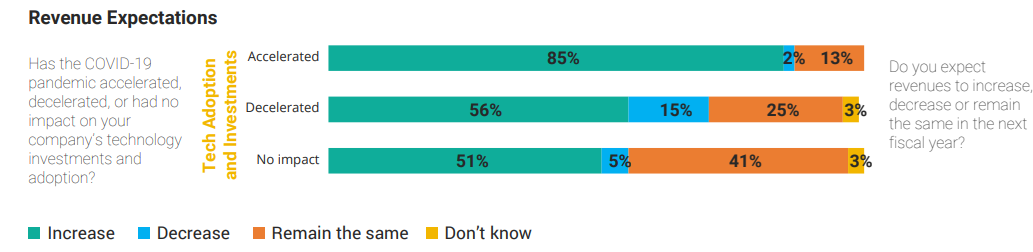
In this study, SMBs that said they had accelerated technology adoption and investments due to the COVID-19 pandemic were about 1.6 times more likely to anticipate increased revenues in their next fiscal year than those that decelerated or made no changes.
Has the COVID-19 pandemic accelerated, decelerated, or had no impact on your company’s technology investments and adoption?
SMBs Are Using Technology to Automate Tasks and Replace Human Labor
SMBs are putting automation to work to help address the talent shortage and rising labor costs.
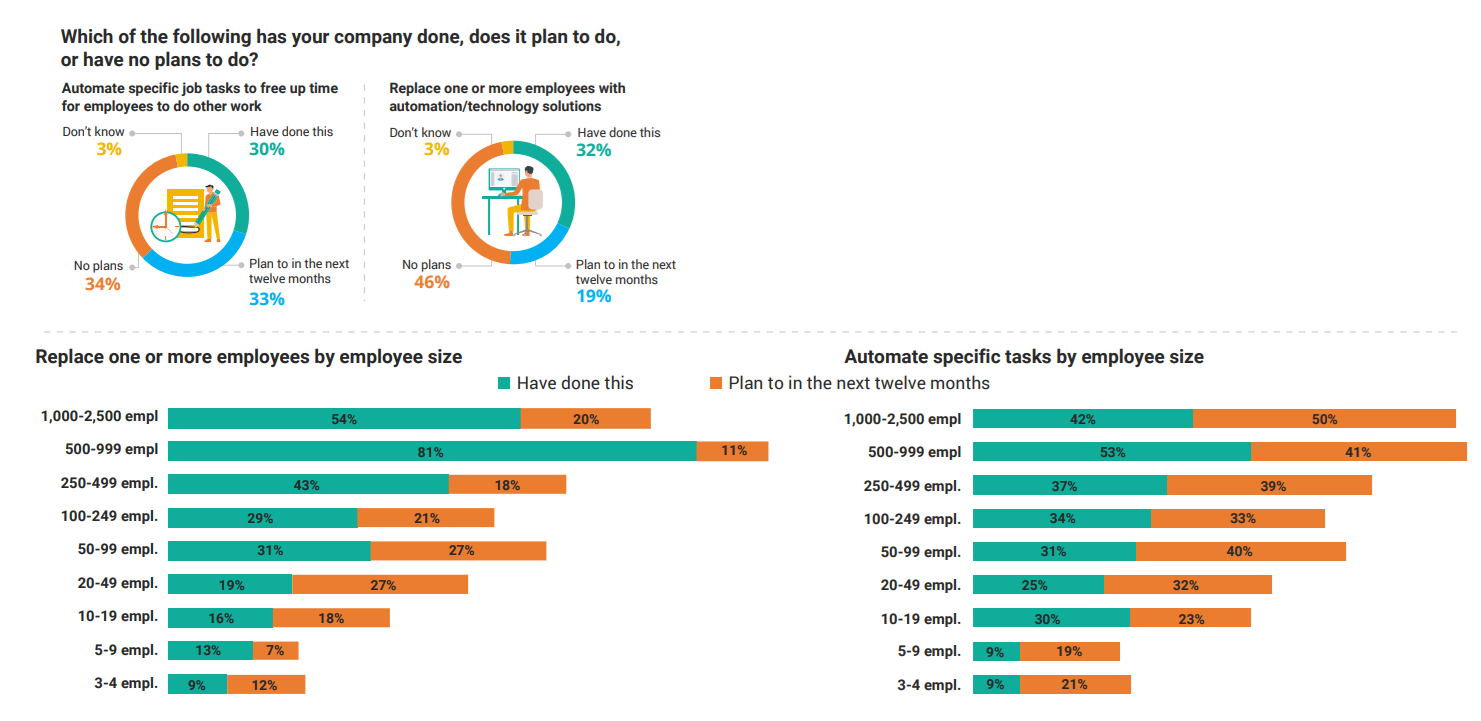
Overall, about one third said that they are using technology to automate specific tasks and free up
employees for higher-value work. Roughly one third said they have replaced employees with automation. Examples include using robots to scan and stock shelves, replace restaurant waitstaff, and help with cleaning chores.
Looking ahead, 33% plan to deploy technology to offload low-value, repetitive tasks, while 19% plan
to use automation to completely replace one or more employees.
Larger SMBs are much more likely to engage in both actions than smaller SMBs are. But over time,
this trend will accelerate and trickle down to smaller companies as time and cost savings are realized, and as vendors develop new ways to automate more of the work that businesses need to get done.
Embedded Technologies Are Becoming an Important Factor in Solution Selection
SMBs increasingly understand that innovative technologies can provide them with a competitive
edge–from improving customer experience, to minimizing risk, to streamlining operations, to
providing better data for decision making.
But in most cases, SMBs don’t have the in-house expertise to source, select, and integrate new
technologies into their existing business and collaboration applications. They need application
vendors to embed these technologies into their applications.
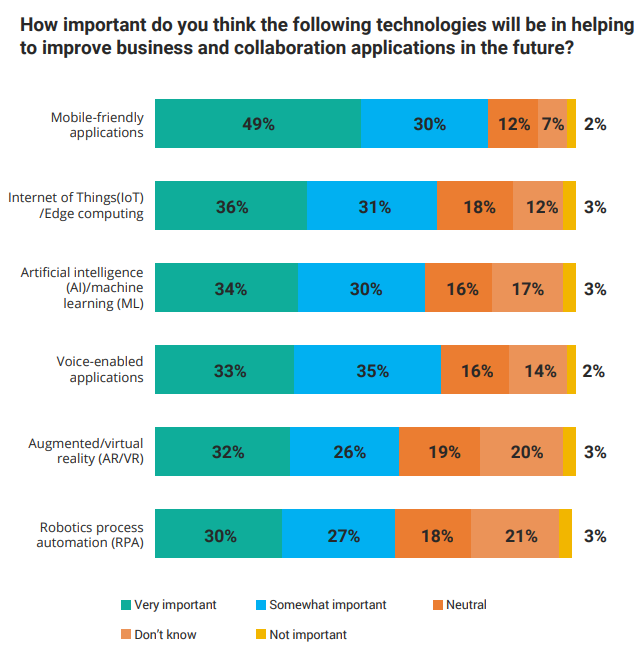
Many vendors have already created mobile versions of their applications to provide users with
anytime, anywhere, any device access. Embedded AI and ML capabilities are also becoming the
norm, helping users spot trends, identify anomalies, tailor actions to specific needs, and course
correct across the application spectrum.
Other technologies are in earlier stages but are poised to gain traction. For instance:
- Edge-based IoT capabilities embedded within retail management solutions enable retailers to
view real-time data to manage inventory more precisely. - Augmented reality technologies embedded within customer service applications allow service
personnel to see customer issues and assist in repairs without having to make in-person
service calls.
These examples barely scratch the surface of the immense value that these technologies can
provide to SMBs. But as their value becomes more evident, SMBs will seek out vendors that can
seamlessly integrate these technologies into solutions to provide more business value.
Takeaways
- SMB optimism has been rising steadily during the past two years—but is tempered by strong headwinds, including inflation, supply chain issues, the talent shortage, and continuing uncertainty about COVID-19.
- Remote and hybrid work is here to stay: SMBs have a higher percentage of employees working remotely or working in a hybrid situation than employees working strictly at a company location. They are more likely to increase remote and hybrid work options than they are to pull back.
However, about one third of SMBs are also planning to open new commercial locations. - The level of integration among collaboration applications matters: SMBs that have integrated all or most of their applications are 4 times more likely to be very satisfied with the level of integration than with some integration, and 15 times more likely to be very satisfied than those that
said none are integrated. - SMBs are directing a substantial portion of their hardware spending to support remote and hybrid employees. This is especially the case when it comes to PCs and laptops, where 68% of recent and planned purchases are for remote and hybrid workers.
- SMBs need more cybersecurity safeguards to securely support remote and hybrid work.
- SMBs are developing more flexible workplace and workforce practices and are using HR-related solutions to help them meet hiring and retention goals amidst the talent shortage.
- Just under half of SMBs said that they accelerated tech adoption due to COVID-19. The link between tech investments and performance is clear:
SMBs that accelerated technology adoption and investments were 1.6 times more likely to anticipate increased revenues in their next fiscal year than those that decelerated or made no change. - SMBs are putting automation to work to automate task and replace human labor. Larger SMBs are leading the charge, but this trend will accelerate and trickle down to smaller companies.
- Embedded technologies are becoming a key factor in solution selection—SMBs are looking for vendors that integrate new technologies into solutions to provide more business value.