Canada (English)
 Colombia
 Caribbean and Puerto Rico
 Ecuador
 India
 Indonesia
 Ireland
 Malaysia
 Mexico
 Panama
 Peru
 Philippines
 Singapore
 South Africa
 Sri Lanka
 Thailand
 United Kingdom
 United States

Discover how industry peers achieved a significant return on investment with acumatica’s modern cloud erp application
While implementing an enterprise resources planning (ERP) system may seem disruptive and costly, the rewards are boundless when the right platform is chosen and implemented correctly. Imagine the possibilities for your company as you graduate from entry-level accounting systems like QuickBooks or migrate from legacy ERP platforms.
Calculating ERP return on investment (ROI) may seem daunting, but with proper guidance, it can be a manageable process. By first calculating the total cost of ownership for a new system, you can clearly understand the financial implications. ERP costs vary widely from vendor to vendor, but with careful consideration of licensing, implementation, infrastructure, and internal costs, you can identify the initial and ongoing cost of ownership.
Calculating ERP ROI is challenging without data. Companies must take the time to set goals for the system, capture benchmarks before implementing the new system, and evaluate results after they go live. ROI can come from many system areas, including licensing reductions, elimination of infrastructure costs, automated accounting tasks, and improved marketing and sales activities. Industry-specific ERP applications offer many unique benefits to enhance ROI in these areas.
ROI should include tangible results such as efficiency improvements, cost savings, and sales growth. It should also consider intangible results such as employee satisfaction, customer loyalty, and other difficult-to-measure benefits.
This eBook helps business leaders understand areas where they can achieve a return on investment for ERP applications like Acumatica. It also provides real-world testimonials and examples from more than 60 small and midsized companies in varied industry segments based on their digital transformation projects.
“Through decreased software costs and by increasing capacity, Ask Afrika has calculated a return on investment of R1.5 million.”
Calculating Total Cost of Ownership (TCO)
Determining the total cost of ownership for an ERP system is challenging. Vendors have varied pricing models for system and user license fees. Costs to install required hardware, implement the system, and maintain infrastructure add to the total costs. Other factors, such as internal costs, industry variations, project management, integration, and multi-company implementations, must also be considered.
Traditional ERP applications are licensed perpetually, meaning that companies purchase the software outright with annual maintenance and support plans for bug fixes, new releases, and technical support. Conversely, modern cloud ERP applications are hosted online and licensed annually. They offer a much lower total cost of ownership by eliminating costly infrastructure and system administration. Further, cloud ERP software subscriptions include maintenance and support and are easier to deploy. Acumatica is one of the only cloud ERP applications offering unlimited user licensing to eliminate barriers to growth for small and mid-sized organizations.
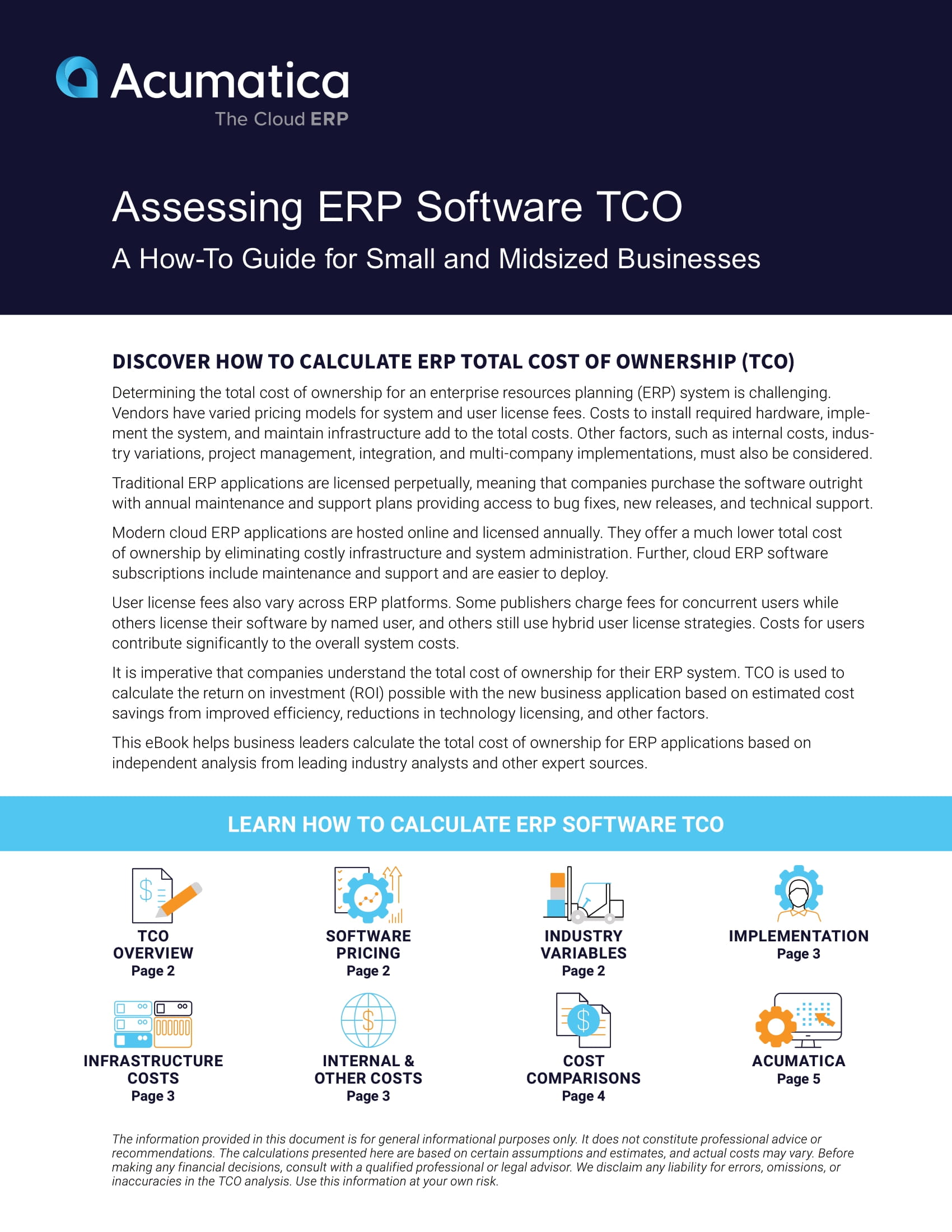
Based on data from 180 Systems1 and Ultra Consultants,2 Acumatica estimates the five-year total cost of ownership of a modern cloud ERP application for small and midsized businesses at less than $260,000. This is almost half the cost of a traditional, perpetually licensed ERP system. Cost estimates presented in this document provide guidelines for calculating total cost of ownership. Contact your Acumatica partner for a comprehensive total cost of ownership evaluation including software license quotes.
Learn How to Calculate ERP Software TCO
Download Acumatica’s Assessing ERP Software TCO Solution Brief for a detailed analysis of ERP system.
General Business ROI
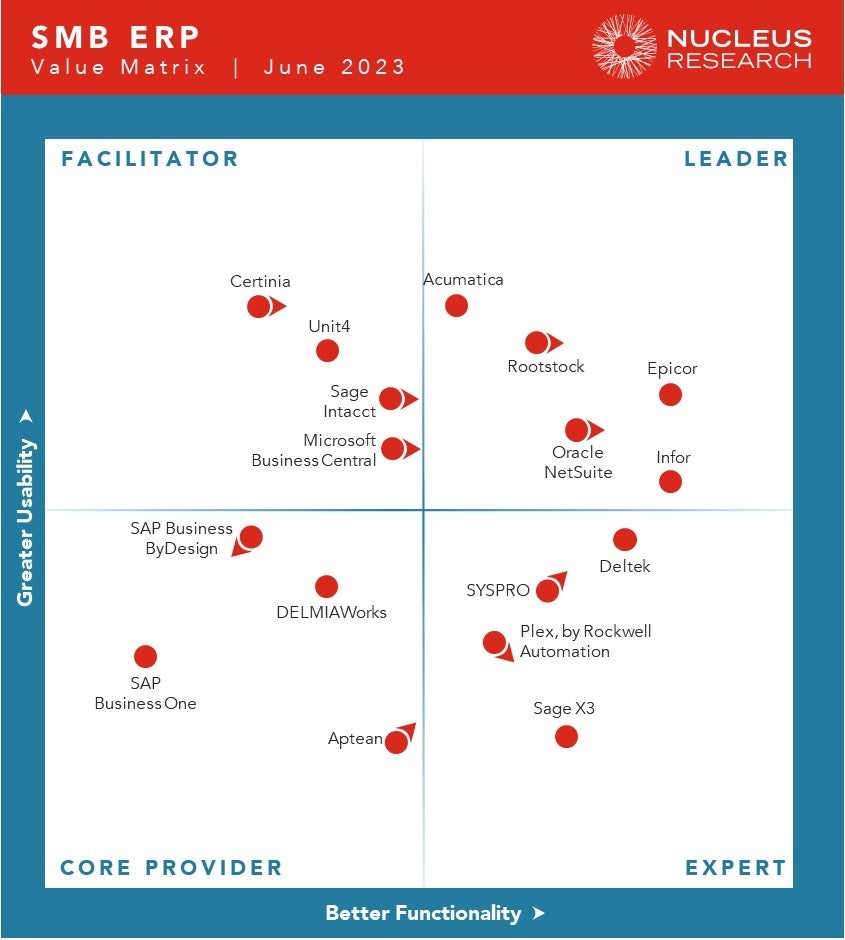
Nucleus Research3 reports that, on average, companies implementing modern cloud-based ERP achieved a positive return on investment in just 16 months with a 200% ROI. These businesses enjoy many benefits over traditional perpetual on-premises ERP deployments or entry-level accounting systems, including savings on ERP license fees (including annual maintenance and support), infrastructure costs, accounting-related benefits, and customer-facing marketing, sales, and support improvements.
Increase Profits
PostcardMania said, “Conservatively, we’re looking at an increase of $600,000 in EBITDA profitability.”
Acumatica customers support the Nucleus Research claims with their own unique stories. For example, Ray Allen Manufacturing reported a 25 percent improvement in their call center, 20 percent in distribution, and 10 percent in finance and marketing. Another user, AFF|group, said, “With Acumatica, we can double the size of the business without doubling the space and the people because we have power in the information. We can work more logically, provide better service, and save millions in labor by not having to double the staff size.
“During the first month we billed $1.7 million straight out of Acumatica and closed the month in 45 days. In January, it only took 30 days to close, February 15 days and March was 5 days.”
Calculating Labor Savings
ROI is often calculated for efficiency gains, elimination of headcount, or avoidance of new employee hires. These improvements must be calculated based on the time saved and the estimated cost for employees in the role.
The table below provides insight into compensation averages for US-based employees in various business and industry roles. When calculating efficiency gains, you may consider the burdened compensation rate, which is generally 1.25 to 1.4 times the base compensation,4 accounting for insurance, benefits, overhead, and other factors.
Organizations in areas with higher costs of living or low-cost regions may need to adjust compensation rates. For example, the median compensation for an experienced accounts receivable clerk is at least 10 percent higher in Los Angeles, CA ($53,781) and about 10 percent lower in Jackson, MS ($42,919)5 than the national average.

Using the table above, a 10 percent efficiency improvement for a warehouse/inventory manager would save between $9,600 to $13,440, considering a high burdened rate. Similarly, a company achieving a 10 percent efficiency improvement with 20 general laborers should expect to save between $72,000 and $100,000.
- Source: Comptool.com, 2023
- Source: Salary.com (Los Angeles, CA), Salary.com (Jackson, MS)
- Source: Salary.com, Low-End Estimates for Positions
Software and Technology Savings
Software and technology are significant components of the total cost of ownership. Companies running modern ERP platforms minimize technology costs for an improved ROI.
Selecting the right business platform is one of the most important decisions you can make. For example, Acumatica customer Mous said they avoided Oracle NetSuite based on customer feedback that indicated the system required heavy customization for reports and surprise annual inflationary costs that often exceeded 10 percent. Another Acumatica customer, PracticeMax, evaluated Oracle and SAP. They indicated that it would have cost millions more for the software and user-based pricing.
Security risks are incredibly costly. Modern cloud ERP applications like Acumatica provide multiple levels of security. Security controls are managed within the application and for the ultra-secure platform hosted on Amazon Web Services (AWS) or Microsoft Azure. In fact, non-profit Mozaic experienced a ransomware attack. The only program untouched by the attack was Acumatica, hosted in the cloud.
Consolidate Business Platforms
“Smartnumbers lowered technology investments by 80 percent by replacing 12 standalone systems with Acumatica.”
Purchasing, maintaining, and supporting hardware and other required ERP infrastructure is costly. Conversely, modern cloud applications like Acumatica do not require servers, server operating system licenses, database licenses, or database administration. Further, they are backed up automatically with redundancy and scalable resources for optimal performance. Erickson International, now American Standard Window Films (ASWF), said, “With Sage 100, we had to maintain a server, and that server had a lot of associated costs.”
Implementation costs are another source of high technology costs. Larger ERP systems cost much more to implement, and on-premises software implementations take longer due to hardware configuration, software installation, and on-site services. Conversely, cloud-based ERP systems reduce implementation costs.
While most companies take a systematic approach to implementation, many have cut implementation costs to the bare minimum. Power Storage Solutions, a spin-off from Interstate Battery, had a compressed implementation plan. They said, “In 60 days, we went from nothing in Acumatica to launching a $24 million company with 20,000 parts, 5,000 customers, sales orders, projects, inventory, payables, receivables, and going live.”
Minimize Implementation Costs
Caswell minimized implementation costs by going live on Acumatica in just 10 days!
Modern cloud ERP apps provide low-code and no-code tools to create or modify screens, reports, and business workflows without programming. Acumatica customers OFS International saved $250,000 by avoiding software modifications. Further, Boulder Creek Stone says, “In Acumatica, so much is configurable, whereas in Sage, everything was an expensive customization. For a small/medium business, farming stuff out at $150 to $200 an hour can be expensive. Now we can do that configuration in-house . . .”
Other Acumatica customers report significant software and technology cost reductions and benefits:
- Industrial Specialty Services (ISS) notes that IT Industry benchmark studies show that well-run, mature enterprises have IT departments that cost 1 to 3 percent of revenue. After implementing Acumatica, they projected to be at less than 1 percent of TOC for IT.
- KFC Singapore estimates that Acumatica saved them about $50,000 in IT resources due to the cloud-based system’s lower administrative and maintenance costs. By switching to Acumatica’s SaaS solution on Windows Azure, they also eliminated infrastructure and related support costs.
User License Savings
ERP user fees are a significant consideration. Most ERP publishers price their applications by module with additional fees for concurrent user licenses. A few companies sell named-user licenses, and others use a hybrid approach with perpetual users for most applications and named users for specific apps like warehouse management, field service, or warehouse management, where many workers require access to a limited set of features.
Acumatica believes that every user should have access to the ERP system without restrictive and costly user-based licensing. For example, Key Code Media said, “[Acumatica] is totally different from the other ERP vendors we considered. For example, 40 percent of our company are engineers, who will rarely access the system. They may need to enter a timecard or access the system for five minutes a day. Some subcontractors may only need to access the ERP once a week. So why should we pay for an expensive full-user license for each of them, as other ERP providers require?” ProPharma saved $120,000 annually with Acumatica’s unlimited users.
Unlimited User Licenses
“[Dakota Red] went from 10 users in our old system to 70 users now, and we don’t have to worry about if somebody is only going to be in the system for 15 minutes a day. We can get them access to Acumatica at no additional cost, so they can enter the work in real-time.”
Fast-growing acquisitive companies like BLD Brands, American Meadows, and Dukathole praise Acumatica for its consumption-based pricing model that allows them to spin up new companies with unlimited users with minimal effort and cost.
Accounting and Finance Savings
ROI in accounting takes many forms. Acumatica customer Ask Afrika reduced accounting activities from 63 hours a week to just 20 hours, freeing 43 hours for the staff to focus on more strategic tasks. Another customer, LifeSource, leveraged Acumatica’s workflows and automation to eliminate manual data entry, which resulted in a 40% improvement in efficiency. They further reduced aged invoices over 90 days by over 50%. Similarly, OFS International reduced invoicing from 21 days to the same day.
Closing the books is a cumbersome process. This is one area where a modern ERP application like Acumatica can help. For example, Acumatica customers Liveview Technologies, Smartnumbers, and Power Storage Solutions report period close improvements of 67 percent, 75 percent, and 89 percent, respectively.
Other customers improved accounting activities, including:
- ComCenter reduced accounts payable activities from 40 hours a week to just 10 hours or less, thanks to automated document recognition and approval processes.
- Liveview Technologies does business in 45 states. Acumatica’s embedded Avalara sales tax solution saves them a full-time accounting resource annually.
- Lighting manufacturer Fidelux automated commission payments, saving 7 hours a month.
- Parallels reduced financial consolidation time and costs by 80%.
- Target Enterprises reduced reconciliation from about a week to just two hours.
- DDB Unlimited eliminated $80,000 annually by bringing accounting in-house.
Simplify Invoice Processing
Bob Davis Sales reduced invoice processing from 30 hours to just 2 hours!
Sales and Marketing Savings
Another key area where companies can reap huge benefits is in marketing and sales. Acumatica provides flexible order management and pricing capabilities, embedded marketing and sales automation, and suggested items to optimize sales using up-sell, cross-sell, and item substitution strategies. ComCenter said, “Now, every school in the country gets at least three to five sales calls, plus 20 to 30 emails . . . We’re projecting a 7- or 8-fold growth in the school segment of our business from when we first adopted Acumatica . . .”
Acumatica CRM is built into the core product, providing a 360-degree view of prospect and customer activities, communications, and transactions at a fraction of the price of third-party CRM applications. Boulder Creek Stone says, “The pricing on Acumatica CRM is way better than Salesforce. Acumatica is at least four times less, to be conservative.”
“The sales reps were never allowed into our ERP system, but now they can connect at any time . . . With access to CRM, they can see notes and activities entered by the customer service team. There is improved communication between our reps and the inside team, which we didn’t have before.”
Reporting and Business Intelligence Savings
Access to information is one of the largest wastes of time in any organization that relies on inflexible, legacy ERP systems requiring developers to create, maintain, and deliver custom reports. Modern ERP applications like Acumatica provide role-based dashboards, flexible Generic Inquiries, and no-code reporting tools with drill-downs to source transactions and automated notifications. M3 Technology Group agrees, “Customization within the report designer is fantastic. The report designer is also easy for anyone to learn.”
Cornell Cooperative Extension creates reports on state agriculture programs like maple syrup production or dairy programs that previously took months and were outdated when delivered. They said, “Now I have easy access to that information, and I can meet legislator’s deadlines that sometimes are just a couple of hours as opposed to a couple of days.”
Automate Inter-Company Transactions
The Las Vegas Metro Chamber of Commerce saves 3 to 4 hours weekly with Acumatica’s inter-company accounting features.
Safety Management Group’s CFO estimates that Acumatica’s role-based dashboards free up 12 weeks of her time annually.
Boulder Creek Stone said, “I love, love, love the generic inquiries we can build. It gives us better data for analysis of our business processes, so we can see what we are doing well and take a deeper dive into where we need to improve.”
Multi-Company Benefits
Some ERP applications require separate deployments for multi-company support. Further, some systems offer limited intercompany features. Acumatica branches are commonly used to manage multiple businesses.
UK-based Incubeta said, “Since launching on Acumatica, we acquired two businesses, one in the U.S. and another in Northern Ireland. We’ve brought them on very quickly into our accounting structure, allowing us to visualize reporting, which was a massive benefit for us.”
Industrial Specialty Services has plans to grow through acquisition. They said, “We won’t need much more (infrastructure) to add a similar-sized company. As far as the back office goes, we can absorb a majority of employees and only need maybe two people in admin roles to handle safety requirements.” UK-based SAM said, “We’re looking at creating a building company for residential homes. We know with Acumatica we can spin up a new division easily to facilitate that, and, if we acquire more businesses, Acumatica can continue to grow with us.”
Other Business Benefits
With modern ERP applications, there are hundreds of ways that companies save time and money for a positive return on investment.
For example, the average organization spends between 7-14% of its total costs on paper document processing, wastes 7.4% of staff time searching for documents, and spends 280 hours annually looking for lost documents.7 Additive-X leverages Acumatica’s digital document storage to eliminate manual filing and physical storage costs annually for as many as 18 bankers’ boxes of paper documents.
Customer self-service is another area that reduces business costs. With Acumatica’s customer portal, Caystone Solutions saves 6-8 hours per client every quarter.
Acumatica is consistently rated highest for usability by users in peer review sites. The user-friendly, contemporary design minimizes employee training costs and shortens onboarding cycles. Tulsa Performing Arts Center said, “Our clerk had no previous accounting experience, and now she’s doing all the AP work. I just hired an accountant, and I didn’t have to teach her at all; she just got on the system and easily uses it.” Kelly Products agrees, “Acumatica is not a complicated system . . . and the modules have the same look and feel, which makes it easier to train employees . . .”
“REMCAN is excited to start using the AP Artificial Intelligence invoice recognition. We’re processing well over 2,000 invoices a month, and the AP AI will allow us to be more efficient.”
Industry ROI
Ultra Consultants found that distributors and manufacturers implementing ERP systems experience a return of more than $7 for every dollar spent on the ERP project.8 Similar results are typical in construction, professional services, retail, and other industries.
Construction
Construction firms struggle with entry-level and legacy construction accounting systems. They need tools to connect field operations with the back office, as well as detailed project management and reporting designed for their industry.
Since implementing Acumatica, Phoenix Renovation and Restoration has had a positive cash flow, with no need to tap into its line of credit. General contractor Carlson-LaVine replaced its aging Sage system with Acumatica, eliminating duplicate billing processes and automating payroll processes. Bruce Young, president and co-founder of Curran Young, says, “I’m saving 30 to 35 percent of my time, so I’m able to be much more efficient.”
Specialty trade contractors experience similar cost and time savings. Alpha Insulation & Waterproofing used to spend a day and a half preparing work-in-process (WIP) reports. With Acumatica, the process is now completed in a matter of minutes. Before implementing Acumatica, American Asphalt archived its paper project folders, which grew to over 50 banker boxes in an average year. That information is now easily retrievable.
Wholesale Distribution
Distributors can achieve a positive ROI with ERP software by improving picking accuracy, increasing inventory turns, lowering carrying costs, improving order fulfillment, and gaining other warehouse efficiencies.
Concrete products distributor Dakota Red “. . . can now place orders faster and react to sales quicker.” As a result, they expect to reduce total inventory by $1.5 million to $2 million. Acumatica customer ToughBuilt leveraged online platforms to eliminate 20 hours of data entry and avoided hiring three to four more employees for order processing.
Another Acumatica user, SpaceManager Closets, was able to save 30% with bulk purchasing based on better inventory and demand data. cbdMD saved weeks’ worth of work with Acumatica’s improved physical inventory cycle counting. Digital Planet reduced procurement processes by 25 percent, improved warehouse operations by 20 percent, and expects to improve an additional 15 percent with Acumatica’s native WMS application.
Manufacturing
Manufacturers have countless ways they can garner a fast return on their ERP investment. These include increased machine utilization, reductions in scrap and downtime, increased throughput, faster changeovers, more accurate costs, improved quality, and more.
Data Security, Inc., a Telesis company, makes degaussers to remove data from government computers. After moving to Acumatica, they said, “I couldn’t even tell you how much we’ve benefited. It’s ridiculous . . . We have built over two times the amount from before Acumatica.”
Another Acumatica customer, Portacool, used to track finished goods manually. It took four days for information to get into their system. They said, “Now, with Acumatica, it takes less than a day.”
Quality Material Handling built an Acumatica dashboard to monitor production. COO Julia Pinto Cisneros said, “I’ve set up a dashboard with the key performance indicators I need to manage our business, which have been color-coded . . . It takes me about 15 minutes to look at the dashboards before we meet.”
AFF|group and Fabuwood have seen dramatic improvements with Acumatica MRP. AFF|group says that MRP “has been a game changer . . . We didn’t know what was on order or what to make until we reviewed the order. Now the computer tells us what to make and when to make it.” Fabuwood’s material planner became a production bottleneck. With Acumatica MRP, the planner spends no more than an hour weekly on plans.
Professional Services
Managing projects, time, expenses, and schedules are daunting tasks for professional service firms using outdated software, disconnected systems, and spreadsheets.
Boston-based Interaction Associates uses Acumatica to recoup lost time and cut expenses by 50 percent. Chris Williams, Director of Business Operations said, “I now spend two hours a week in Acumatica when I was previously spending 20 hours on the same tasks, so the time savings was huge. The ability to program contractual requirements at a project level and for the system to seamlessly pull time and expenses and data into one place was just enormous in time savings, in accuracy, and made our team joyful about how they were working. They are not stressed or worried, and they don’t have do things two or three times.”
Retail and Commerce
Digital native merchants and brick-and-mortar retailers often work in disparate systems. ERP is used for backoffice functions while they focus much of their attention on stand-alone commerce storefronts and marketplaces. Spending countless hours updating items, prices, and orders between systems is expected. Acumatica’s Retail Edition provides bidirectional synchronization to harmonize information between the business application and varied retail platforms.
Saddleback paid $230,000 annually for Oracle NetSuite and most likely spent another $4 million over seven years to keep it running with a large development staff. By switching to Acumatica, they reduced development headcount from 14 to 2 employees and eliminated $750,000 in costs.
Killer Merch and Jeffree Star Cosmetics saved two full-time employees with matrix items to manage items using size, style, and color attributes. Another Acumatica customer, ComCenter, shaved 75 percent of the time needed to review online orders for accuracy. Similarly, MiiR shortened online order processing from 30 minutes to just a few minutes. Another Acumatica customer, Superprem Industries, witnessed an 80% improvement in commission activities and reduced inventory transfers from three hours to about 5 minutes.
Other Industries
Acumatica customers in diverse industries, such as non-profits, education, healthcare, agriculture, and other industries, find unique ways to improve their business and daily operations.
SEACOM used automated accounting workflows to save 10 to 15 percent of its employees’ time monthly. Further, they said, “We are looking at several acquisitions…and deploying them quickly with Acumatica is critical. We’ve deployed Acumatica to 13 companies in five months, so we know we can easily get new companies onto the platform very quickly.”
Private investment firm Seaport Capital lost access to its business system and much of its data after Hurricane Sandy flooded its New York City building. With Acumatica, they have a reliable system that simplifies intercompany transaction processing for multiple business entities.
The Council for Advancement and Support of Education (CASE) gained significant improvements in receivable and payables workflows. Further, they said, “We’ve eliminated at least two weeks off of our monthly close, if not more.” Another non-profit, the Cesar Chavez Foundation, reduced payroll processing from four days down to less than a day.
The Learning Lab is an educational center based in Singapore. Through automation, the company eliminated several positions devoted exclusively to manual data entry between various systems.
Avoid the Cost of Doing Nothing
Investing in a new business system can be overwhelming, and you will make a considerable financial investment regardless of the system you select. This is why so many business leaders delay ERP projects. However, limping along on your existing systems with manual data entry and scores of spreadsheets limits your competitive positioning, lowers employee morale, and creates barriers to growth.
It is essential that you evaluate new systems, conduct a total cost of ownership analysis, and build an ROI business case. If the results point to a significant ROI, you really have no choice but to move forward. Deferring your decision one more year means that you are essentially losing one year of savings.
Transform your business with an industry-specific ERP platform for small and mid-sized organizations
Switching business applications is costly, disruptive, and challenging. However, growing organizations must invest in technology to automate mundane business activities, manage costs, enter new markets, and fend off competitors.
Evaluating system costs can be confusing, as there are varied pricing models for applications and users, hidden costs (or savings) related to infrastructure, and other variables, including deployment options, implementation methodologies, and more.
Acumatica provides a modern, intuitive, and robust platform with industry-specific features to achieve a positive and realistic return on their ERP investment with a low total cost of ownership.
Acumatica users across industry segments contain staffing and technology costs with significant improvements in accounting, sales and marketing, and reporting and business intelligence. Industry editions provide additional benefits for construction firms, professional service organizations, wholesale distributors, retail merchants, and manufacturers.
Unlimited user licensing empowers every employee without restrictive user license fees. Companies can grow knowing they can add additional applications, features, and computing resources.
Schedule a personalized demonstration to see why Acumatica is the fastest-growing cloud ERP application with the industry’s highest usability and satisfaction ratings.
“With Acumatica, you are going to save money, save time, and you are not going to need to hire more (accounting) people. Being in the cloud makes everything more reliable and easier. Today, everyone wants information, and they want it right away. Because Acumatica is web-based, information is there at your fingertips for you to pull whenever and wherever you need it.”