Canada (English)
 Colombia
 Caribbean and Puerto Rico
 Ecuador
 India
 Indonesia
 Ireland
 Malaysia
 Mexico
 Panama
 Peru
 Philippines
 Singapore
 South Africa
 Sri Lanka
 Thailand
 United Kingdom
 United States

How to drive business growth with erp software
Success hinges on more than great products and services. Unfortunately, many companies bootstrap progress by relying on entry-level business software that is ill-equipped for evolving businesses. Standalone accounting systems lack the scalability to support new markets and the sophistication to handle unique business and industry needs.
Organizations must continually improve all aspects of their operations to succeed in today’s intensely competitive arena. For example, they need fresh insights into customer behavior and market trends to outmaneuver competitors. Their systems must support omnichannel go-to-market strategies with native marketing and sales management applications. In addition, they must optimize front and back-office operations.
Standalone applications only address one piece of the puzzle, thereby stifling growth. Technology must streamline operations, connect disparate workflows, and give users ongoing access to updated information. For example, construction crews need mobile applications to view and edit blueprints, lists of materials, and project plans remotely from the job site. Manufacturers must integrate workflows to streamline design and production processes, while distributors need to tailor solutions to automate order fulfillment pick, pack, and ship processes.
Disconnected applications create data siloes with inaccurate data and process bottlenecks. Enterprise resource planning (ERP) solutions break down barriers by connecting information and processes in real-time on a holistic, centralized platform. Modern ERP solutions provide a scalable, cloud-based solution and mobile framework that delivers robust financials and integrates industry-specific workflows. In addition, those with role-based dashboards, automatic alerts, and collaboration tools help optimize service levels. However, not all ERP systems are equal.
Acumatica’s modern ERP solution delivers a future-proof platform built for growing businesses globally. The award-winning solution features an open architecture that can flex to support emerging business needs with minimal programming and proves easy to use, easy to learn, and adaptable to organizational roles.
This eBook helps businesses understand how ERP software optimizes processes to boost profits and reduce costs.
Methods of Manufacturing
What an ERP Solution Is and How It Empowers Growth
Enterprise Resource Planning (ERP) platforms represent the next step for growing organizations. An ERP platform connects critical functions across the business with an integrated solution that streamlines processes while promoting data transparency. Modern cloud-based ERP solutions deliver additional benefits by optimizing operations without the burden of an on-premises technology platform.
“As our business is growing so quickly, it’s really important to have up-to-date information at our fingertips, at any point, any day, and at any moment. I can look at any point to see, ‘Are we meeting our forecasted projections? And do we have the right infrastructure to continue to stabilize this growth?’”
ERP Basics
Definition
ERP platforms automate and manage core business processes in a centralized database. They streamline operational and financial processes across departments, business entities, and industry disciplines. ERP suites can include applications to manage financials, customers, inventory, project accounting, and sales. They can cater to distributors, construction firms, manufacturers, and other organizations. Users share information between functions and collaborate in real-time. The ERP software further aggregates and presents data for reports, inquiries, and business analytics.
Deployment Options
ERP platforms serve as an application development framework for connecting processes with a central database. The underlying technology can differ substantially between solutions. Legacy platforms use proprietary technology that is challenging to customize. Native cloud solutions are more flexible and adaptable.
On-Premises. Early ERP systems emerged in the 1970s into the 1980s and were installed on-premises, primarily on mainframe servers or mini-computers. They required extensive customization to connect disparate business processes and significant implementation and licensing costs since customers had to manage the hardware infrastructure and software. Eventually, most early systems became obsolete due to limited scalability and difficulty connecting new technologies.
Cloud ERP Solution is Software as a Service (SaaS) empowering users to access ERP applications over the Internet while removing the burden of installing, maintaining, and upgrading complex hardware and software systems. Consequently, Cloud ERP systems have much lower upfront costs and virtually no maintenance or IT administration needed. Computing resources are leased rather than purchased, requiring minimal hardware and infrastructure investment. Providers generally help organizations configure the ERP system for their unique needs as well as handle maintenance and upgrades. Cloud ERP systems provide access to business-critical applications anytime from any location.
Private or Hosted ERP Solution. Most Cloud ERP systems operate on a public cloud. However, organizations may choose a third party to host their ERP application in a private data center, or they may host the ERP system on their internal servers with remote VPN access from outside the office. Private hosting providers manage application installation, database back-ups, security, upgrades, and supporting infrastructure.
Hybrid. Some ERP providers allow companies to deploy some applications on the cloud and others on-premises or in a private data center. Organizations with unique security issues may choose a hybrid approach with the option to eventually migrate all services to the cloud when the time is right based on their unique needs.
The Acumatica xRP platform provides the building blocks for developing web-based applications with an open architecture for integrating external systems. Therefore, companies can capitalize on the applications to support new markets and deploy emerging technologies without affecting the operations running on the upper layers.
Growing Pains
How Do You Know You Need ERP Software?
Every day inefficiencies stop growth in its tracks. Technology must enable success not inhibit it. Consider an ERP system when technology fails to enable growth but instead impedes it. For example:
- When employees struggle to find information
- When leaders identify new markets but question if their technology can support their vision
- When simple, everyday tasks, like fulfilling orders, take hours or days instead of minutes
Eventually, most companies face mounting setbacks due to growing pains and fluctuating market dynamics. Point solutions automate some functions but also introduce complexity and risk. As a result, inefficiency festers. Businesses must act when they notice the following warning signs.
“We needed a system that was flexible and could scale and fit the needs of a small business like ours. If you’re looking for a cloud-based solution that is flexible for your current and future business needs, I highly recommend considering Acumatica.”
Waning Competitive Edge
Yesterday’s success does not guarantee tomorrow’s results. Companies must continually analyze their industry and seize new opportunities or fall behind. However, they cannot evaluate their performance without studying financial, sales, customer, and operational data. Disconnected processes prevent analysis and forecasting. Organizations must integrate sales and marketing to understand customer behavior and identify opportunities. They cannot generate effective leads or empower sales without marketing intelligence. Additionally, competing globally requires systems that support international business and accounting requirements and multiple currencies.
Ever-Changing Demands
Systems that once efficiently powered operations start to buckle under rising demands. Deadlines slip and mistakes increase amid increasing complexity. Expanding into new countries requires taking on additional financial, legal, and language requirements. Meanwhile, adding new partners and divisions places more burden on the infrastructure. Most companies manage applications and workflows individually. They cannot efficiently execute orders or keep everyone focused on priorities without integrated workflows and reporting.
Acumatica streamlines routine operations and alleviates error-prone manual tasks, so employees can collaborate freely and focus on strategic work.
Declining Customer Service
If companies can no longer anticipate and support customer needs, they should revamp their technology. Disparate systems diminish service quality when order volumes spike and product lines expand. Relying on spreadsheets to track requests causes unfathomable delays. Unless companies can see new orders, available inventory, delivery status, and billing information at-a-glance, they cannot efficiently support customers. Meanwhile, customer trust erodes further as sales teams make promises that support cannot keep.
Organizations that lack storefront connectors and integrated service management and instead use different systems to manage back- and front-office operations will watch customer service falter. Employees cannot respond fast enough to meet service level agreements and resort to manual workarounds that increase errors and prolong response time. Without integrated case management, customer dissatisfaction escalates and referrals decline.
Rising Operating Costs
Rising expenses are a normal part of growth. But unchecked expenses and inefficient processes diminish profitability. A business cannot drive efficiency if it cannot view real-time operational data across its enterprise. Routine operations, like month-end closing, take too long to perform. Manual data entry and spreadsheets cause errors and delay decisions. Bottlenecks stay hidden as productivity wanes.
Expanding IT Stack
Companies implement point applications to handle specific tasks without realizing how the added complexity affects outcomes. In addition to user training, they require IT expertise to maintain each application and create custom interfaces to share data.
Acumatica connects systems, workflows, people, and data across the enterprise to present 360-degree views of the operation.
Profitability Factors
What Capabilities Fuel Profitability?
All companies experience growing pains as they scale to support escalating demands. However, common challenges can transform into bottlenecks that thwart growth. They must decide whether to plug inefficiencies—one at a time—or adopt a comprehensive strategy to address multiple issues. Organizations should adopt new practices when they find themselves:
- Relying on manual processes to perform internal operations and customer support
- Continually adding new applications to manage routine processes
- Working with conflicting versions of data
- Struggling to gather real-time insights to inform decisions
Remember, technology should promote efficiency, not jeopardize it. Companies can transform their infrastructure from a liability to an enabler by pursuing the following capabilities.
“Basic accounting software is not built to handle these complexities. These basic systems cannot integrate data across each business line, making it difficult for decision-makers to have a complete picture of the business. The business can capture comprehensive business data in real-time by implementing an ERP solution. This data enables the business to make more informed decisions and increase efficiency and productivity.”
Robust, Interconnected Applications
Automating basic accounting does not suffice. A good start involves extending functionality to include advanced financial management, such as deferred revenue management, expense management, and intercompany accounting. Then companies should link back-office and front-office capabilities, connecting sales, customer management, and finances. In addition, they should automate and integrate industry-specific features, such as inventory, warehouse, and project management. Companies often need multi-language, multicurrency, and localization features to compete globally.
Integrated, Scalable Workflows
If users cannot get the technology to do what they need, they will deploy manual workarounds that rely on tribal knowledge. Adding users to standalone applications limits scalability. Companies need integrated systems that connect workflows and provide visibility into operations. Look for a platform that lets you add modules and users without requiring custom interfaces. Cloud-based systems with consumption-based licensing can support unlimited users.
Acumatica integrates diverse business functions on one centralized platform that provides all users with one version of financial truth.
Accurate, Accessible Data
Standalone applications cannot efficiently share information, forcing users to work with multiple databases and adopt off-line workarounds, which leads to costly errors. As a result, companies make billing mistakes, fail to resolve support requests promptly, and miss lucrative opportunities. They need a secured, centralized database that delivers one version of the truth.
End-to-End Visibility
Promoting growth requires eliminating obstacles. Companies must view operational status across every area in real-time to address issues and identify trends. In addition, they must generate reports that pull real-time and historical data from each system on demand.
Analytics and Intelligence
Succeeding in today’s fiercely competitive market requires informing strategic and routine decisions. Companies must extract, analyze, and deliver insights from across the enterprise. They need technology that automatically aggregates data from across their enterprise and presents actionable information quickly to inform decisions.
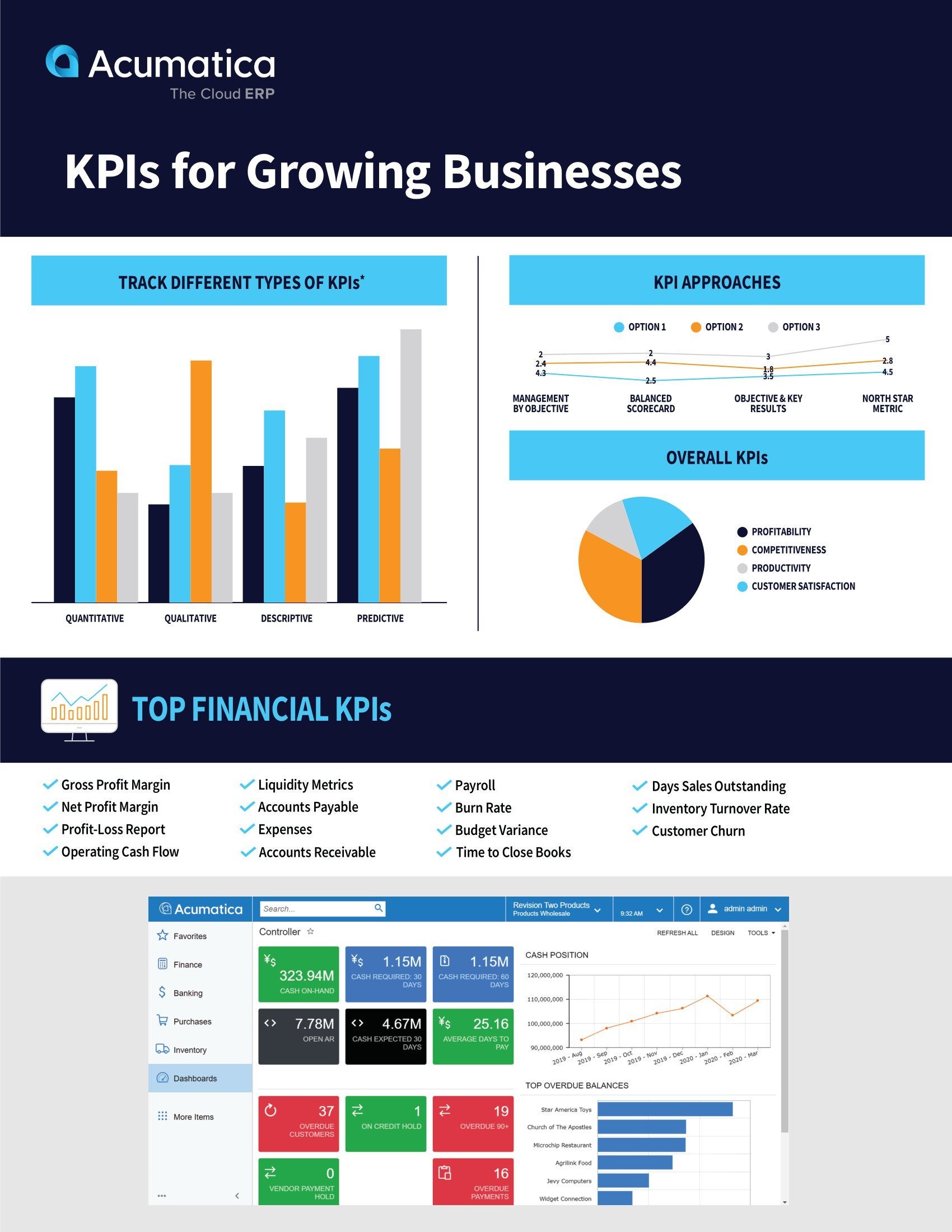
Acumatica informs decisions with role-based dashboards that present strategic insights and real-time KPIs.
1 ERP Today, Moving on: When it’s time to adopt a dedicated ERP system
ERP Solution Benefits
Know What to Expect from an ERP Solution
Migrating to an ERP solution represents a digital transformation initiative that delivers widespread benefits that affect nearly every aspect of the business. Organizations should expect to reap tangible results.
“Acumatica has definitely cut down on the time it takes to look up orders within our system, the status of an order, and in looking up inventory. No more being shuffled around to different members of our team who may not have the information needed. That’s been a huge value add in efficiency. As we integrate more of our systems into Acumatica, we’ll only continue to see more efficiencies.”
Boost Sales
Sales flounder without quality leads. Bad data costs companies $600 billion per year.2 Most salespersons manually enter data in multiple applications, increasing inaccuracy and risk. Unified CRM and ERP systems eliminate bad data. Marketing can execute demand generation campaigns and automatically send sales new opportunities. Instant access to customer history and financial data helps sales capitalize on upsell opportunities, tailor discounts, and expedite revenue collection. An ERP solution eliminates data entry, streamlines searches, and shortens the sales cycle.
Enable Entry into New Markets
ERP platforms empower companies with the insights they need to identify market opportunities. They can use personalized reports to detect issues and conduct trend analysis for new products and resell opportunities. Companies can also leverage their ERP system to support mergers and acquisitions by integrating new systems into their solution suite. Cloud-based systems can scale to support multiple enterprises across the globe on one ERP system. In addition, some support multiple currencies, languages, and financial regulations.
Improve Customer Satisfaction
Customer service suffers when companies scramble to keep up with rising volumes and complexity. ERP systems with embedded customer management boost service and support by putting everything users need to support customers at their fingertips. For example, users can access real-time customer order history, service requests, and contact data. Automated alerts keep requests on track while integrated workflows move tasks to appropriate users.
Increase Productivity
Using different applications for various tasks, such as one for accounting and another for purchase orders, hampers productivity and collaboration. They fuel error-prone manual tasks and force IT to individually update applications. ERP solutions streamline operations by automating tasks and integrating workflows. Acumatica connects disparate hardware and systems and automatically aggregates real-time data from each source into a centralized solution. As a result, employees make better decisions and optimize routine operations. For example, they can close the books and fulfill orders in a fraction of the time. Acumatica uses artificial intelligence with machine learning to populate forms and eliminate additional manual entry. ERP reports enhance productivity by keeping priorities visible and informing decisions. In addition, mobile frameworks allow work to get done anywhere, anytime.
Acumatica’s real-time reporting, personalized dashboards, and alerts notify users when KPIs, like productivity metrics, falter so they can proactively address issues.
Enhance IT Security and Value
A burgeoning IT stack drains efficiency while increasing costs and risk. An ERP solution alleviates IT security and data integrity risks with a centralized database that provides one version of the truth. In addition, companies can integrate new applications into the ERP system to streamline IT resources.
Thanks to its open architecture and APIs, companies can integrate external systems into Acumatica with minimal or no programming.
2 The Data Warehousing Institute: Study Poor Data Quality Costs $600B Yearly.
Considerations
What You Should Know When Choosing ERP Solutions
ERP solutions differ substantially between providers. Many ERP applications reside on aging technology platforms, initially designed for on-premises deployment. Older technology cannot scale to meet evolving needs and lack intuitive navigatione. No matter how robust an ERP solution is, it cannot deliver everything an organization will ever need. Therefore, it must provide scalability and flexibility to support growing applications, user base, and markets.
“Our people are more effective and can focus on relevant issues rather than manual work, and that’s as good as gold. With Acumatica’s one version of the truth, the understanding and realization that what one department does affects another has created deeper alignment and decisively improved collaboration.”
Future-Proof Tech Stack
Fueling long-term growth starts with a solid foundation that can flex to meet evolving demands. Look for an extensible tech stack with an open architecture and leveraging the latest technologies. Avoid proprietary and legacy systems, which require extensive programming to configure and enhance.
Acumatica resides on a future-proof platform with an open architecture, which leverages a cutting-edge web development environment and an open-source SQL server and database.
Flexible Cloud Platform
Insist on a native cloud-based ERP solution developed that offers the flexibility and scalability to support multiple entities globally.
Built on a modern cloud, Acumatica provides security and global support with multi-language, multicurrency, and localization services. Open application programming interfaces (APIs) enable data to flow in and out of the centralized database from multiple sources and make one version of truth accessible to all. As a result, companies can easily configure workflows and add new applications with little or no programming. The Visual Workflow Engine lets them define workflows by dragging and dropping elements.
Industry Expertise
Organizations must integrate industry and unique business processes into their solution to maximize ERP benefits. Therefore, they should pursue an ERP solution with industry expertise and open architecture.
Mobile Framework
Delays cost money. ERP systems with mobile capabilities enable companies to keep workflows moving 24/7. Look for a solution with an intuitive mobile interface that lets users pick up their last task, view automated alerts, and act quickly.
Acumatica’s on-the go-mobility enables users to personalize their mobile desktop to complete tasks on the mobile device, like approving transactions. Support staff can answer customer questions. Sales can access all the data they need to seize a new opportunity.
Scalable Design
Licensing and User Fees. Companies maximize their ERP solution value when they freely connect employees and partners. Look for a provider that supports unlimited users. Acumatica’s consumption-based licensing lets companies add as many users as they want without added fees. Role-based secures sensitive data.
Integration Flexibility. Scaling to meet future needs requires adding new applications easily. Acumatica’s integrated web services facilitate ongoing connectivity with external applications and devices. In addition, it empowers a growing global footprint by supporting multiple tenants and instances while securing each tenant’s data.
Ethical Business Practices. ERP providers follow different policies. For example, some charge for historical data and other hidden fees. Make sure to choose one with happy customers and a stellar reputation.
Acumatica’s open architecture lets companies rapidly integrate new hardware, software, and divisions into their ERP solution without disrupting core operations.
Prioritize Productivity
Unfriendly solutions fail to deliver maximum returns. People shy away from cumbersome technology and rely on old workarounds. As a result, companies should seek ERP solutions with proven usability and strong, lasting customer relationships.
Pursue Proven Usability
Intuitive Interface
Acumatica’s intuitive interface and single sign-on let users navigate between embedded applications and integrated external systems. In addition, it reflows content to fit various screens so users can work anywhere.
Numerous Industry Awards
Gartner: Customers and analysts consistently award Acumatica top honors for usability. The ERP platform currently has a 4.4-star rating on Gartner Peer Insights, with over 91% of users giving Acumatica a four or five-star rating.
G2: Recent reviews highlight Acumatica’s impact on small and mid-sized businesses. In 2022, Acumatica earned top marks from G2 for usability and relationship. Nucleus Research also selected Acumatica as the market usability leader in its ERP Technology Value Matrix.

Find a Company That Puts Your Needs First 📷 icon: contract with a seal
Acumatica’s Customer Bill of Rights protects customers with an End User License Agreement (EULA) and guarantees no hidden fees. It outlines Acumatica’s commitment to consumption-based licensing that does not inhibit growth and protects customers’ access to their data anytime, even if they end their relationship. In addition, Acumatica Open University provides free online training to all users at all times.
Evaluate the ERP Solution’s Total Economic Impact
Estimate the ERP solution’s bottom-line impact before choosing your solution. Then, use an analyst-created calculator to view how Acumatica can drive profitability across the organization objectively.
Must-Have ERP Capabilities
Many organizations fail to reach their potential because their platform cannot seamlessly connect diverse systems. An ERP platform should promote growth by connecting all application data in a single database that provides a real-time and complete 360-degree view of every business area.
“Once we launched, it was amazing. During the first month, we billed $1.7 million straight out of Acumatica and closed the month in 45 days. In January, it only took 30 days to close, February 15 days, and March was five days.”
Comprehensive Financial Management
Do not settle for basic accounting features alone. Instead, obtain an ERP system with robust financial management, project accounting, intercompany account, recurring and deferred revenue, payroll, billing, and contract management.
Real-Time, Personalized Reporting
Without transparency into operations, organizations cannot discern company health, identify trends, and seize opportunities. Insist on real-time and past-performance reporting and ongoing access to historical data for trend analysis. Some vendors charge for historical data or block access to your data if you terminate your relationship. Acumatica customers have ongoing access to all of their data without additional fees, even if they end the relationship.
Additionally, look for standard reports and the ability to create custom reports without programming. For example, Acumatica combines its customizable reporting engine with business intelligence to deliver real-time KPIs and personalized dashboards to each user without coding.
Industry Editions
Choosing an ERP solution designed for your industry can provide feature-rich functionality out-of-the-box. Check out success stories to see their impact on similar companies. Remember, a strong user community helps enhance the solution for the long term.
Acumatica offers award-winning editions for Construction, Distribution, Manufacturing, and Retail markets and supports a full range of micro-vertical markets.
Native Integrations and Add-Ons
All ERP solutions connect functions to a central database. Many offer similar core functions. However, no solution provides everything a company will ever need, no matter how extensive. Consider available integrations a starting point. Then, evaluate the ease of integrating new ones and pursue an intuitive solution.
Acumatica enables organizations to configure their ERP system without extensive programming. Open APIs expedite development. Contract-based APIs ensure integrations will not change or break during upgrades.
The Acumatica Marketplace offers hundreds of certified industry and business applications so companies can easily expand their solution.
Embedded CRM
Do not overlook the impact of integrated CRM. Connecting sales, finance, and support helps close deals faster, generate upsells, settle outstanding bills, and improve customer satisfaction. Acumatica’s unified CRM and ERP solution generates quality leads and boosts sales.
Emerging Technologies
Ensure the provider regularly enhances its ERP system with the latest technologies since older technologies lower efficiency and restrict innovation. Consider how innovations like artificial intelligence and machine learning automate processes and reduce errors.
Acumatica provides a holistic suite with unparalleled breadth across an extensive accounting, sales, project, case, and customer management application suite.
ERP Options
Compare ERP Options
ERP solutions deliver extensive financial management capabilities that rival accounting software. They also provide a full range of business functions, such as CRM, payroll, and eCommerce. Their strength lies in their ability to graft industry-specific and general business functions into the platform. The following chart highlights the differences between standard accounting software and Acumatica.

Implementing an ERP Solution
Implementation Guidance
Adopting a cloud ERP system takes significant time, effort, and investment. Since it will affect nearly every aspect of the business, deploying an ERP solution requires meticulous implementation and close partnership between business leaders, IT teams, and software providers. The following summarizes the major steps.

“Acumatica has undoubtedly supported SEACOM’s rapid expansion. We’ve deployed Acumatica to several acquired companies in the last five months, so we know we can easily get new companies up and running on the platform very quickly.”
The Bottom Line
Modern ERP Solutions Fuel Success
Most companies eventually outgrow their infrastructure. The technology that once empowered them not only fails to meet their evolving needs but also jeopardizes their success. Disparate applications prevent them from visualizing company health, while manual workflows diminish productivity.
A modern and adaptable ERP solution helps burgeoning organizations connect data from multiple applications and provide real-time insights into end-to-end operations. An ERP solution also streamlines processes and integrates workflows. However, all ERP solutions were not created equal. Therefore, organizations must carefully evaluate their options and choose an intuitive ERP platform to meet today’s and tomorrow’s needs.
Acumatica’s future-proof modern ERP platform enables organizations to scale to support new divisions, product lines, and unlimited users. Organizations can tailor Acumatica to meet their unique needs.
Businesses can leverage Acumatica’s open architecture to rapidly merge new applications, devices, and branches into their ERP platform without disrupting operations. Open APIs enable data to flow in and out of Acumatica’s centralized database from multiple sources and make a single version of truth accessible to all users. Acumatica’s rapid implementation program and data migration utilities ease the burden of system and data migration, resulting in lower costs and accelerated implementations. For example, Acumatica provides a toolset that maps QuickBooks data into the ERP solution.
In addition, Acumatica’s award-winning ERP solution provides the flexibility businesses need to enter new global markets. Set a technology foundation for global connectivity with multilingual translations, localized business practices, multicurrency, and international accounting and tax support. Empower employees with an ERP application that is easy to use, easy to learn, and adaptable to their specific roles.
“Acumatica can be molded to our specific needs, which allows us to achieve the highest degree of efficiency and automation that products for a better bottom line.”