Canada (English)
 Colombia
 Caribbean and Puerto Rico
 Ecuador
 India
 Indonesia
 Ireland
 Malaysia
 Mexico
 Panama
 Peru
 Philippines
 Singapore
 South Africa
 Sri Lanka
 Thailand
 United Kingdom
 United States

Acumatica’s superior industry-specific features win out
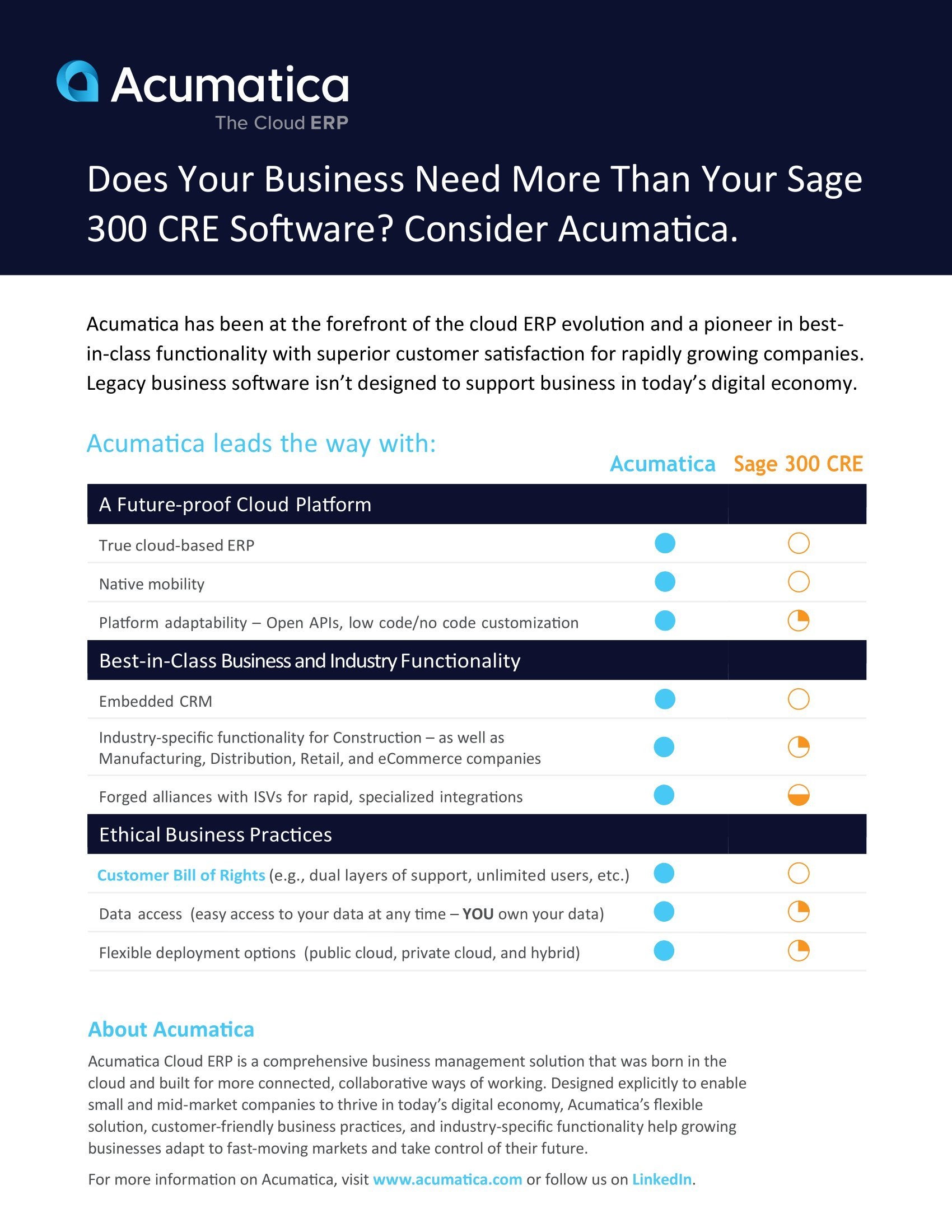
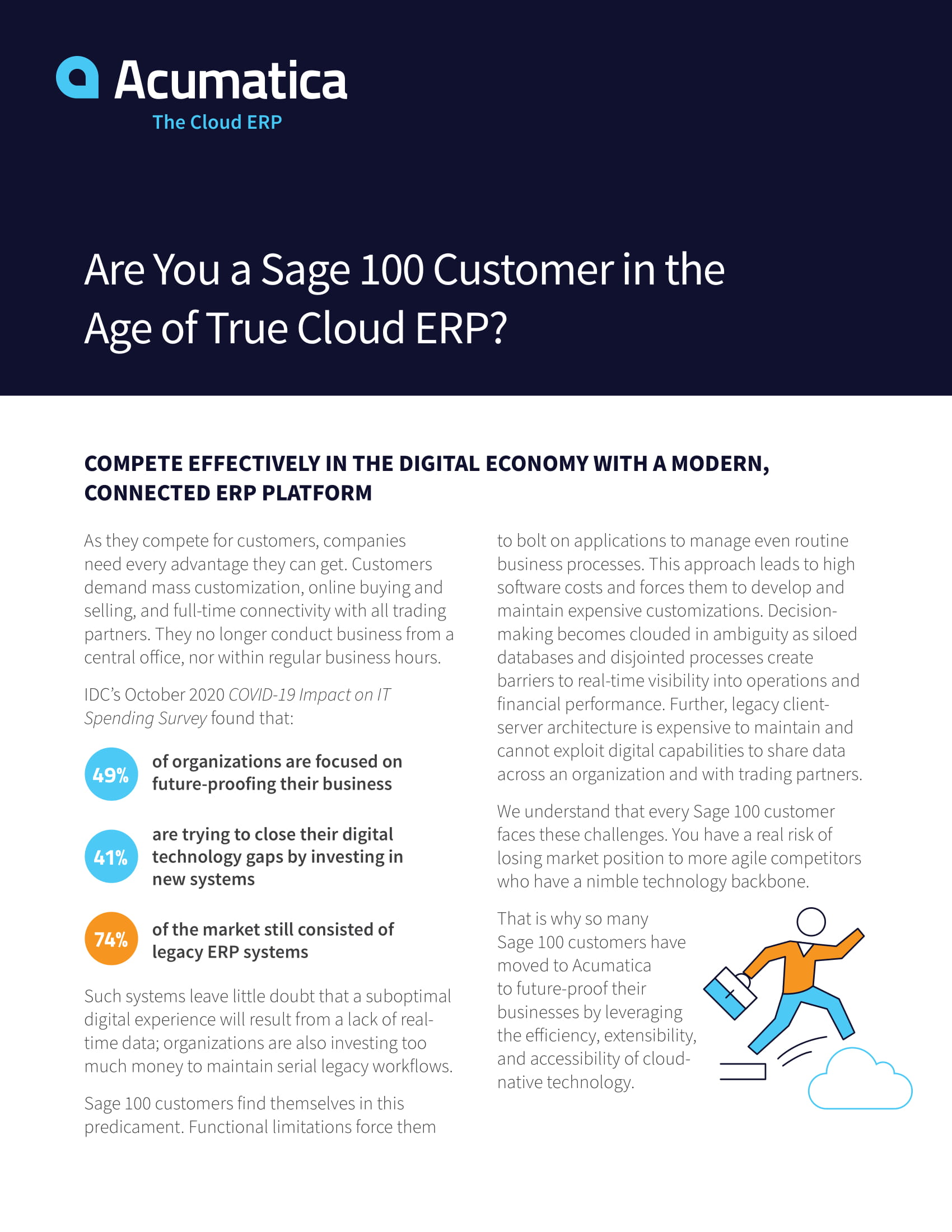
In today’s global and digital economic environment, organizations are being forced to adapt to rapid change or risk extinction. This is especially true of small and mid-sized businesses (SMBs) who have scarce resources to devote to non-core competencies. After all, it’s a full-time endeavor to sell, deliver, maintain, and service customers—never mind thinking about long-term planning. Many of these younger organizations have installed entry-level computer systems such as QuickBooks or Xero to get them started. Yet others run on legacy software such as Sage (50/100/200/300/500) or Microsoft (Great Plains, Solomon). These older software platforms show their limitations as companies grow beyond their bounds.
Perhaps your business processes are disjointed, with staff needing spreadsheets to track costs, orders, or customers off-line. Are employees manually entering the same data into different systems? How long does it take to produce an ad-hoc report requested by a manager? Do leaders have an at-a-glance visual view of the top KPIs for your company? Are you struggling with inventory accuracy and on-time order shipments? These and many other obstacles to company efficiency are bleeding the organization of time, money, and customers.
However, technology can be a great enabler for business and yield a significant competitive differentiation for those who deploy and leverage systems to take advantage of economic opportunities. Sage Intacct and Acumatica are two such systems—modern, cloud-based ERP suites, with the latest automation, on-demand reporting, and integration features to future-proof your business for years to come.
It can be challenging to navigate all the marketing materials and make sense of which ERP products are truly a strong fit for your business requirements. Software vendors claim they can expertly support all customer types across every industry sector – but that is rarely true, particularly in the SMB market.
This solution brief examines several factors to consider when evaluating Acumatica and Sage Intacct. Read on to learn why Acumatica offers tangible advantages over Intacct for growing organizations who want to modernize operations and improve their competitive standing in the market.
Horizontal Parity in Many Areas
A strong and stable financial accounting system is absolutely core to every organization. Both Intacct and Acumatica provide best-in-class financial management capabilities. From tightly integrated ledgers with receivables, payables, and cash management transactions to advanced features that support AP automation, revenue recognition standards, multi-entity and inter-company accounting, fixed asset management, and multi-currency features, each system accommodates the complexities of managing an organization’s books.
Intacct has solid capabilities around billing, budgeting, and integration with Salesforce CRM. Acumatica excels with dashboard flexibility, native CRM and payroll applications, and universal searching features.
Regarding the software platform, both Intacct and Acumatica have a modern, web-native platform with many similar capabilities, including process workflows, intuitive usability, event triggers, custom reporting, and web-based APIs for integrating data with 3rd party software solutions.
Both vendors score industry-leading ratings in terms of usability and customer satisfaction levels, according to peer review site G2.com.
The critical differences lie in vertical industry capabilities. Intacct is well-suited for non-profits, service-based firms, software and subscription-based companies, and accounting support for healthcare providers. While Acumatica also caters to subscription-based companies, it has further advantages in manufacturing, distribution, retail, and construction—where Intacct has low penetration.
Differentiation #1
Support for Manufacturing Operations
Growing manufacturers are consistently asked to do more with less—maximize productivity while meeting demanding customer schedules and quality. Manufacturing software help meet those market demands.
Acumatica gives manufacturers automated tools for producing, storing, selling, and post-sale servicing. The software suite supports make-to-stock, make-to-order, assemble-to-order, engineer-to-order, batch, and even those who engage in multi-modal operations (more than one production type).
Acumatica offers a robust portfolio of manufacturing modules including bills of material, material requirements planning (MRP), production management, advanced planning, visual scheduling, a product configurator, and engineering change control features. Over 600 manufacturers use Acumatica today. See some of our customer success stories.
Meanwhile, Intacct does not support manufacturing operations. They have announced plans to release a manufacturing suite in several geographies, but these applications will not be available until mid-2023.

Differentiation #2
Wholesale Distribution
Wholesale distributors often have overlapping business needs with manufacturers and retailers in addition to their own core requirements. Some distributors add value by preparing kit assemblies or performing light production on items before packing and shipping. Many others want to sell via multiple sales channels such as online, in-store, or directly out of warehouses. As a core competence, Acumatica has the gambit of distributors covered.
Advanced inventory features include matrix items, automated replenishment, cross-sell/up-sell and item substitution, plus FIFO, LIFO, FEFO, Average, and Actual item costing methods. Embedded warehouse management supports complex distribution networks or a single location with optimization capabilities based on cost or delivery. Manufacturing features and omnichannel support extend a wholesaler’s range of services and customer delivery options. Native CRM displays real-time customer history and information to serve users expeditiously, while Acumatica’s service management module arms field personnel with the right tools and parts to the right location at the proper time.
Sage Intacct doesn’t offer a native warehouse management system (WMS) and relies on ISV partner applications. Additionally, Intacct does not offer embedded CRM or field service management for post-sales servicing of customers.
Intacct offers inventory management features within their core verticals, but with fewer features than most distributors need to efficiently manage operations. There are not many customer references for their inventory management solution. Reviews claim the module is better suited to inventory accounting than managing operational transactions.

“We’re seeing a lot more interaction amongst executives, and everyone can now view inventory, sales dollars, and sales performance at each location. That visibility allows them to call each other for help and locate inventory, which didn’t happen before.”
Differentiation #3
Retail and Omnichannel Commerce
In today’s global, digital economy, companies must adapt quickly to survive the slew of competitive pressures faced daily. New channels must be discovered, customer satisfaction levels must be ever-increasing, and supply chain management has never been more critical.
Acumatica offers capabilities for retailers and other businesses who need to provide superior sales and customer service. These include real-time inventory accuracy across locations and channels, order management and fulfillment from multiple sales sources, returns and exchanges, customer-specific pricing, drop-shipping and blanket sales order management, as well as native point-of-sale (POS) system integration. Acumatica’s Retail Edition is a natively built solution and works seamlessly with all other Acumatica modules, providing synchronized, bi-lateral data flows in real-time, so operations are kept up-to-date, accurate, and a single source of truth for merchants. There are embedded connectors from the core ERP system to the most popular online commerce platforms and marketplaces such as Shopify, Amazon, and BigCommerce—and Acumatica has taken the work of obtaining Amazon’s API security keys out of customers’ hands. Security keys are provided by Acumatica, saving tons of time, effort, and frustration for users who sell on Amazon’s Seller Central marketplace.
Sage Intacct has no such native connectors integrating eCommerce sites with back-end business management systems. They acquired a partner solution in 2022 called Brightpearl to serve as the gateway to online commerce channels like Shopify and Amazon.
While Brightpearl does a reasonable job of supporting omnichannel sales, the software has been a self-contained solution for retailers prior to Sage’s acquisition. Aside from connecting to marketplaces, Brightpearl contains financial management modules, order management features, inventory control capabilities, and analytics functionality. Many of these solutions are part of Intacct’s portfolio as well. Sage must reconcile the overlapping features of Brightpearl with core Intacct to provide customers with a comprehensive—yet efficient—operating platform for merchants.
Brightpearl users must work directly with Amazon to procure the needed security keys to participate on Seller Central. Ask folks who have gone through this process to understand how difficult and tedious it can be. Further, Brightpearl reviews claim that additional middleware is required to complete the integration with commerce platforms and marketplaces, an extra cost and an extra component in the technology stack. G2.com reviewers have spoken about the difference in integration capabilities between Acumatica and Brightpearl—giving much stronger ratings for Acumatica.
Note that Brightpearl does not offer a mobile application, so users must login from a laptop or desktop to access the system. It only supports English, limiting usage in non-English geographies.

“Our success is ultimately tied to Acumatica’s success, and they are building a strong and healthy product. They have a vibrant customer and development community and a product that’s growing, not stagnant. We can really craft Acumatica to do what we need it to do.”
Differentiation #4
Support for Construction Firms
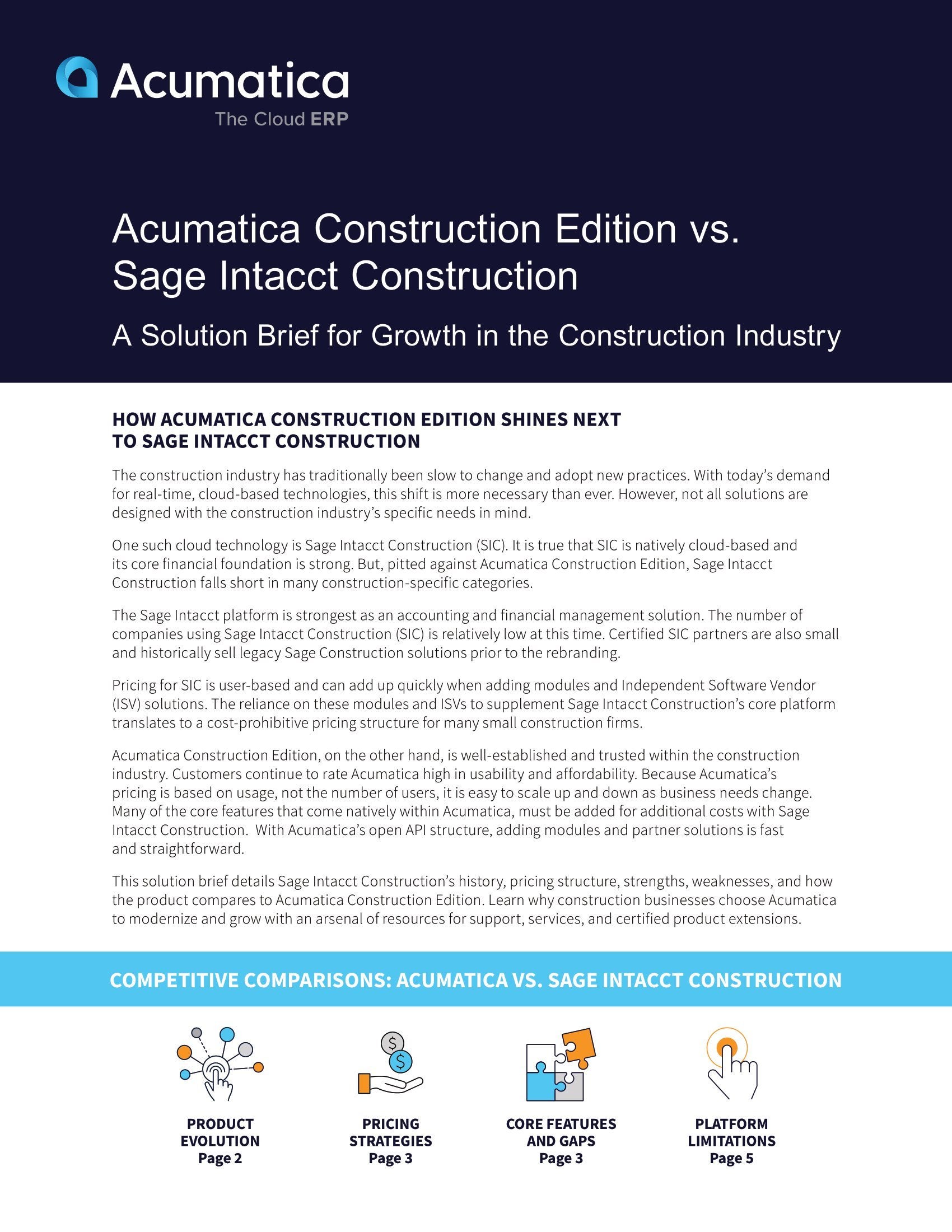
Construction is a common vertical industry supported by both Acumatica and Sage Intacct. Acumatica released its Construction Edition in early 2018, while Sage debuted Intacct Construction in 2020. It may not sound like a significant difference, but as software suites build out functionality over time through product enhancement releases, Acumatica indeed offers features yet to be part of Sage Intacct.
Both Acumatica and Sage Intacct cover the basics of construction management rather well. Project accounting capabilities are thorough. Dashboards depicting project completion, progress status, expenses, and profitability—at the individual project level as well as a consolidated view across projects—are well-designed and configurable for ease of consumption by all employees and contractors. Revenue recognition compliance, necessary for project-based businesses, is a core competence of both systems. As is sub-contract management, whereby portions of work are delegated (contracted) to other companies to complete.
However, Acumatica provides other key features for construction firms that Intacct does not, starting with a native Payroll solution and a native field service management application. Acumatica offers superior capabilities for change order management processes such as profitability analysis and detailed audit trails to budgets and commitments. Acumatica provides embedded construction-specific project management functionality—Intacct uses 3rd party software like Procore. Support for regulatory, OSHA, and construction-specific reporting compliance is all part of Acumatica’s suite, whereas Intacct relies on partner solutions to fill those gaps today.
Finally, Acumatica offers a complete mobile application of its application, a necessity for the volume of field personnel out on job sites or away from the office who require system access to handle event alerts, approve purchase orders or employee expenses, provide information to eager customers, or just check the status of a project. Intacct’s mobile capabilities are more immature, including the user interface.
For property managers, Acumatica Construction Edition for property managers is a comprehensive and future-proof business application with role-based activities and insights for property managers, tenant services, construction managers, finance, information technology, and sales and marketing executives.

Acumatica is THE Choice for Small and Mid-Sized Businesses
Small and mid-sized businesses selecting an ERP platform to support their accounting and overall business operations have many choices, Acumatica and Sage Intacct being two of the most popular cloud-based solutions. Acumatica offers several essential advantages when it comes to serving your industry-specific requirements.
To get the most from an ERP platform, look at each vendor’s support in the following verticals:
- Manufacturing
Acumatica has been providing manufacturers with robust functionality since 2008, including major enhancements semi-annually. - Wholesale Distribution
Acumatica’s portfolio of order management, inventory and warehouse management, pick-pack-ship, and connected financials provide efficient business processes for all levels of employees. - Retail and eCommerce
Acumatica’s native commerce connectors integrate multiple marketplace platforms directly to back-end ERP systems for a complete end-to-end business operation to those wanting an award-winning omnichannel sales strategy. - Application Integrations
Acumatica’s marketplace contains hundreds of pre-built, certified applications to meet almost every customer’s needs. - Construction
Construction companies benefit from Acumatica’s comprehensive features that support field operations, financial regulations, and management decision-making in one application suite.
Acumatica’s modern, cloud-native platform and robust industry features for manufacturers, distributors, retailers, and construction companies make it a great choice for your next business management software system.
“Acumatica is magic. We haven’t found anything we can’t do with Acumatica.”