Canada (English)
 Colombia
 Caribbean and Puerto Rico
 Ecuador
 India
 Indonesia
 Ireland
 Malaysia
 Mexico
 Panama
 Peru
 Philippines
 Singapore
 South Africa
 Sri Lanka
 Thailand
 United Kingdom
 United States

Increase Manufacturing Profits with Insights to Grow Sales and Control Costs in Uncertain Times
Manufacturers struggle to maintain profit margins amidst increasing labor costs and volatile materials markets. Meanwhile, supply chain disruptions force companies to overstock raw materials with increased carrying costs that erode margins. Notoriously slow to adopt modern technologies, manufacturing executives must innovate to grow, especially in printing and publishing, non-metallic minerals, fabricated metals, and automotive industries, where gross profit has decreased substantially in the past five years.
Manufacturers using entry-level accounting and legacy ERP applications struggle to contain costs and capitalize on new market opportunities. This is due, in part, to delayed and incomplete information spread across disparate systems for financials, production, and customer relationship management. Often an afterthought, website development, commerce storefronts, and digital marketing provide opportunities for manufacturers to outmaneuver less agile competitors.
Growth is within your grasp with strategic investments to fortify product portfolios, maximize profits with innovative pricing initiatives, expand go-to-market strategies, and implement promotional activities. Add customers while retaining and growing existing accounts with a world-class customer experience.
Armed with information, proven strategies, and systems to automate business processes, manufacturing executives gain insights to boost sales, contain costs, and enter new markets. This eBook gives executives an overview of Acumatica Cloud ERP for profitable manufacturing operations, marketing, sales, pricing, and discount strategies to thrive in uncertain times.
Manufacturing Sales Overview
On average, manufacturers enjoy healthy 33 percent gross margins. However, a closer look reveals several industry segments have experienced significant margin erosion since 2016. Conversely, industrial equipment, rubber and plastics, furniture and fixtures, and other manufacturing industries are growing gross margins, albeit slowly, at less than two percent annually.

Manage the 5 Ps of Manufacturing Marketing and Sales
Marketing and sales are impacted by product, price, place, promotion, and praise. Increase profits by eliminating slow-moving and low-margin products while expanding your portfolio to boost sales. Carefully evaluate and adjust pricing often to account for cost changes in volatile markets. Understand go-to-market strategies like direct sales, indirect sales through sales reps or wholesale distributors, and direct-to-consumer (D2C) opportunities with connected commerce storefronts and marketplace applications. Use analytics and technology to craft promotional marketing campaigns to fill your pipeline with high-quality opportunities while shortening the sales cycle. Finally, implement customer satisfaction strategies to build customer loyalty to fend off competitors, increase sales, and boost customer retention.
Evaluate Your Product Portfolio for Increased Profitability
It is easy to be complacent with your product mix. Manufacturers succeed with a few products that differentiate them from competitors and build their business around those products. But what happens when competitors introduce similar products at a lower price? Manufacturers must continually improve existing products and introduce new products for sustainable growth.
Invest in research and development to improve existing products and test new products to boost customer sales or attract entirely new markets. Implement lean manufacturing strategies and analyze costs to reduce waste and improve processes for greater profitability. Explore product customization and personalization options and evaluate service offerings to add more value while differentiating from competitors. Lastly, consider modern technologies like 3D printing to make unique products on demand to grow revenue.
“With Acumatica, we respond faster to our customers because the information is more readily available. For example, if a sales rep asks if an order can be shipped out faster, she pulls information on open orders, sees what materials are required, and makes a quick decision.”
Evaluate Your Product Mix
Leverage data to spot dead products and less profitable items to remove from your product mix. Slow-moving or obsolete products burden sales processes with high carrying costs and wasted warehouse space. Use surveys to discover which products or item variations customers would purchase if available.
Personalize and Customize Products
Consider offering personalized or custom products. Ensure your ERP system and connected retail or commerce storefront applications support order personalization details. Rules-based product configurators may help calculate manufacturing costs, customer pricing, and bills of material and labor operations for production.
Invest in Research and Development
Track R&D costs with a project management application and connected CAD or PLM software to improve existing product designs and to create innovative new products to add to your portfolio. Use market data to spot trends and collaborate with customers and vendors to improve product designs.
Add Complimentary Services
Add paid or free services to differentiate from competitors. Services may include free shipping, discounted training, or on-site installation and repair plans. Use connected CRM applications to offer customers technical support.
Evaluate New Technology
Test new technologies like 3D printers for rapid prototyping, replacement part production, or entirely new products. Consider moving to a modern cloud ERP solution with native CRM to improve customer service. Warehouse management systems (WMS), shipping, electronic data interchange (EDI), and other technology may reduce costs while improving the customer experience.
Contain Costs for Improved Profits
Eliminate waste from inventory and manufacturing processes with automated warehouse activities and barcode scanning for manufacturing data collection. Use analytics to understand manufacturing costs, labor and work center utilization, scrap, and machine downtime so you can implement cost-saving measures to boost profit margins.
Improve Profits with Flexible Pricing Strategies
Manufacturing pricing is complex. Many raw materials are in short supply with volatile price fluctuations. This is compounded by inflation impacting overhead rates, skilled labor shortages that drive up costs, and escalating shipment fuel prices. Knowledge is power. Arm yourself with cost details to derive strategic prices for a better bottom line.
“Our business in not going to be successful through chance. It will be successful through change and having a robust ERP system [like Acumatica] that can give us that added flexibility in these unique and very uncertain times is going to help us win in the future.”
General Setup
Automate validation rules for minimum markup percentages based on items, item classes, customers, customer classes, or other parameters. Establish pricing for specific units of measure, such as a case order volume break. Adjust overhead rates, prices, and promotions by warehouse or manufacturing location to manage margins across geographic regions. Use multiple base currencies across geographies, with sales prices set for specific foreign currencies with currency conversions. Define products and services as taxable or non-taxable with connections to tax engines like Vertex or Avalara for tax calculations.
Inventory Valuation Options
Inventory valuation directly impacts COGS, gross profit, and net income and is crucial for establishing pricing. Acumatica supports standard, average, specific, and FIFO valuation methods providing flexibility so businesses can adopt the best options.
Manufacturing Costing
Import vendors, items, and price lists. Process mass updates for seasonal demand or cost increases. Markup fixed, variable, indirect, and direct costs for materials, labor, tooling, and overhead for manufacturing estimates. Gain insights into production costs by job. Acumatica supports actual, estimated, and standard production costing. Further, use the native project accounting application to capture cost details for production and non-production activities with cost-plus markup strategies.
Cost Monitoring
Monitor work in process (WIP). WIP represents the sum of material costs, value-added labor costs, tooling, and subcontracted service costs. WIP is a temporary cost since finished goods are processed into inventory when manufacturing is completed. By monitoring WIP, manufacturers identify issues before they impact profitability. For example, supervisors can be alerted when excessive scrap is reported to production. Historic WIP analysis is helpful for continuous improvement initiatives. Create role-based dashboards to analyze margins by product, product groups, warehouses, customers, customer classes, and other criteria. Use business events to notify executives when vendor costs change, and margins fall below targets for specific orders.
Engineered Products
ETO manufacturers consider material and labor costs during product designs. Synchronization of engineering and manufacturing bills of material is essential with cost roll-ups for finished goods. Pricing rules may be applied once costs are established. This process must be repeated for part revisions to impact product prices.
Configured Products
Rules-based product configurators calculate material and production costs with rules to generate base product prices. These prices are used in the ERP system to set sales prices based on customer-specific pricing, promotions, or other pricing rules.
Service-Centric Pricing for Non-Stock Items
Acumatica supports service sales with non-stock items and conversions between non-stock and stock items. Native project accounting, customer support cases, and service management enable manufacturers to offer billable consulting, product design, technical support, and field services. Flexible contract management and deferred and recurring revenue support recurring revenue streams for product subscriptions and support and service agreements. Further, flexible project billing supports fixed-price, time and materials, or usage-based retainers. Mobile timecards and expense receipt automation powered by artificial intelligence ensure that all costs are reflected in projects and field service activities for billing.
“Recently when a salesman and I were looking something up, we pulled it up immediately because finding information in Acumatica is relatively straightforward and simple. He said to me, ‘You realize what you just did would have taken us six hours in the old system.’ That’s just one of Acumatica’s tremendous benefits.”
Flexible Discount and Manager Approval Strategies
Discounts are commonplace in manufacturing businesses. Some discounts are planned as approved promotions, while others are needed to retain customers or win competitive deals. Sales reps must have a certain level of autonomy to create discounts. Meanwhile, sales managers need transparency to identify and prevent steep discounts that erode profit margins.
Promotional Pricing with Effective Dates
Acumatica’s promotional pricing supports start and end dates. Approved discounts flow through to sales, online, and point-of-sale orders, providing a seamless customer experience. Encourage volume purchases with volume pricing, where the cost per unit decreases with tiered order volume and offer free shipping on larger orders. Empowers sales with discounts by amount or percent for an order line, groups of lines, or entire orders.
Best Price Selection Rules
Analyze pricing rules and active promotions to find the best price based on criteria. The system may limit how many discounts may be applied for a single order protecting profit margins.
Manual Discounts
Empower sales executives with manual discounts to outmaneuver competitors and retain customers. Establish processes to place orders on hold pending approval before processing discounts. Approval workflows can be routed to individuals or groups with single or multiple approvals.
Profitability and Margin Visibility
The Daily Sales Profitability report provides insights into order margins with filters to group data for analysis. The Sales Analysis Profitability inquiry displays margins for invoiced order lines.
Manager Notifications and Approvals
Use events to trigger notifications for new orders requiring discount approval. Sales executives access notifications inside Acumatica or on their mobile devices anytime, anywhere while traveling. Set up role-based dashboards and use reports and inquiries to monitor discounts in real-time.
Advanced Pricing and Discount Strategies
Save time and solve complex pricing problems with fewer errors and more profitable sales with sophisticated formulas and multiple layers of price and discount rules with certified marketplace apps like Rockton Pricing Management.
Expand Sales with Multiple Go-to-Market Strategies
With modern ERP systems, you can be in more than one place at the same time. Continue selling to strategic accounts with internal sales teams while capturing local sales through retail showrooms and attracting new buyers with connected commerce storefronts and marketplaces. Acumatica provides an omnichannel platform to grow B2C sales with options to expand into D2C markets with connected rental and service applications.
“One element that we’ve been extremely excited about is a partnership that we did with BigCommerce . . . which was able to pull the stock items from Acumatica all the way to the product pages of our website”
Direct Sales
Acumatica delivers an embedded CRM solution tightly connected with order management, production, and financials to reduce sales cycles, increase close rates, improve efficiency, and boost collaboration. Use Advanced Planning and Scheduling logic to notify prospects how many units of an item will be available by a specified date or calculate availability dates for a requested quantity of items based on finite capacity constraints, material availability, and vendor lead times.
Convert leads to opportunities, create estimates, convert estimates to quotes, and send quotes to customers with electronic signatures for approval. Convert approved quotes to sales orders. Estimates are easily copied to bills of material and routings for the linked production order. Streamline invoicing and collections with automated dunning letters and commission calculations on a monthly, quarterly, or annual basis.
Brick-and-Mortar POS and Counter Sales
Acumatica connects to multiple point-of-sale apps with native counter sales for manufacturers with showroom sales. Manage point-of-sale transactions with real-time inventory and connected retail hardware and systems, including cash registers, credit card terminals, barcode scanners, and receipt printers. Acumatica supports mixed orders for counter sales where sales and returns may be processed on a single sales order to streamline walk-in sales and returns.
B2B Commerce Storefronts
Empower business customers with the Acumatica for BigCommerce Native Connector. B2B customers can access stock levels, process returns and exchanges, enjoy customer-specific pricing, and place orders on account through the secured online storefront with self-service inquiries into sales history, statements, payments, and invoices.
D2C Direct-to-Consumer Sales
Acumatica’s native integration with Shopify connects your Shopify eCommerce website or Shopify POS with Acumatica financials, inventory, warehouse management, and product information, providing a flexible back-office system that grows with your company. The extensive Acumatica Marketplace provides additional B2C connectors, including Magento and WooCommerce.
Marketplace Connectors
Automate the synchronization of orders or invoices, inventory levels, shipment, and tracking notifications from Amazon to Acumatica order management, inventory, financial, and CRM modules. Optimize your financial reporting and reconciliation process by importing Amazon fees into your accounting system and understanding per-unit profitability. Connected applications extend Acumatica to additional marketplaces, including eBay and ChannelAdvisor’s extensive commerce network with access to more than 300 global marketplaces like Wish, Facebook, Google, Target, Etsy, Walmart, Rakuten, and more.
Fill Your Pipeline with Embedded CRM for Marketing and Sales
Manufacturers rely on marketing to drive demand, foster relationships, and increase sales. Leads come from traditional sources like advertising, website traffic, word-of-mouth, trade shows, and email campaigns. Improve win rates and increase sales value with automated lead assignment, automated notifications for delayed deals, and real-time insights into sales activities with a 360-degree view of sales activities, orders, inventory, production, and financials.
“Acumatica CRM has good guts that can effectively manage the sales staff and connect them to the data they need without bothering customer service. The pricing on Acumatica CRM is way better than Salesforce. Acumatica is at least four times less, to be conservative.”
Web Marketing
Embedded marketing automation and native inbound marketing connections to tools like Hubspot empower users to manage content for search engine optimization (SEO). Monitor traffic and conversions from landing pages or commerce storefronts.
Email and Telemarketing Campaigns
Segment customer and prospect lists for email and telemarketing campaigns. Log follow-up calls, schedule meetings, and store documents for improved activities. Analyze email deliverability and campaign open and click rates to measure results.
Advertising and Events
Create campaigns to assess advertising, webinar, podcast, trade show, and event performances. Define campaign costs to determine the value of each lead, opportunity, and return on investment.
Partner and Referral Marketing
Create relationships between prospects and distributors or sales agent records for visibility into referral networks with analytics to identify and grow top sales partners.
Streamline Sales Processes
Assign leads automatically based on geography, product line, and other criteria. Use business events to move prospects between nurture campaigns and sales processes.
Integrate Loyalty Programs and Gift Cards
Connect sales activities with loyalty programs and use gift cards from certified apps to drive sales.
Gain Insights into Stock and Resources
Provide secured access to stock levels, open purchase orders, and service resources for support, projects, and field services. Tag purchase orders to sales orders and reserve stock for customer orders.
Grow Revenue with Item Suggestions
Sell more with system recommendations for sales order up-sell and cross-sell to boost sales revenue and never lose a sale with item substitutions.
Empower Sales Teams with Mobility
Arm sales reps with mobile apps to access CRM information and manage sales activities from mobile devices. Connected applications provide advanced features for route sales activities.
Manage Teams Effectively
Create sales reporting structures and establish teams for reporting with role-based dashboards, actionable reports, and real-time sales analysis.
Retain Customers and Grow Existing Account Sales with a World-Class Customer Experience
Create legions of loyal customers by exceeding expectations with self-service and data transparency. Fend off competitors with value-added services and build long-term relationships with embedded CRM.
“We can get reports out quicker to our customers. This improves customer relationships.”
Customer Self-Service
Empower customers with secure self-service access to account statements and customer support via the customer portal. Customers can place orders and optionally view stock levels with connected B2B and B2C commerce storefronts.
Automated Communication
Provide product and order transparency with automated alerts and reports sent to customers with order status updates, notifications for receipt of back-ordered products, and shipment tracking links.
Foster Relationships
Embedded CRM provides a 360-degree view of customers. Know what’s happening with every account with access to customer invoices, support cases, orders, returns, and opportunities. Tailor the CRM system for customer anniversary notifications or contact birthday reminders.
Reward Customers for Good Behavior
Robust dashboards and reports provide insights into your best customers. Leverage this information to reward customers for on-time payments, referrals, and product reviews with connected applications for gift cards and loyalty programs.
Customer-Centric Business Practices
Establish workflows and metrics to encourage customer-centric business practices. Recognize employees for exemplary customer service and use metrics to identify ways to improve the customer experience. Reduce paper and waste with Acumatica’s digital platform to build a market-leading reputation as a sustainable supplier.
Unmatched Reliability
Connected quality control ensures high-quality products reducing returns and exchanges. Native warehouse management and automation streamline order processing and fulfillment. Manage customer issues effectively with support cases.
Value-Added Services
Create unique customer value with extended product warranties and loaner products while customer products are being repaired. Customers will flock to you for technical support, product subscriptions, consulting, and field services.
A Complete Manufacturing Platform
Acumatica is a holistic business platform with robust financials, flexible business analytics, and connected applications for order management, inventory planning, service, manufacturing, and construction. Advanced financials improve quote-to-cash and procure-to-pay cycles. Depreciate assets with fixed assets and manage payroll effortlessly with native payroll management. Access hundreds of best-in-class applications from the Acumatica Marketplace to extend your system for exceptional customer satisfaction and supplier interactions.
Maximize Profits with Advanced Strategies
A modern ERP platform provides manufacturers with tools to streamline business processes, boost sales, and cut costs for higher profit margins and happier customers.
“With Acumatica, we have a much tighter connection between the sales process flowing to manufacturing . . . Avalara’s sales tax integration has been really beneficial for us . . . I would have had to hire a full-time person just to handle the different sales tax scenarios, and now it’s done in the background seamlessly.”
Manage Slow-Moving Items and Dead Stock
Optimize warehouse space by isolating and eliminating slow-moving and dead stock items for more profitable sales and reduced carrying costs.
Evaluate Prices Often
Use CRM to capture and document competitor pricing for analysis. Review prices often, especially for top items and products with seasonal cost and availability fluctuations. Create alerts to inform you when vendor price increases erode margins based on established customer price definitions.
Improve Demand Forecasting
Use seasonality to predict future demand or set up blanket sales orders to improve demand forecasts for contractual sales agreements. Smarter demand forecasting mitigates roadblocks to growth.
Special Orders and Requisitions
Use purchase order requisitions with vendor bidding to find hard-to-find items your customers need. Quickly create inventory records and manage special orders to grow revenue.
Improve Response Time
Leverage technology for quote creation, quote delivery, and electronic signatures to expedite sales processes. Implement online chat from storefronts for faster customer response and improved online sales conversions.
Diversify Supplier Networks
Use purchase order requisitions to discover new suppliers and unique products to differentiate against competitors. Ensure that you have multiple suppliers for top-selling items.
Measure with Continuous Improvement
Understand customer value, churn, and growth using dashboards and reports. Analytics help executives and sales professionals maximize customer value and retention.
Evaluate Shipping Costs
Harness the power of embedded shipping apps to select low-cost shipping providers and analyze shipping costs for strategic planning and pricing. Know which providers to use based on geography, shipping quality, and special considerations like a weekend or home delivery and accessorial requirements for specialized equipment.
Reduce Carrying Costs
Implement strategies to reduce carrying costs with exact vendor lead times and dynamic safety stock levels with automated replenishment.
Consigned and Vendor Managed Inventory
Reduce costs with consigned and vendor-managed inventory, secure access to system records, and reports for strategic suppliers, and automated reporting and order processing.
Expand Markets and Channels
Grow internationally with a business platform designed for multiple base currencies, multi-currency conversions, and localized tax and accounting standards such as sales tax, use tax, value-added tax, generally accepted accounting principles (GAAP), and international financial reporting standards (IFRS).
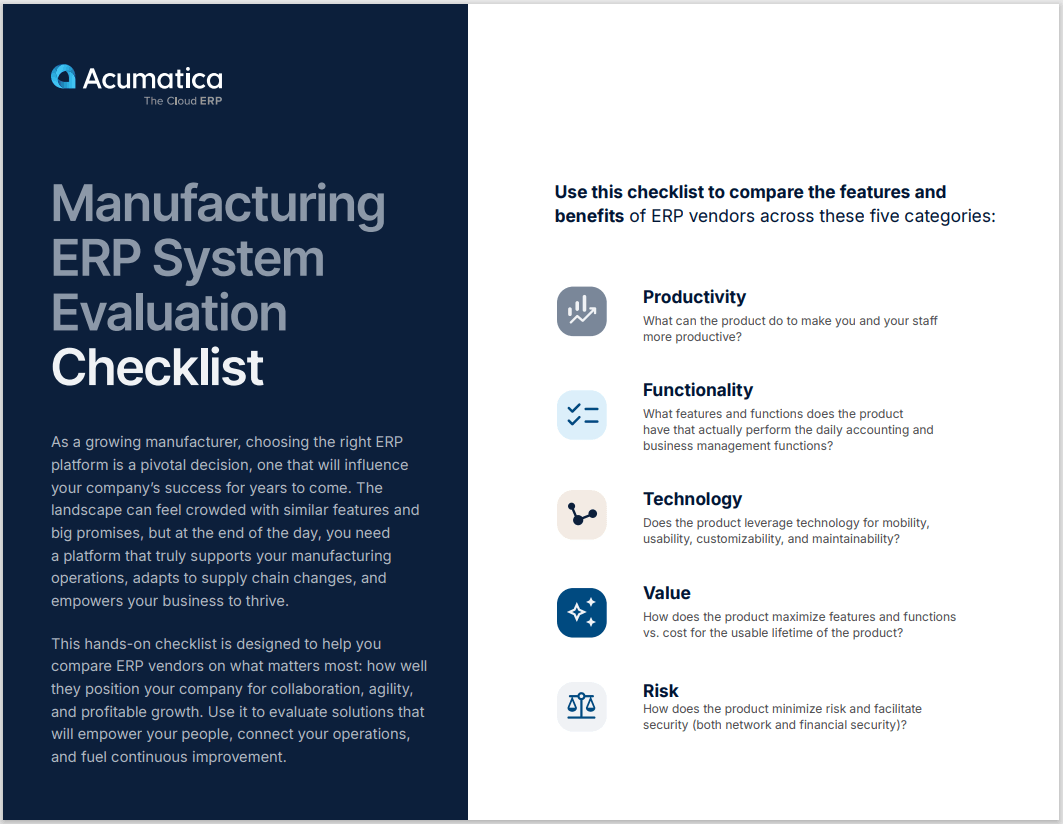
ERP Feature Checklist
Acumatica provides a general ERP feature checklist with standard accounting requirements. A similar checklist is available for general manufacturing features. The checklist below provides a consolidated list of marketing, sales, pricing, and customer-centric features manufacturers should expect to find in modern ERP systems.

Grow Your Business with a Modern ERP Platform
Manufacturing margins are eroding, flat, or barely keeping pace with inflation across industry segments. Executives need help managing unpredictable supply chains and volatile material costs. Labor shortages and increasing customer demands force manufacturers to improve service and product quality with less staff.
Acumatica’s modern ERP platform empowers manufacturers to improve products, manage pricing and discount strategies, and streamline sales cycles with embedded CRM. Omnichannel sales, returns, and exchanges enable manufacturers to continue selling directly with in-house sales staff while expanding sales with native point-of-sale and connected B2B and B2C commerce storefronts. Quality control, customer self-service portals, and embedded apps for service and support elevate manufacturing offerings for increased sales.
Acumatica’s multi-modal manufacturing application provides ample flexibility for job shop estimates, configure-to-order, engineer-to-order, make-to-stock, and project-centric manufacturing philosophies. Robust business intelligence tools arm executives with accurate and timely information to curb costs, unlock growth opportunities, and fend off competitors.
Acumatica delivers an unparalleled experience for users and customers alike. It is built on a scalable cloud ERP platform with open architecture and backed by the industry’s best value-added reseller (VAR) network with hundreds of connected applications from leading development partners.
“Dashboards have changed everything. Our sales grew 21 percent this past year. The reason for that is we’re selling smarter. Before we used to outwork a problem. But now with Acumatica, we outthink the problems.”