Canada (English)
 Colombia
 Caribbean and Puerto Rico
 Ecuador
 India
 Indonesia
 Ireland
 Malaysia
 Mexico
 Panama
 Peru
 Philippines
 Singapore
 South Africa
 Sri Lanka
 Thailand
 United Kingdom
 United States


Summary
Every construction project is a network of interconnected subprojects, each with its own complexities. Success hinges on seamless coordination between field and office teams; without effective collaboration tools, small setbacks escalate into larger issues.
Project coordination, resource allocation, regulatory compliance, risk mitigation, and budget control all affect cash flow, yet many general contractors lack the visibility to manage them because of disconnected systems and siloed data.
Those inefficiencies limit growth, whether a firm is expanding its services or attracting a workforce with both traditional skills and digital expertise. Outdated legacy software restricts flexibility and potential.
This digest explores general contracting market trends, challenges, and how general contractors can use technology to streamline processes, make data-driven decisions, and achieve better project outcomes.
“Our biggest benefit in implementing Acumatica is the time spent on analyzing data versus inputting data. We have eliminated probably 95% of the inputs.”
The unique makeup of general contracting firms
The sector spans a wide range of project types, each with its own bidding model, margin profile, and regulatory burden. Your path to success depends on your specialization and the owners you serve. Smaller organizations dominate every segment: 91% of construction establishments with payroll have fewer than 20 employees.
- Multifamily and operative builders
Multifamily developers and operative builders run repeatable, multi-unit programs with many subcontractors and phased draws. Consolidated project reporting, progress billing, and retainage control keep cash flowing across phases and sites. - Commercial buildings
The largest non-residential segment builds offices, retail, healthcare, and institutional space under competitive bids. Preconstruction speed, change order discipline, AIA billing, and owner and lender compliance decide who wins and who profits. - Industrial buildings and warehouses
Industrial and warehouse builders work to fast schedules and tight specifications, often self-performing parts of the work. Real-time cost tracking, equipment and material coordination, and certified payroll keep complex scopes on budget. - Single-family residential
Homebuilders manage high volumes of fast-moving jobs, from custom homes to remodels. Margins depend on tight estimates, trade and supplier coordination, and current draws and change orders. A connected platform ties estimates to budgets and purchasing.
“Acumatica delivers on its promise with its intuitive, easy-to-use, and flexible platform tailored for small and mid-sized companies. The sense of community support feels like having a network of experts always ready to help. The real-time data capabilities have transformed the way we anticipate business disruptions, which is pivotal for future growth.”
What is driving the market
$713.9B
Projected U.S. commercial construction market by 2032, up from $567B in 2025
4.6%
Projected annual growth of the U.S. construction market, 2025 to 2030
91%
Of construction payroll establishments have fewer than 20 employees
Sources: Mordor Intelligence (2026); Technavio (2026); CPWR, 2014 to 2023.
General contracting is facing real opportunity alongside ongoing uncertainty. Investment and demand keep projects coming, while material costs, labor constraints, and shifting requirements continue to threaten margins and timelines.
Market expansion
Infrastructure investment and demand for real estate fuel steady growth across residential, commercial, and industrial work. At the same time, supply chain concerns push material prices up and put pressure on project budgets. Contractors that use digital tools for bidding, budgeting, and forecasting are positioned to capture the volume.
Specialization and scale
Larger contractors benefit from consolidated project dashboards and multi-project reporting, while smaller firms differentiate through agility, local relationships, and flexible, easy-to-customize tools.
Talent and labor constraints
Finding skilled and even unskilled labor is the perennial challenge. Easy-to-learn mobile apps for field crews, guided onboarding, and modern tools help attract a workforce with both traditional skills and digital expertise.
General contracting operational hurdles
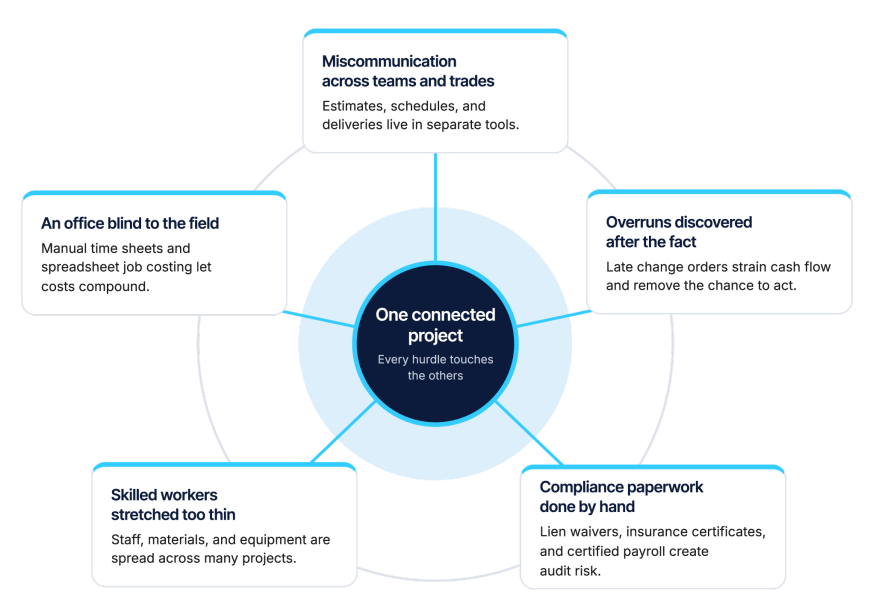
These five challenges are not separate problems. A coordination gap becomes a budget overrun, which strains compliance and stretches crews thin, until the office and the field stop seeing the same job.
- Miscommunication across teams and trades: Estimates, schedules, and deliveries live in separate tools.
- Overruns discovered after the fact: Late change orders strain cash flow and remove the chance to act.
- Compliance paperwork done by hand: Lien waivers, insurance certificates, and certified payroll create audit risk.
Skilled workers stretched too thin: Staff, materials, and equipment are spread across many projects. - An office blind to the field: Manual time sheets and spreadsheet job costing let costs compound.
Tech transformation in general contracting
General contractors who embrace connected business systems set new benchmarks in project delivery, cost control, and owner satisfaction. Modern technology brings job costing, field operations, compliance, and AI-driven insights together, replacing the disconnected tools that create blind spots on complex projects.
- Anomaly detection: Flags unexpected spikes in labor, material, or equipment costs against budget before they affect profitability.
- AI Assistant: Ask project and financial questions in plain language and get answers without waiting on a report or an IT request.
- S-curve forecasting: Gives project managers early warning on spending, so risks surface while there is still time to act.
Mobile-first field empowerment
Foremen and field crews get mobile visibility into schedules, daily field reports, and photo capture, with compliance notifications. Workers clock in to active jobs from any device, so data reaches the office in real time.
Unified project visibility
A real-time view of contracts, budgets, committed costs, and job progress across every project, with configurable dashboards and parent-child projects for consolidated reporting.
Billing, payroll, and compliance
Flexible progress billing with AIA reporting, certified payroll, automated lien waiver tracking, and e-signature integration cut cycle times and manual effort.
Subcontractor and material control
Automate change order workflows and drop-ship purchase orders to the jobsite. Subcontractors and vendors check subcontracts and POs in the Construction Exchange portal.
Customer Story · IOC Construction
“Acumatica has been phenomenal. We have a really strong grasp on our financial picture, our margins, and conversion rates, and the data is relatively easy to pull.”
Joel Sisto, CFO, IOC Construction
General contractor based in Batavia, IL
6
staff moved off data entry
35 min
saved daily on spreadsheet formatting
300+
paper project folders eliminated
Four moves toward sustainable growth
- Upgrade your core systems
Choose cloud platforms that unify project updates, financials, and compliance, with integration options for owners, vendors, and field applications. Streamlined data flows remove bottlenecks. - Develop and retain talent
Equip your team with intuitive mobile apps, step-by-step guides, and customizable onboarding. Automated training records and compliance alerts make growth easier to sustain. - Strengthen customer relationships
Track leads, bids, and owner relationships in a CRM connected to estimating and project accounting, so every opportunity moves from bid to project without re-entering data and historical job data informs pricing. - Act on real insight
Use interactive dashboards and embedded analytics to forecast labor and material needs and track KPIs across every active project, so risks surface while there is still time to act.
See how Acumatica tracks every job, crew, and dollar
Choosing Acumatica means joining a community committed to advancing the construction industry, with reliable, customizable tools for contractors of every size.