Canada (English)
 Colombia
 Caribbean and Puerto Rico
 Ecuador
 India
 Indonesia
 Ireland
 Malaysia
 Mexico
 Panama
 Peru
 Philippines
 Singapore
 South Africa
 Sri Lanka
 Thailand
 United Kingdom
 United States

Ensure your legacy with a systematic succession plan
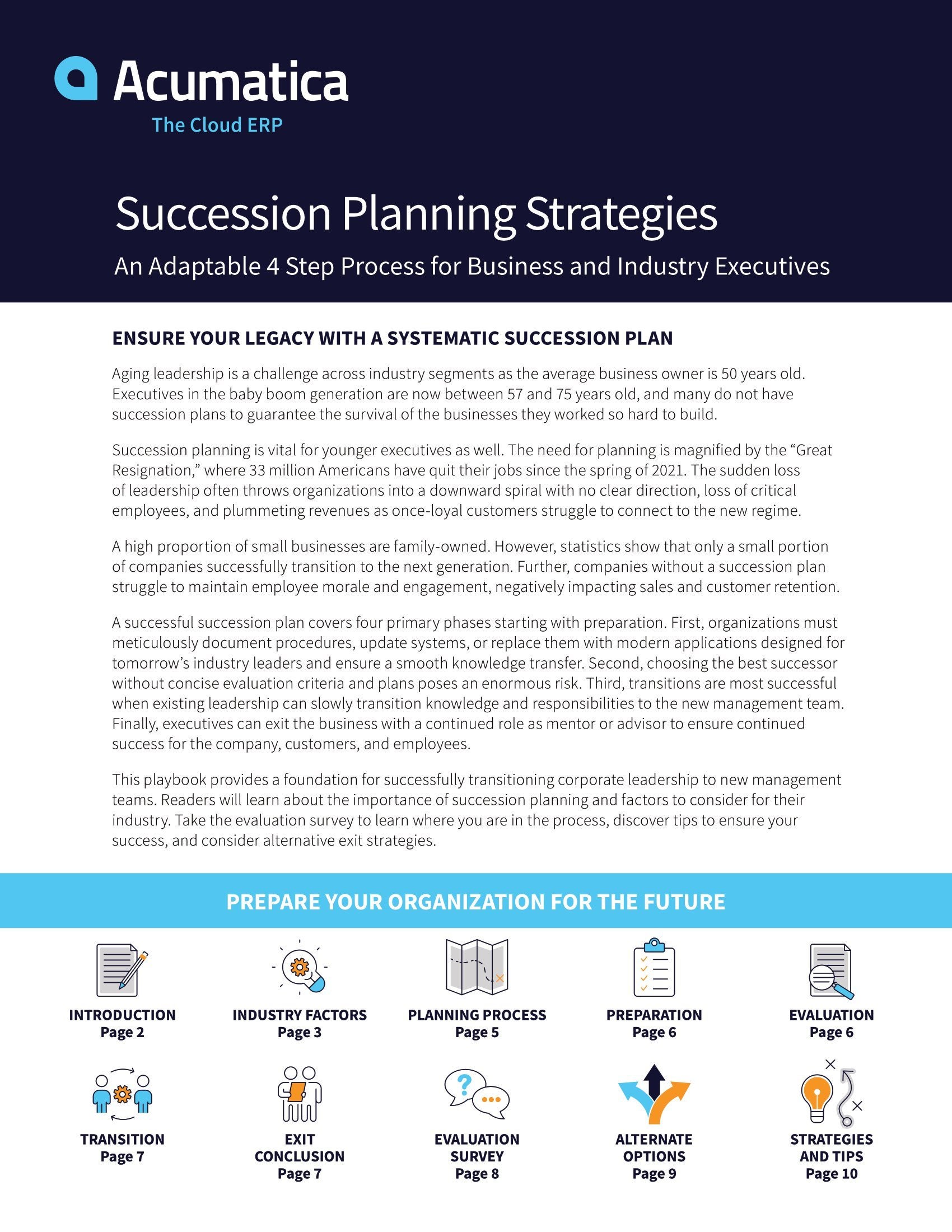
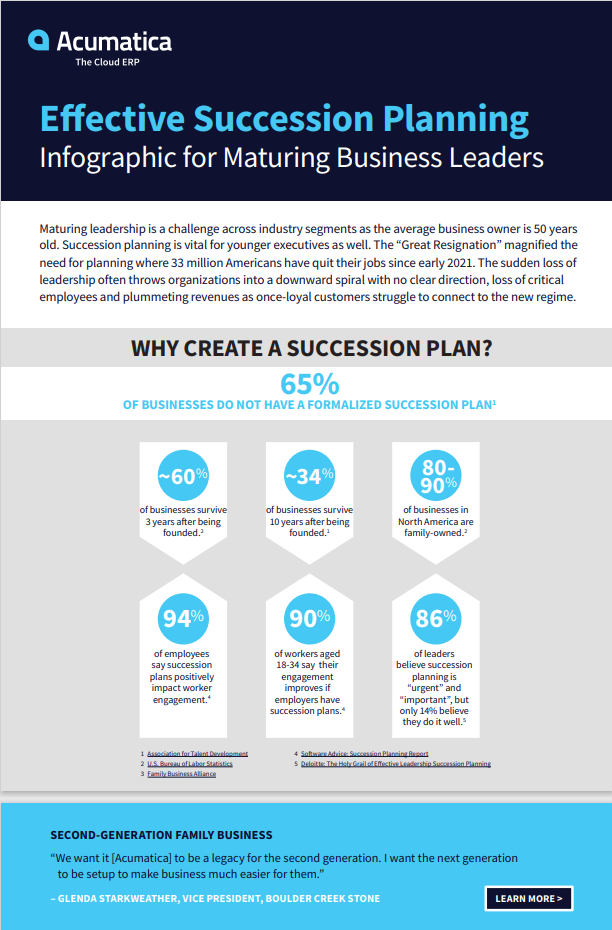
Aging leadership is a challenge across industry segments as the average business owner is 50 years old. Executives in the baby boom generation are now between 57 and 75 years old, and many do not have succession plans to guarantee the survival of the businesses they worked so hard to build.
Succession planning is vital for younger executives as well. The “Great Resignation” magnified the need for planning, where 33 million Americans have quit their jobs since the spring of 2021. The sudden loss of leadership often throws organizations into a downward spiral with no clear direction, loss of critical employees and plummeting revenues as once-loyal customers struggle to connect to the new regime.
A high proportion of small businesses are family-owned. However, statistics show that only a small portion of companies successfully transition to the next generation. Further, companies without a succession plan struggle to maintain employee morale and engagement, negatively impacting sales and customer retention.
A successful succession plan covers four primary phases starting with preparation. First, organizations must meticulously document procedures, update systems, or replace them with modern applications designed for tomorrow’s industry leaders and ensure a smooth knowledge transfer. Second, choosing the best successor without concise evaluation criteria and plans poses an enormous risk. Third, transitions are most successful when existing leadership can slowly transition knowledge and responsibilities to the new management team. Finally, executives can exit the business with a continued role as mentors or advisors to ensure continued success for the company, customers, and employees.
An effective succession plan covers four primary phases starting with preparation. First, meticulously document procedures, update systems, or replace them with modern applications designed for tomorrow’s industry leaders and ensure a smooth knowledge transfer. Second, choose the best successor using concise evaluation
criteria. Third, slowly transition knowledge and responsibilities to the new management team. Finally, exit the business with a continued role as a mentor or advisor to your successor to ensure continued success for the company, customers, and employees.
“We want it [Acumatica] to be a legacy for the second generation. I want the next generation to be setup to make business much easier for them.”
Introduction to succession planning
Why is succession planning so important?
According to the U.S. Bureau of Labor Statistics, only 36 percent of businesses survive ten years, and only 12 percent make it to their twenty-sixth year. In fact, less than one percent of companies reach the century mark.
According to the U.S. Bureau of the Census, about 90 percent of American businesses are family-owned or controlled, with an average lifespan of just 24 years. Less than half make it to the second generation, and only 13 percent make it to the third generation.1
Founders and owners across industry segments are aging. For example, the average age for finance, insurance, and real estate business owners is 54 years. Other industry segments with owners over 50 years of age include wholesale trade, agriculture, forestry, fishing, mining, services, public administration, and manufacturing. Conversely, construction, retail trade, and transportation industries have younger ownership with an average age of less than 50 years.2
Succession planning is vital for older business owners. However, succession planning has manybenefits for younger business executives. For example, a 2015 Software Advice survey concluded that 94 percent of employers said a succession plan positively impacts employee engagement.
Succession plans inspire younger workers between 18 to 34 years old. A survey revealed that 90 percent of younger workers would “improve” their engagement level if a clear succession plan were implemented. However, 29 percent of businesses did not have plans defined.3 Other benefits include improved training and employee development, brand integrity protection, lower employee turnover, reduced recruitment costs, and risk mitigation. Below is additional research supporting the importance of succession planning.
• 86% of leaders believe succession planning is an “urgent” and “important” priority, yet only 13%
believe they do it well.4
• Only 35% of organizations have a formalized succession planning process.5
• 40% of family business owners expect to retire. But of those planning to retire in less than
five years, less than half have selected a successor.6
1 Source: Cornell University: SC Johnson College of Business
2 Source: Experian: Providing more insights into the small business owner
3 Source: Pivotal Advisors: What’s Your Succession Plan?
4 Source: Deloitte: The Holy Grail of Effective Leadership Succession Planning
5 Source: Association for Talent Development: Succession Planning – Is Your Organization Prepared?
6Source: Conway Center for Family Business
Industry factors
Industry succession planning concerns
Transitioning leadership strains every business, with each facing unique challenges. In addition, successful transition plans must meet the specific needs of the company’s industry. For example, construction owners should transition leadership in slower winter months instead of busy summer months. Accountants may transition later in the year to avoid busy tax seasons. Likewise, retail and commerce owners may want to avoid transitions during peak sales around the holidays. Industry concerns also impact what owners need to do to prepare for the change. For example, communication and utility executives should update emergency plans, so the successor knows what to do when disaster strikes. Similarly, executives working in equipment-intensive industries
like manufacturing, transportation, and distribution should update or replace equipment to reduce distractions during the succession transition process.
“Upon flipping the switch for go live with Acumatica, we were receiving orders, our trucks were out on the road, all was well; we were drinking champagne.”
Planning process
Four steps to successful succession transitions
Every succession plan follows four general steps —preparation, evaluation, transition, and exit. Preparation is vital to ensure key employees and staff are ready for the change, systems are updated or replaced with modern and intuitive applications, and transition processes are defined clearly. The second step sets criteria to evaluate potential successors and establishes the evaluation process and timeline. Next, the outgoing executive transitions power to their successor. The most successful transitions allow exiting executives to work alongside their successors before leaving
the organization. Finally, outgoing leadership mentors their successor with periodic oversight to safeguard business operations.

STEP 1: PREPARATION
Prime Management and Update Systems and Processes
Retain critical employees and fill open positions. Talk candidly with employees about the succession plan. Next, consider replacing ineffective managers and promoting staff. Then, evaluate essential business processes. Document procedures and consider simplifying or automating complex procedures where possible. Set yourself up for success by upgrading business applications, purchasing modern and intuitive ERP software like Acumatica, and fixing or replacing aging equipment. Throw away unnecessary files and consider renovating or adding office space and rearranging the warehouse or plant floor.
STEP 2: EVALUATION
How to Find the Best Possible Successor
Many family-owned businesses have children or younger relatives in mind to take over. However, sometimes children have no interest and pursue a different career path. In other cases, the next generation may not be ready to take control of the organization. Bring them into the organization early and expose them to different business areas. Mentor them to become leaders and teach them about business practices and daily operations. Consider hiring an experienced CEO in cases where a
younger family member is not ready to take control. If no heir is apparent, consider top managers for the role, transfer the organization to your employees, or hire a reputable recruitment firm to identify potential candidates. Create a job description listing the attributes of the ideal succession candidate.
STEP 3: TRANSITION
Arm Successors with Knowledge and Feedback
Create executive dashboards and critical reports and inquiries that help your successor. Work alongside your successor for at least six months before exiting the business. Train your successor on systems and equipment. Meet with them often to discuss policies, procedures, and changes to the organization. Slowly remove yourself as the leader in meetings and give them more face time with employees. Monitor their progress and offer constructive feedback to help them along. Assess the successor’s performance and survey managers. Take corrective actions for issues and publicly praise your successor’s accomplishments. If the successor continues struggling, you may need to consider replacing them and starting over. This is another reason it is crucial to begin the planning process early.
STEP 4: EXIT CONCLUSION
Stepping Away for Good
A thorough succession plan enables owners and executives to step away from the organization, knowing the business they worked so hard to build is positioned for success. Some retired executives retain a minor role while others start enjoying their retirement. Maintaining relationships with the successor is advisable. Owners may maintain a presence on the company’s board of directors to oversee business results and track potential issues using mobile access to dashboards, reports, and notifications.
“With Acumatica, everything is in one database. I do not have to close out the payroll module then close out the job costing module to update costs. What used to take a full week to do, can now be done in 20 minutes.”
ALTERNATE OPTIONS
What to Do When You Cannot Find a Successor
Business owners may not have children or relatives interested in taking over the business when they retire. Other executives struggle to identify an outsider in time for their planned or untimely exit from the company. Below are three alternative options to consider.
TRANSITION OWNERSHIP TO EMPLOYEES
Transfer the business and assets to a single employee, group of employees, or all employees as part of an employee stock ownership plan (ESOP). Consult with a professional financial planner, trusted CPA, and business attorney for questions and assistance.
SELL THE BUSINESS
Sometimes it is best to sell the business to a third party. This could be a competitor or any individual interested in owning a business with the financial means to acquire the company. Be cautious to protect loyal employees and customers. Sales agreements may include legal clauses to guarantee employment for staff.
LIQUIDATE BUSINESS ASSETS
Your best choice may be to liquidate assets and close the business. This strategy is typical for smaller companies in industries with declining market share with no clear successor where there is no interest from an outside acquiring company.
STRATEGIES AND TIPS
Improve Your Chances for a Positive Transition
Executives and owners improve their chances of success by implementing strategies that support the transition process. Further, slight changes make it easier to transition business leadership from generation to generation or executives outside the organization. Look to peers and trusted business associates for advice and assistance.
• Give Yourself Ample Time
• Commit to the Process
• Be Transparent and Honest
• Do Your Research
• Use Technology to Your Advantage
• Select the Best Candidate No Matter What
• Know the Value of Your Business
• Get Outside Help
Protect Your Legacy with Acumatica, a Future-Proof, Cloud ERP Application
Aging business owners often struggle to transition their business to the next generation. Unfortunately, few family-owned businesses make it to the next generation and fewer make it to the third generation. Lack of succession plans disrupts business operations, hurts employee morale, and causes a lack of continuity that frustrates customers and limits growth.
The four-step succession plan prepares executives to manage their transition effectively. First, prepare business systems and management for the change. Next, set successor candidate criteria and identify the best possible person to take over when you leave. Finally, work with your successor during the transition period and
continue to mentor them and evaluate their performance after your departure.
Modern ERP applications like Acumatica improve succession planning by providing an intuitive user interface, robust features, and a friendly mobile application for younger leaders. In fact, Acumatica is consistently highly rated for usability by industry analysts and customers alike. Further, role-based dashboards, configurable workflows, and actionable reports and inquiries empower leaders with real-time information to manage the entire business.
Acumatica delivers unparalleled value to small and midmarket organizations. Integrated workflows span the full suite of business management applications, from Financials, Project Accounting, and Inventory Management to CRM. Specialized industry solutions include Construction Edition, Manufacturing Edition, Retail Edition, and Distribution Edition. Acumatica is built on a future-proof platform with open architecture for scalability, ease of use, and rapid integrations.
“We’re seeing tangible and intangible results. Tangibly, we’re seeing better inventory control. That obviously goes straight to the bottom line. Intangibly we have an up-tick in customer satisfaction. We can get answers much faster then we were ever able to get in our previous system. ”