Canada (English)
 Colombia
 Caribbean and Puerto Rico
 Ecuador
 India
 Indonesia
 Ireland
 Malaysia
 Mexico
 Panama
 Peru
 Philippines
 Singapore
 South Africa
 Sri Lanka
 Thailand
 United Kingdom
 United States

Retail dynamics and technologies
The retail industry is undergoing significant transformation, driven by consumers who increasingly demand convenience, personalization, and service around their shopping experience. In fact, 90% of shoppers are more likely to choose a retailer based on convenience than any other factor.1
Far less frequent are the days of traditional retail, with customers browsing in-store shelves for items, taking them to the front register, and waiting in line to pay with cash or a credit card. Now, current technology enables buyers to purchase anywhere, receive goods anywhere, and return items anywhere. Hence, retailers must allow consumers to research, buy, pick up, and return goods as easily as possible—in-store, over the phone, online, via kiosks, and with a frictionless engagement process. Whether selling to consumers (B2C), commercial customers (B2B), or directly from the manufacturer to end-user (D2C), this is the essence of an omnichannel sales model.
Technology is vital for suppliers to efficiently stock, sell, deliver, and refund/exchange goods in this rapidly evolving environment. Technology is just as crucial to manage internal business processes. Growing retailers who use entry-level accounting or legacy ERP systems must modernize customer-facing and internal business operations to remain competitive.
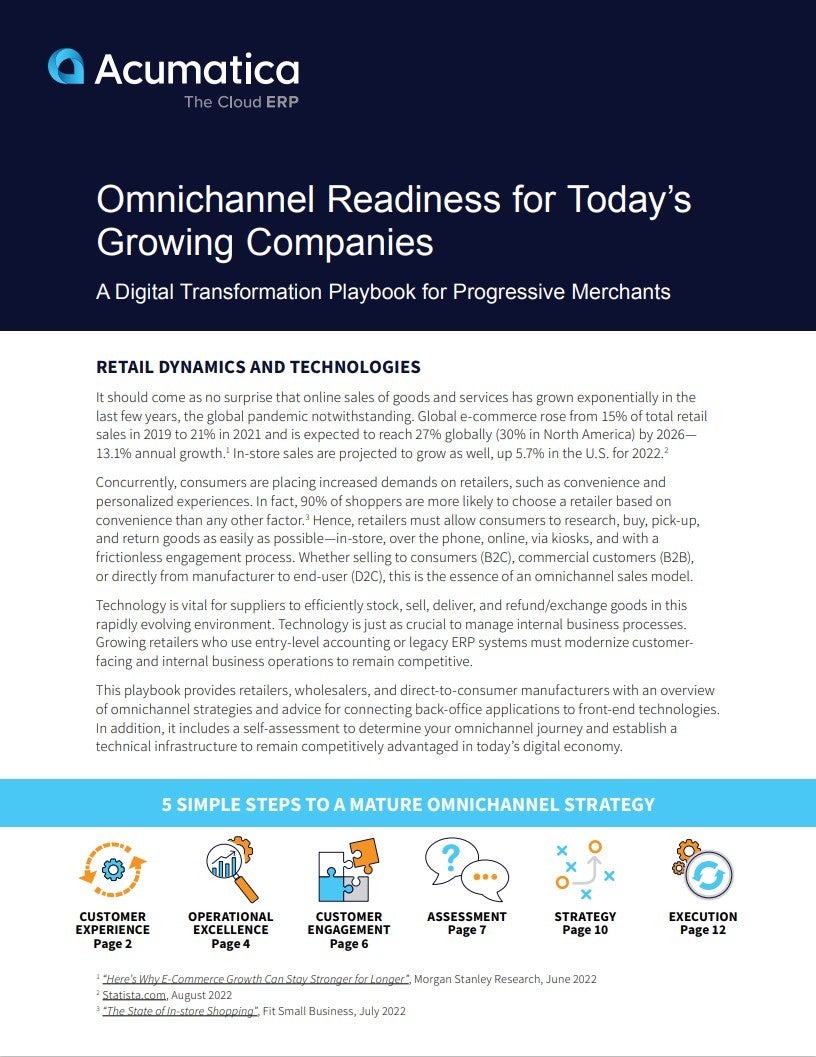
This solution brief provides merchants who sell to consumers with an overview of omnichannel strategies and advice for connecting back-office applications to front-end technologies. In addition, it includes a self-assessment to determine your omnichannel journey, with technical infrastructure recommendations to remain competitively advantaged in today’s digital economy.
For a deeper understanding of omnichannel requirements and transformation factors, please read the companion playbook to this brief, “Omnichannel Readiness for Today’s Growing Companies.”
Omnichannel Success Factor #1
Superior Customer Experience
Consumers expect simplified access to product and inventory visibility across all channels—online and offline. They want the ability to research online before buying in-store, buying online and picking up goods in-store (BOPIS), and returning goods either online or at any of the merchant’s brick-and-mortar retail sites. Additionally, these transactions must be transparent, intuitive, and frictionless for consumers as they navigate multiple channels.
Inventory Availability
Consumers routinely check item levels before venturing out to the store or placing an online order. They are unlikely to visit a retailer if in-store inventory is not available online.
Modern business systems such as Acumatica:
- track real-time inventory levels across all stock locations and warehouses,
- reserve stock allocations for firm orders,
- support lot and serial number traceability for regulatory compliance,
- minimize inventory obsolescence with “first-expired-first-out” item rotations (FEFO),
- have bi-directional data flows between commerce websites and back-end systems for accurate reporting and customer trust.
Delivery Date Estimates
Aside from inventory data, consumers expect to know how long they must wait for an out-of-stock product to become available. This is known as the “available-to-promise” date.
Make certain that ERP systems support:
- automated inventory replenishment with integrated purchasing and vendor tracking,
- dashboards to show vendor lead times with event-based notifications,
- connected CRM systems for keeping customers updated on their order status.
Product Information
Consumers conduct online research when contemplating a purchase, and they require ubiquitous product information across channels. Product data must include item descriptions, images, color/size/style options, pricing with shipping and taxes, and peer user reviews.
Modern ERP systems such as Acumatica integrate directly with webstores, marketplaces, and POS devices to deliver:
- full item descriptions with attached photos,
- customer-specific pricing, promotions, and discounting,
- real-time shipping options and tax rates,
- product variant SKUs (e.g., color-size-style).
Customer Self-Service
One of the biggest reasons for shopping cart abandonment associated with online purchasing is the cumbersome checkout process. Top omnichannel brands have empowered consumers with expedited checkout online and self-checkout in-store.
Look for ERP systems that support multi-channel ordering, accurate real-time inventory levels, and dynamic tax and shipping quotes. And, for consumers to buy anywhere, receive anywhere, and return anywhere, merchants must harmonize their business processes across all channels within a single IT stack.
“It’s a challenge for small organizations like us to meet, but customers expect it. You need to have a tool like Acumatica that’s integrated with all the other tools you have in place to meet Amazon-level consumer expectations.”
Omnichannel Success Factor #2
Operational Excellence
Supporting multiple sales channels requires a well-executed operational strategy. This includes training front-line staff to properly implement omnichannel programs. A leading analyst firm reports that 80% of retailers claim that training in-store staff to pick, pack, and ship online orders was a challenge. Order fulfillment and return processes must be embedded into the fabric of the work and streamlined across departments using automation and workflows to operate efficiently and profitably at scale.
Inventory Accuracy
Shoppers want updated, accurate inventory information on the products they seek. The key questions for merchants to provide include, “how much stock is available, from where, and how can I receive it?”, as well as “how long must I wait for an out-of-stock item to become available, and how do I get it?”
Cloud-native applications such as Acumatica:
- automate data capture in the warehouse, with mobility-enabled barcoding,
- automate stock replenishment, cite forecasted delivery dates, and offer shipment options that suit each consumer,
- integrate inventory data with sales orders, vendors, warehouses, and finance to orchestrate order-to-cash processes.
Perfect Order Rates
Perfect orders—those received “on time” to the correct location, with all goods included and undamaged—are a test of retailers’ ability to fulfill consumer purchases reliably. It is a direct input into profitability and customer satisfaction.
Acumatica enables high perfect order rates via:
- standard workflows and approvals,
- automated inventory replenishment,
- advanced support for directed pick, pack, and ship activities,
- dashboards and exception reporting to resolve obstacles before final shipment.
Omnichannel Fulfillment
A successful omnichannel strategy centers on successful fulfillment principles. Fulfillment models include buying online and picking up in-store (BOPIS), shipping to the local store, shipping from the store, and curbside delivery.
Acumatica connected to webstores and POS devices can:
- manage inventory visibility across warehouses and shelf spaces,
- keep buyers informed of expected goods with Available-to-Promise algorithms,
- detail training and learning materials for staff in a document management module,
- integrate inventory data with sales orders, vendors, warehouses, and finance to orchestrate order-to-cash processes.
Customer Communication
When changes to an order or delivery date occur, merchants must notify consumers promptly and with recommended actions. Validating order changes, change of address notifications, and returning goods also need to be confirmed with buyers. It is imperative for retailers to have a robust CRM system to facilitate customer communication. Acumatica CRM is natively integrated with the core ERP.
- E-mail and SMS communications can be managed directly from CRM,
- Purchase history, past complaints, and customer contacts provide a holistic view of consumers to best support their needs,
- Create, expedite buyer issues within CRM.
Discover Why Retail & Commerce Firms Rely on Acumatica for Digital Transformation
Omnichannel Success Factor #3
Customer Engagement
Customer satisfaction and operational excellence involve order and fulfillment success, customer engagement aims to bring interaction with consumers to the fore. Examples of engagement include a contextualized mobile application, endless aisle capabilities, and promotions around loyalty programs, gift cards, and order personalization.
“We still take 30 percent of orders on the phone, and we need to interact with customers quickly. We need to look them up, create new customers, add items, take credit cards, and we’ve scripted a lot of that because the customer doesn’t want to wait while we process their credit card or enter data.”
Mobile Application
It is common for shoppers to use their smartphones to search for available coupons while inside a store. Mobile applications that can automatically send coupons to consumers proactively will engage customers where they are—and increase sales simultaneously.
Likewise, price-matching a competitor’s advertised cost has the benefit of keeping consumers aligned to your brand with unrefusable offers. Performing price comparisons online and through point-of-sale (POS) devices empowers buyers to feel they are receiving extraordinary service on behalf of the retailer.
Some innovative brands offer a virtual reality experience for shoppers who are buying apparel or home goods, so they can visualize how products will look on their person or in their living room before actual purchase.
To deploy these features, demand business management software that has:
- a comprehensive mobile application,
- strong web-based APIs to integrate with online shopping sites, coupon aggregators, virtual reality tools, and other forms of consumer engagement automation,
- customer-specific pricing to offer special discounts to the most profitable customer groups.
Endless Aisle Options
Consumers who come into a physical store and see their desired item is out-of-stock are inevitably disappointed. Merchants can address this effectively with an ‘endless aisle’ kiosk. It allows shoppers to search and order products from the retailer’s entire portfolio, whether or not items are sold in-store or not. It also provides information on expected stock deliveries and users can reserve such stock for a future pick-up in-store or home shipment.
ERP backbones must support an online shopping experience at endless aisle kiosks, featuring:
- inventory visibility,
- mobile order management,
- direct webstore interactions including real-time tax and shipping options.
Promotions and Personalization
Promotional discounts, loyalty programs, gift cards, and order-related services like engraving and custom messages also engage customers with a brand. Plan to reward engaged customers with preferred pricing and loyalty benefits. Know how shoppers affect your bottom line with role-based dashboards, flexible financial reports, and engagement scores from CRM transactions connected into the ERP system of record.
Assessment
Where Are You in Your Omnichannel Journey?
Every retailer is different, and so too is their omnichannel journey. Merchants on entry-level accounting systems have few tools to connect systems. Established retailers on legacy ERP systems also have difficulty connecting to today’s technologies and web-based marketplaces. Your software needs will vary depending on your industry, the types of products you sell, and your customers’ preferences. Complete the self-assessment survey to determine where you are today and what next steps you should take.
Current State Survey
For retailers and wholesalers who sell via multiple sales channels (online, in-store, phone, kiosk, etc.), complete the survey below. Count your checkmarks and enter the totals at the bottom.


Note: Please refer to the “Omnichannel Readiness for Today’s Growing Companies” playbook for details on strategy and execution to move your omnichannel forward based on these assessment results.
“When we switched to Acumatica, it really created a seamless experience for our consumer because our data accuracy, our inventory, and the way we communicated with our customers was in one spot and created a single source of truth. Our department could spend less time monitoring the backend and more time creating marketing content to grow the brand.”
Transform Omnichannel Operations with Acumatica, the Cloud ERP
A well-coordinated omnichannel sales strategy is essential for retailers, wholesale distributors, and manufacturers who sell directly to end-users to thrive in today’s digital economy. Unfortunately, entry-level business applications and legacy ERP software force many merchants to limit their ability to adequately fulfill orders and delight customers.
Brands need to understand how modern technologies can positively transform their businesses through automation to streamline operations, reach consumers where they are, bolster sales, cut costs, and improve customer satisfaction and loyalty.
A disciplined strategy is critical to the success of a brand’s digital transformation. The strategy establishes a solid foundation, provides research, and defines priorities for the modernization plan. In addition, a four-phased execution approach ensures system and process implementation success.
Acumatica is designed for omnichannel sales organizations. Acumatica provides native connectivity to commerce sites, marketplaces, in-store point-of-sale devices, and external applications for a singularly transparent view of activities across the company and with customers. Acumatica provides the best business and industry management solution for transforming your business to thrive in today’s fiercely competitive retail market.
And tomorrow’s.
“We’re implementing actions and a forum on our site, which we couldn’t do before. We wanted it for years and years, and there is a long list of marketing things we can do now that we couldn’t before.”