Canada (English)
 Colombia
 Caribbean and Puerto Rico
 Ecuador
 India
 Indonesia
 Ireland
 Malaysia
 Mexico
 Panama
 Peru
 Philippines
 Singapore
 South Africa
 Sri Lanka
 Thailand
 United Kingdom
 United States

Guidelines for Companies Seeking to Capitalize on an IPO
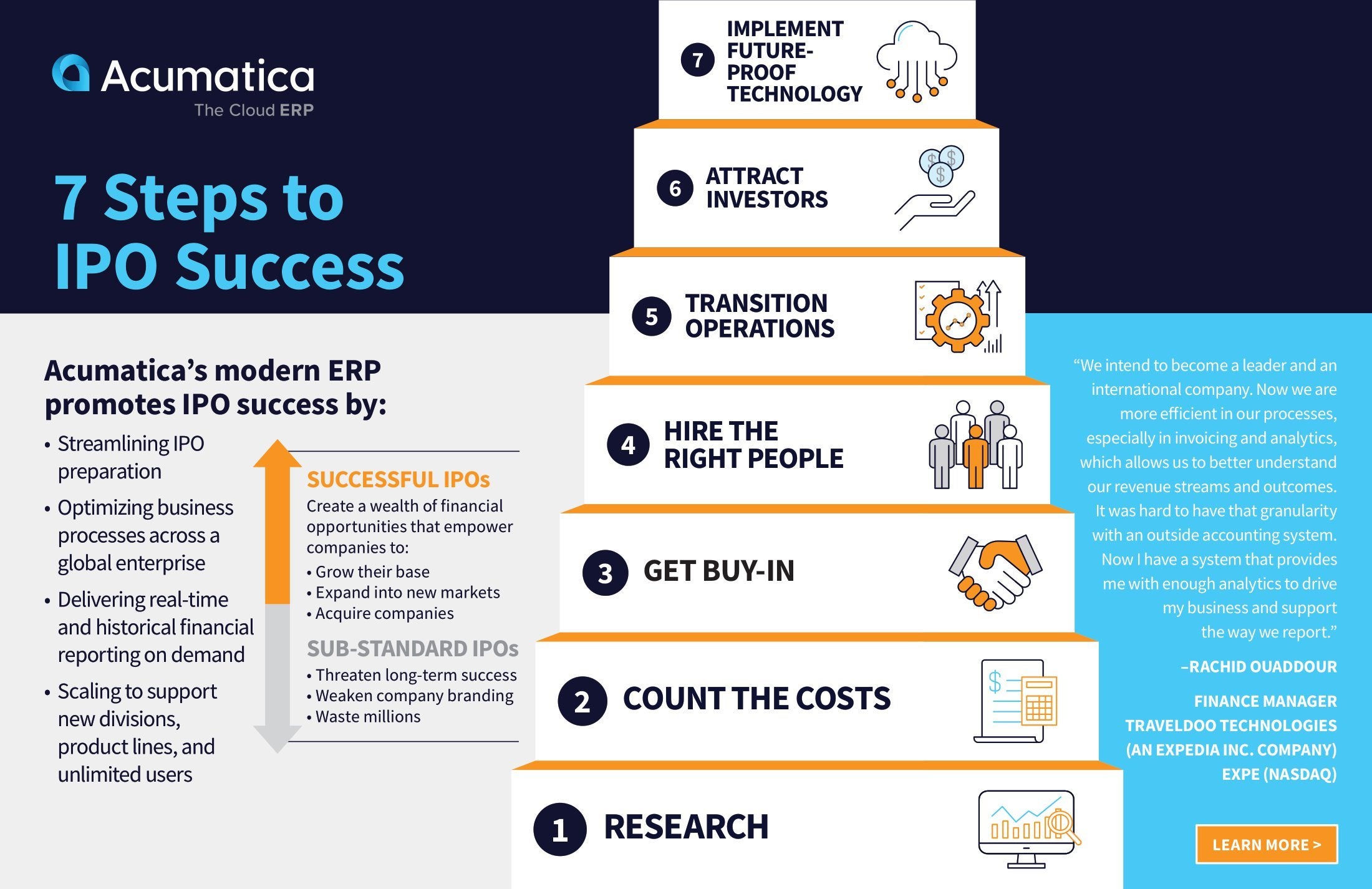
Transforming from a private company to a public one poses enormous risks but offers even greater rewards. Successful initial public offerings (IPOs) can turn an obscure company into an overnight sensation, serving as a rallying cry for enthusiastic investors eager to attach themselves to a rising star. The corresponding cash windfalls can empower growing companies to seize new opportunities, expand their product line, break into global markets, and acquire smaller companies.
However, preparing to launch into a stock market entails a rigorous, multi-year preparation process. U.S.-based companies can petition to join the American Stock Exchange (AMEX), New York Stock Exchange (NYSE), or the Nasdaq Stock Market. Although some filing requirements vary, each exchange requires similar preparations and offers similar opportunities.
Failing to comply with stringent federal regulations and investment bank demands can delay a launch and jeopardize growth, forcing companies to divert substantial resources to satisfy these demands. In addition, market volatility can lead to dismal short-term returns and disappoint investors.
A successful IPO hinges more on planning, preparation, and technology than popularity. Before they can participate in public markets, companies must revamp business processes, enhance senior leadership and boards, and implement new financial reporting practices. Most companies overhaul their technology infrastructure to deliver the transparency regulators and investors require, gaining operating efficiencies in the process.
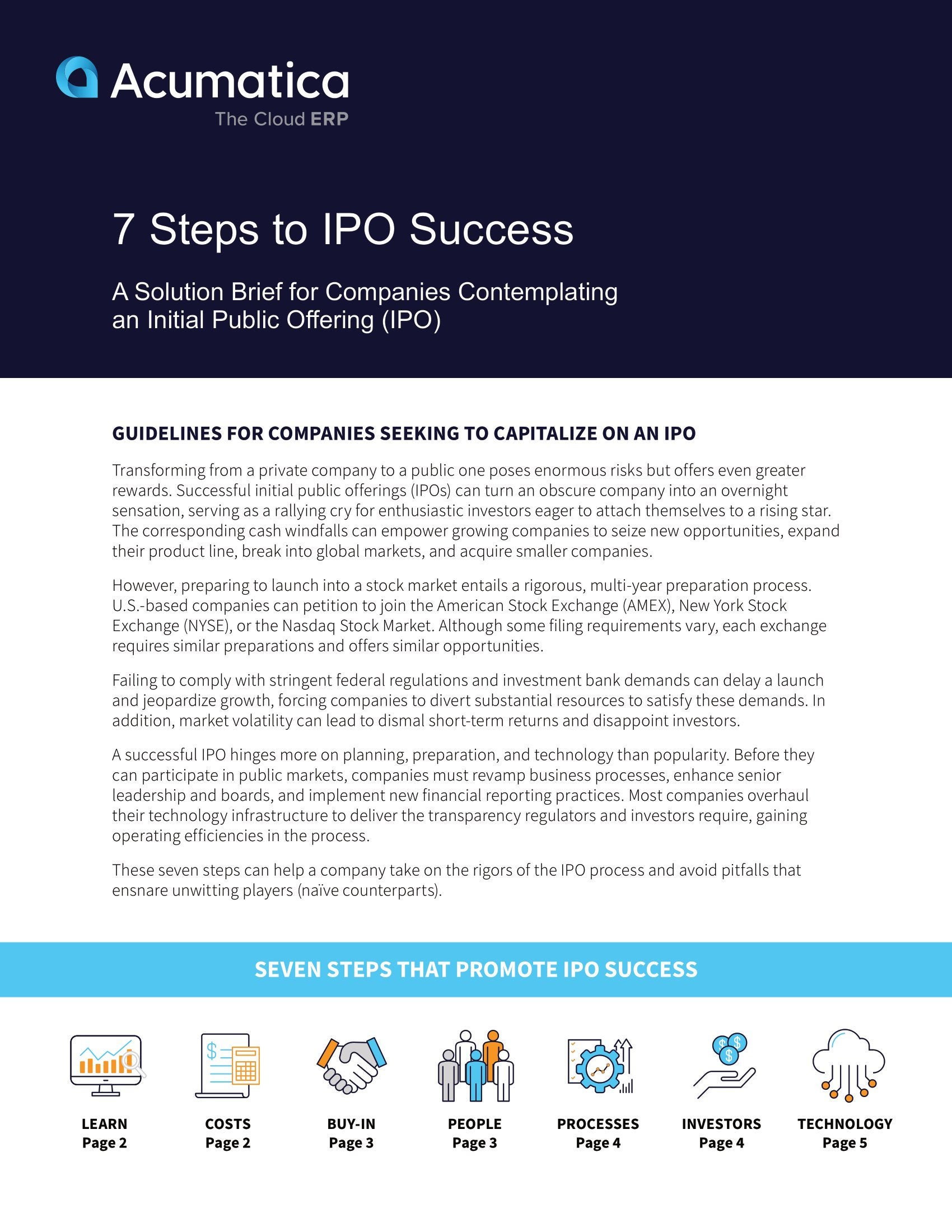
These seven steps can help a company take on the rigors of the IPO process and avoid pitfalls that ensnare unwitting players (naïve counterparts).
Strategy #1
Learn Before Leaping into the IPO Preparation Process
High-profit margins put companies in a great position to consider an IPO, but profitability alone cannot ensure success. Remember, preparation matters more than popularity. Achieving IPO success requires overhauling core business operations and meeting rigorous federal requirements and investor expectations.
Start researching requirements at least three years before you plan to file with the Security Exchange Commission (SEC). It often takes two to three years to prepare for the IPO and transition technology and business practices to meet public company requirements.
Identify the company’s long-term goals and determine how an IPO promotes them. Estimate an IPO’s impact on the company’s growth trajectory and how it compares to private company projections. Analyze the industry, market conditions, and performance of comparable public companies and competitors. Research answers to the following questions:
- How open are investors to companies with a comparable size and product line?
- What is the addressable market?
- Can you differentiate your company, business model, and track record from competitors?
- How strong are your risk controls?
- Can the infrastructure support a public company’s reporting requirements?
Although launching an IPO does not guarantee stellar growth, the additional liquidity and brand awareness can help a company penetrate new markets, expand its infrastructure, and attract top talent.
Acumatica’s future-proof platform creates sustainable, transparent processes that help companies fulfill IPO and public company demands while reducing risk and improving decision-making.
“Financially, everything is easier to track and manage in Acumatica. We’ve connected everything together in Acumatica, giving us an efficient way to manage the business.”
Strategy #2
Count the Costs
Smooth transitions do not just happen. Every aspect of the IPO journey incurs significant costs and risks. Going public puts company finances, business processes, and leaders under a magnifying glass.
Satisfying federal IPO requirements requires an extensive process that can cost millions and take two years or so. For example, companies must revamp business processes, expand their workforce and board, and implement modern technology to meet the demands of a public entity.
As a result, companies can no longer afford to rely on disparate systems to gather and process data. Instead, they must analyze data across their enterprise in real-time. Off-the-shelf accounting software may provide performance data, but can it predict growth, conduct future and historical performance analysis, and produce a plethora of custom reports—in real-time?
Companies should consider a two-fold approach as they start evaluating their operations against public company requirements. Number one, they should assess their systems’ ability to meet SEC and Sarbanes-Oxley (SOX) reporting requirements as well as Public Company Accounting Oversight Board (PCAOB) practices. Number two, they should pursue the best digital transformation practices for streamlining operations. Modern applications on a future-proof ERP platform can set private companies up for long-term public company success.
Acumatica’s robust reporting engine automatically supports strict financial reporting requirements while providing 360 views of the enterprise.
Strategy #3
Get Stakeholder Buy-In Early
Successful IPOs require widespread support from employees, external partners, and board members. Therefore, IPO-related decisions should also stem from consensus. Business leaders must garner widespread support among management, board members, and partners.
Once they win over internal stakeholders, leaders should seek support from external players, such as underwriters, industry thought-leaders, analysts, independent auditors, attorneys, and the investment media. Basically, they must prove the company can sustain ongoing growth by:
- Targeting a sizable, addressable market
- Offering competitive products and services
- Maintaining a proven track record
- Satisfying quarterly growth projections
- Presenting a focused business plan
- Compiling a public-ready management team
- Displaying strong financial, operational, and compliance controls
- Following sustainable business practices
- Demonstrating a favorable environmental, social, and corporate governance (ESG) profile
Companies need a value proposition that shows they are ready to take the market by storm with leading-edge offerings, competent management, and a promising market plan. Buy-in revolves around solid performance and robust reporting. Finance teams must detail revenue, costs, and equity to meet SEC and investment bank requirements and stand ready to explain each point. ERP solutions can showcase the company’s accomplishments by generating comprehensive reports while streamlining operations.
Acumatica’s modern ERP solution streamlines IPO preparation by integrating and optimizing business processes across a global enterprise.
Strategy #4
Put the Right People in the Right Places
Leaders driving a private company’s success often do so with deep industry expertise. However, they often lack IPO and public company experience. Transitioning into a public company requires adding new roles and expanding leadership, which builds credibility with potential investors, as well as adds leaders with IPO experience.
Companies need internal team members and third-party consultants to navigate IPO complexities, mitigate risks, and convey the company’s value. Prioritize diversity. Diverse teams produce better results and garner favor with regulators and industry analysts. Make sure your team includes the following:
Internal Team Members with IPO Experience
- CFO or Comptroller, or Finance Director
- Financial Analysts with reporting expertise
- Attorneys/Regulatory Specialists
- Board Members
- Investor Relations Manager
- Business Transformation Program Manager
External Partners
- Underwriters
- Sell-side Analysts
- Independent Auditors
- IPO and SOX Advisors
- Tax Advisors
- Investor Relations Firm
Acumatica’s role-based access delivers employees and partners immediate access to real-time financial and operational data in personalized reports while keeping sensitive data confidential.
“Once we launched, it was amazing. During the first month, we billed $1.7 million straight out of Acumatica and closed the month in 45 days. Then, in January, it only took 30 days to close, February 15 days, and March was five days.”
Strategy #5
Start Transitioning Business Processes
Public companies must comply with a myriad of financial, operational, and HR-related regulations that require detailed rigor across the organization. As a result, an aspiring company should start operating as a public company at least 18 months before its IPO, so it can troubleshoot issues that jeopardize IPO success while learning how to navigate compliance challenges.
For example, public companies must report on numerous factors, such as finances, data retention, industry-specific operational procedures, HR practices, and employee dynamics. The process kicks off when the company files an initial S-1 registration statement with the SEC. Then leaders must respond to multiple rounds of SEC inquiries and demonstrate compliance with strict Sarbanes-Oxley Act (SOX) and Public Company Accounting Oversight Board (PCAOB) rules. Creating transparency across operations helps achieve and prove compliance. Unfortunately, the disparate systems many companies use to manage different operations cannot produce the transparency and real-time reports necessary for compliance. In addition, many firms lack the internal controls they need to identify compliance risks. Therefore, IPO candidates must implement a cross-functional, holistic approach encompassing people, processes, and technologies.
Acumatica eliminates functional silos by integrating external and internal systems into a cohesive technology stack and converting real-time and historical data from each system into data-driven insights. As a result, companies can create on-demand reports that monitor ongoing business results and support federal and state reporting requirements.
“We intend to become a leader and an international company. Now we are more efficient in our processes, especially in invoicing and analytics, which allows us to better understand our revenue streams and outcomes. It was hard to have that granularity with an outside accounting system. Now I have a system that provides me with enough analytics to drive my business and support the way we report.”
Strategy #6
Generate Investor Enthusiasm
Being wildly popular in a niche market drives success in private companies but does not guarantee a successful IPO. Prospective companies need a value proposition that appeals to the broader investor community and a well-defined business model that highlights their resilience and agility. Fortunately, working closely with sell-side analysts and investment banks can help them paint an appealing financial picture as long they continue to hit their revenue targets despite market fluctuations. Meanwhile, the investor relations team can help tell their story to a broader audience via analyst meetings, media placements, and eventually, an IPO roadshow.
In addition, companies entice investors when they demonstrate solid competitive standing in a sizable and addressable market. Interested investors will look for a public-ready management team, strong financial and operational controls, corporate governance, and sustainable business practices. Financial transparency and robust reporting are also critical.
Acumatica aggregates financial data from software and hardware systems, breaking down data by specific dimensions, such as product line, store, and customer size. Auditors receive compliance proof and can drill down for a complete history.
Strategy #7
Implement Technology that Promotes Long-Term Profitability
Becoming a publicly-traded company and attracting investors revolves around robust financial reports. Companies need to automate scheduled and on-demand reports that prove they meet all government and stakeholder expectations. Financial reports must provide clear audit trails for all entries and follow best practices, such as Generally Accepted Accounting Principles (GAAP). GAAP presents the framework for reporting elements companies draw from to satisfy SEC and investment bank requirements, such as income statements, balance sheets, and cash flow statements.
Businesses that utilize disconnected systems cannot generate comprehensive, real-time financial reports. Nor can they visualize end-to-end operations. In addition, disparate applications and manual tasks erode bottom line profits with inaccurate financial data and resource-intensive labor. As a result, standard month-end close processes and financial reports are lengthy and error-prone, with users struggling to reconcile conflicting information.
Acumatica’s modern ERP platform equips companies with the tools to comply with strict SEC and SOX reporting requirements and provide all IPO stakeholders with real-time access to detailed financial and business information. The solution delivers user-defined reporting on multiple financial parameters as well as supports GAAP and International Financial Reporting Standards (IFRS) for sales tax, use tax, and value-added tax (VAT), fixed asset depreciation rules, and financial regulation—at users’ fingertips. Users can also drill down to research the underlying transactions.
To launch a successful IPO, private organizations must transform their infrastructure, processes, and business model. In addition to fueling growth, they must continually optimize operations and connect diverse functions via a centralized tech stack.
Acumatica provides the flexibility that public companies need to enter new global markets, as it supports different languages, base currencies, and country localizations. The cloud-based platform enables organizations to scale to support new divisions, product lines, and unlimited users. In addition, businesses can leverage the open architecture to rapidly merge new applications, devices, and branches into their ERP platform without disrupting operations.