
 Canada (English)
 Colombia
 Caribbean and Puerto Rico
 Ecuador
 India
India
 Indonesia
 Ireland
 Malaysia
 Mexico
 Panama
 Peru
Peru
 Philippines
 Singapore
 South Africa
 Sri Lanka
 Thailand
 United Kingdom
 United States
 AcumatiCares


Growing a Mechanical, Electrical, and Plumbing (MEP) contracting business is an exciting journey. You celebrate winning more and larger bids and hiring talented new team members. However, rapid growth brings new operational demands that basic accounting software was never designed to handle.
As your firm takes on more ambitious projects, operational complexity understandably increases. Coordination intensifies, risks compound, and financial exposure expands across the board. What once worked perfectly for a smaller team becomes increasingly difficult to manage across multiple job sites, crews, and service lines. Basic accounting systems do a wonderful job of tracking financial transactions, but growing firms require real-time operational visibility to stay aligned and in control.
If your team feels overwhelmed by manual data entry and disconnected spreadsheets, you are not alone. This overview explains why growing MEP contractors need more than basic accounting tools to meet more complex demands, and how a unified construction ERP solution empowers everyone to collaborate, innovate, and protect project margins.
How Growth Changes System Demands
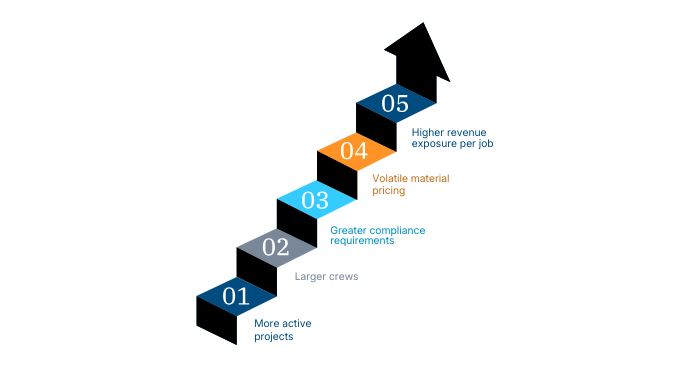
Scaling an MEP business fundamentally changes how you need to manage information. Your team must manage more projects at the same time, coordinate larger crews, meet stricter compliance requirements, track changing material costs in real time, and handle higher revenue per job—making it more important to protect your margins.
When you manage a few projects, project managers may be able to get by with tracking progress in their heads, on a whiteboard, or on a simple spreadsheet. When you manage dozens of complex builds, relying on memory, delayed, or disconnected data creates severe operational risks.
Where Basic Accounting Software Reaches Its Limits
Basic accounting platforms are built to record transactions safely, not to provide continuous operational visibility. Because these systems lack construction-specific field tools, they force growing businesses to rely on fragmented workflows.
When you reach the limits of a basic accounting system, your team typically experiences:
- Limits and confusion from disconnected project and financial systems.
- Manual job cost updates that waste valuable time.
- Spreadsheet-based reporting that breaks easily.
- Delayed field-to-office communication.
- Limited real-time cost visibility.
- Reactive decision-making based on outdated or fragmented information.
The Power of a Unified Construction ERP Solution
A unified construction ERP solution is designed from the ground up to deliver continuous operational visibility, rather than just historical financial reporting. By connecting your entire business in the cloud, an ERP solution breaks down data silos and gives your team the accurate information they need exactly when they need it.
Firms that upgrade to a complete ERP solution enjoy:
- Integrated project and financial management.
- Real-time job cost tracking.
- Live reporting dashboards.
- Connected field-to-office workflows.
- Continuous cost visibility.
- Proactive margin control.
Operational Impact Comparison
You can see real differences in how MEP contractors operate when they transition from basic accounting tools to a unified construction ERP solution. While simple, transaction-focused software may keep your business moving day-to-day, it often holds your team back as projects and expectations expand. Contractors using a purpose-built ERP solution benefit from streamlined collaboration, improved efficiency, and real-time operational visibility.
The table below illustrates how a unified system transforms day-to-day performance:
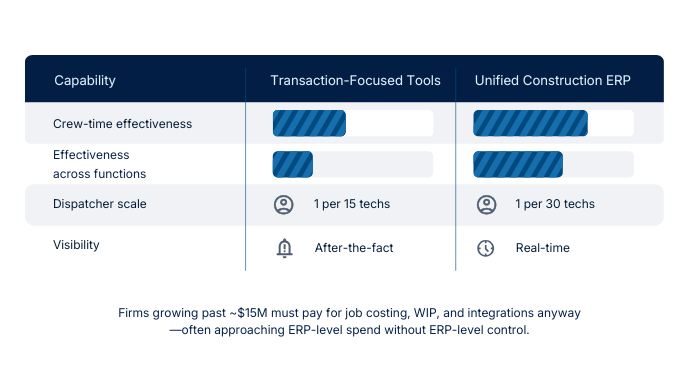
As projects grow in both size and complexity, advanced job costing, work-in-progress reporting, and layered software integrations become necessary. Over time, the cost of maintaining disconnected tools can approach that of a fully integrated system—without ever achieving the unified control and operational efficiency of a comprehensive construction ERP solution.
What It Takes to Scale Successfully
Scaling successfully requires much more than simply adding new software applications to your technology stack. It requires establishing greater control over the business as it expands. To thrive in a competitive market, MEP contractors need to prioritize four key pillars:
- Visibility: Gain early visibility into margin risk before it impacts your bottom line.
- Integration: Connect operational and financial data seamlessly to strengthen collaboration, improve efficiency, and eliminate duplicate data entry.
- Accountability: Maintain consistent performance management across all departments.
- Scalability: Implement systems designed specifically to handle multi-project complexity without requiring additional administrative headcount.
Take Control of Your Firm’s Future
Equipping your people with the right technology is the best way to support your firm’s ongoing success. A unified construction ERP solution empowers your team to make faster, smarter decisions while keeping operations and finance perfectly aligned. If you are ready to leave disconnected spreadsheets behind, start evaluating cloud-based ERP solutions, such as Acumatica Construction Management, that understand the unique demands of the MEP industry.
Ready to move beyond the limits of QuickBooks? Discover practical steps and real-world insights in our dedicated QuickBooks Migration Guide for MEP Contractors. Explore how you can make a seamless transition to a unified construction ERP solution—empowering your business to achieve greater efficiency, visibility, and growth.


