
 Canada (English)
 Colombia
 Caribbean and Puerto Rico
 Ecuador
 India
India
 Indonesia
 Ireland
 Malaysia
 Mexico
 Panama
 Peru
Peru
 Philippines
 Singapore
 South Africa
 Sri Lanka
 Thailand
 United Kingdom
 United States
 AcumatiCares

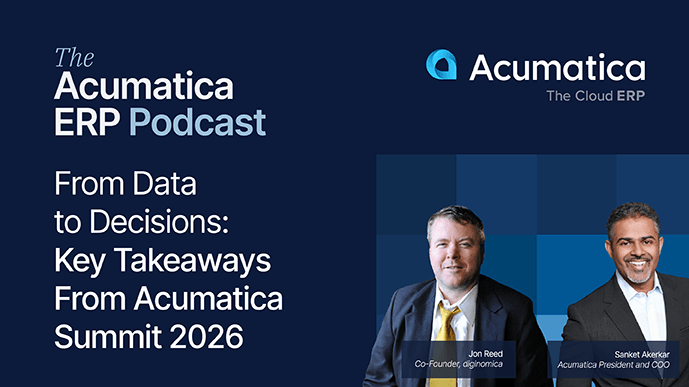
Every year, thousands of Acumatica Community members gather together during Acumatica Summit, and frequent Summit attendee and industry influencer Jon Reed, co-founder of diginomica, has seen the growth of this flagship event. His interest in Acumatica—as with every technology vendor he reviews—stems from his passion for giving customers truthful guidance so they can get their real-world digital transformations right.
During Summit 2026, Jon sat down with me for Episode 6 of The Acumatica ERP Podcast, generously taking time out of his busy schedule to share his thoughts on:
- What Acumatica does right (and could be doing better) at Summit and as an ERP company.
- How the future of ERP is being impacted by AI.
- How AI is helping customers transform their abundant but disconnected data into strategic, business-growing decisions.
Here’s what he along with Acumatica President and COO Sanket Akerkar—who joined me at the end of the discussion—had to say.
Acumatica Summit, Data Quality and AI, and ERP as a Foundation for Success
For Jon, the appeal of Acumatica Summit starts with understanding what attendees want and need. This includes concise keynotes that allow customers the time to attend the in-depth training and breakout sessions. Summit’s success also relies on engaged and enthusiastic partners.
According to Jon, there were a few key themes populating customer conversations but data (and how to act on it) as well as AI topped the list. As a self-proclaimed AI geek with multiple AI certifications, Jon explains that the focus on AI has put the ERP industry on notice.
“I think it’s healthy because it challenges ERP vendors to say, ‘Okay, well, why are we valuable?’”
ERP’s value, Jon believes, lies in being the technological foundation for customers who are seeking to excel in their industries while also balancing challenges with talent, the need to do more with automation (which may or may not include AI), and ensuring data quality. For Acumatica customers, Jon says Acumatica is not just ERP software but a platform.
“That’s what I like about what Acumatica does,” Jon says. “It puts people in a position where they can start thinking about consuming AI based on quality data and yes, good processes. Because if you don’t have that, if you put AI on top of bad data and data processes, you are going to get a bad result.”
Acumatica’s belief in the importance of providing quality data was on full display during Summit, but Jon points out that quality data doesn’t solve every problem. Still, he acknowledges that ERP solutions help generate insights that customers can use to run their businesses more efficiently and effectively.
“I don’t have a problem with the notion that these systems can really help us do our jobs better, but a lot of it is how we enable our technology. And one thing Acumatica gets totally right in their messaging is this not about replacing humans for the most part. This is about helping humans do their jobs better, and I love that messaging.”
What Else Acumatica is Getting Right (And What We Could Do Better)
In addition to recognizing that Acumatica sees technology as a way to empower—not replace—humans Jon points out a few other things Acumatica is doing that sets us apart in the ERP market. For instance, Acumatica’s consumption-based pricing and our emphasis on listening to as well as being transparent with our customers.
“Acumatica has a Customer Bill of Rights, which includes you own your own data. And how many vendors have a Customer Bill of Rights? Two that I know of, and Acumatica was first. And the ownership of data turns out to be critically important for AI.”
Keeping data ownership in the hands of our customers is key to ensuring they can store, access, and use it anytime and from anywhere, and our embedded AI tools help them analyze their data so they can make mission critical decisions. But we understand that with AI comes a huge responsibility to keep their data secure, and Jon highlights our transparent Principles of Innovation.
“A lot of vendors could say we do responsible AI but only a handful that I know of have anything like [Acumatica’s] principles of innovation.”
Jon’s acknowledgement of Acumatica’s strengths also includes our annual Hackathon that kicks off Summit every year. We don’t, however, make this a huge selling point, and he says we should.
“There’s very, very few ERP business conferences that I know of that start with a hackathon. Why is that a big deal? Well…first of all, you need a robust developer community if you really want to have a platform around your software.
“Also, the hackathon brings the developers and the business community together and, and this year most of the hackathon participants didn’t even code. They did most of it with AI and low code. And the winner didn’t code at all.”
Real-World Acumatica Success
During the podcast discussion, Jon talks about the complex requirements small and midsized businesses (SMBs) deal with to produce their complex offerings and how ERP solutions can help uncomplicate it all. Take, for example, Acumatica customer Venture Engineering who is constantly rolling out new business models and services.
Jon spoke to Director Andy Williamson at Summit about why the UK-based company chose Acumatica. According to Williamson in Jon’s article about Summit 2026, it was Acumatica’s flexible platform, which they easily modify with help from their integration partner, Cedar Bay.
“I asked him, ‘Have you had to build anything yet?’ He said, ‘Nope. Acumatica’s system was flexible enough [that] we’ve been able to adapt it to everything that we’ve had to do to expand and grow our business.’”
The ability to grow without coming up against rigid software is something Jon says doesn’t happen very often.
Acumatica: Adaptable and Transformational
For Jon, “future proof” is a buzzword and one that he’s not a fan of. “I am a fan…of being agile, being resilient [and] being able to face different circumstances. And Acumatica, I think as well as any software, puts its customers in a position where, as environments change (there’s a new tariff, there’s a new tax, whatever), you can adapt your business.”
This adaptability is crucial in a time when AI is transforming industries. Jon says companies are going to have to have the hard conversations around data, culture, and processes. They’re also going to need to select partners that will help them take advantage of quality data and utilize AI for better decision making without being responsible for it, thus allowing them to focus on what they do best.
“I think one of the things that Acumatica is doing very well, and I’m really looking forward to tracking their progress this year as the (AI) assistant gets released and all of that, is seeing how they can really embed this in the workflows of the roles and the industries that Acumatica serves, and then the SMB person doesn’t have to think about, oh, I’m getting left out of the AI revolution.”
Jon had much more to say (listen to the full podcast, and read his other article on Summit 2026 for additional insights into cloud ERP, AI, and customer realities).
Summit: An Opportunity to Learn from Customers
Sanket, who joined me at the end of the podcast, offered a few of his own insights on what customers are looking for and how Acumatica can help them achieve it.
“Customers that come here are looking to learn and find out new things to make their businesses better, how they can be more competitive, what’s the technology that’s out there that can help them go forward,” he says.
Like Jon, Sanket believes that AI is the hot topic for businesses looking to succeed, and Acumatica is heeding the call. “I’ve been hearing…a lot of positivity on not only just the industry features but really, the investment in AI, and I think the places where we’re headed, with both AI Studio and AI Assistant, were very, very compelling.”
As part of the leadership team, Sanket appreciates that Summit provides opportunities to learn about Acumatica’s innovative features and capabilities through keynotes, sessions, and face-to-face conversations.
“I learn a ton from our customers, and I think the best way to learn is to go to the source of truth, and the customer’s experience is the truth,” he says. “And I think on the other side, customers want to be heard. They want to know that there’s someone listening, someone understanding what they’re going through and being able to connect those dots, At the end of the day, they want to know that they’re being part of an ecosystem where change will happen aligned with their goals and priorities.”
If you’d like to hear more about what Sanket had to say, the full podcast is available. Also, subscribe to the podcast today so you don’t miss future episodes.