
 Canada (English)
 Colombia
 Caribbean and Puerto Rico
 Ecuador
 India
India
 Indonesia
 Ireland
 Malaysia
 Mexico
 Panama
 Peru
Peru
 Philippines
 Singapore
 South Africa
 Sri Lanka
 Thailand
 United Kingdom
 United States
 AcumatiCares


How ERP Data Improves Cash Flow Forecasting for Growing Businesses
Cash flow forecasting becomes more difficult when financial and operational data is spread across accounting systems, bank portals, sales applications, purchasing tools, and spreadsheets. Receivables, payables, payroll, taxes, inventory purchases, and capital plans change frequently, making manually maintained forecasts difficult to keep current.
Connected ERP data gives finance teams a more consistent foundation for forecasting. Instead of repeatedly exporting and consolidating information, teams can use current transaction data to evaluate expected receipts, upcoming payments, projected balances, and potential liquidity gaps.
Acumatica Cloud ERP includes a built-in 30-day cash flow forecast that shows projected cash account balances, expected customer receipts, and anticipated payments by date.
This article explains how cash flow forecasting works, which ERP data supports it, and how growing businesses can build a more reliable forecasting process. (For those newer to the topic, Acumatica’s cash flow in business guide covers foundational concepts before diving into forecasting tools and workflows.)
Key Takeaways
- Cash flow forecasting is distinct from cash positioning. Positioning reflects where cash stands today. Forecasting estimates where it will be.
- Forecast quality depends on the timeliness and completeness of input data across AP, AR, payroll, taxes, and planned expenses.
- ERP systems reduce manual work by centralizing financial and operational data that would otherwise require manual consolidation.
- Spreadsheet-based forecasting becomes harder to govern as business complexity increases, particularly for multi-entity or multi-currency operations.
- Forecasting software should cover cash account views, projected balances, scenario planning, variance analysis, and auditability.
- Automation should support human judgment in forecasting, not replace it. Finance teams still need to interpret payment behavior, timing risk, and strategic context.
What Is Cash Flow Forecasting?
Cash positioning focuses on current liquidity: what cash is available right now across accounts. Cash flow forecasting looks ahead, estimating future cash positions based on expected inflows, outflows, and timing. Both matter, but they inform different decisions.
Cash flow forecast horizons
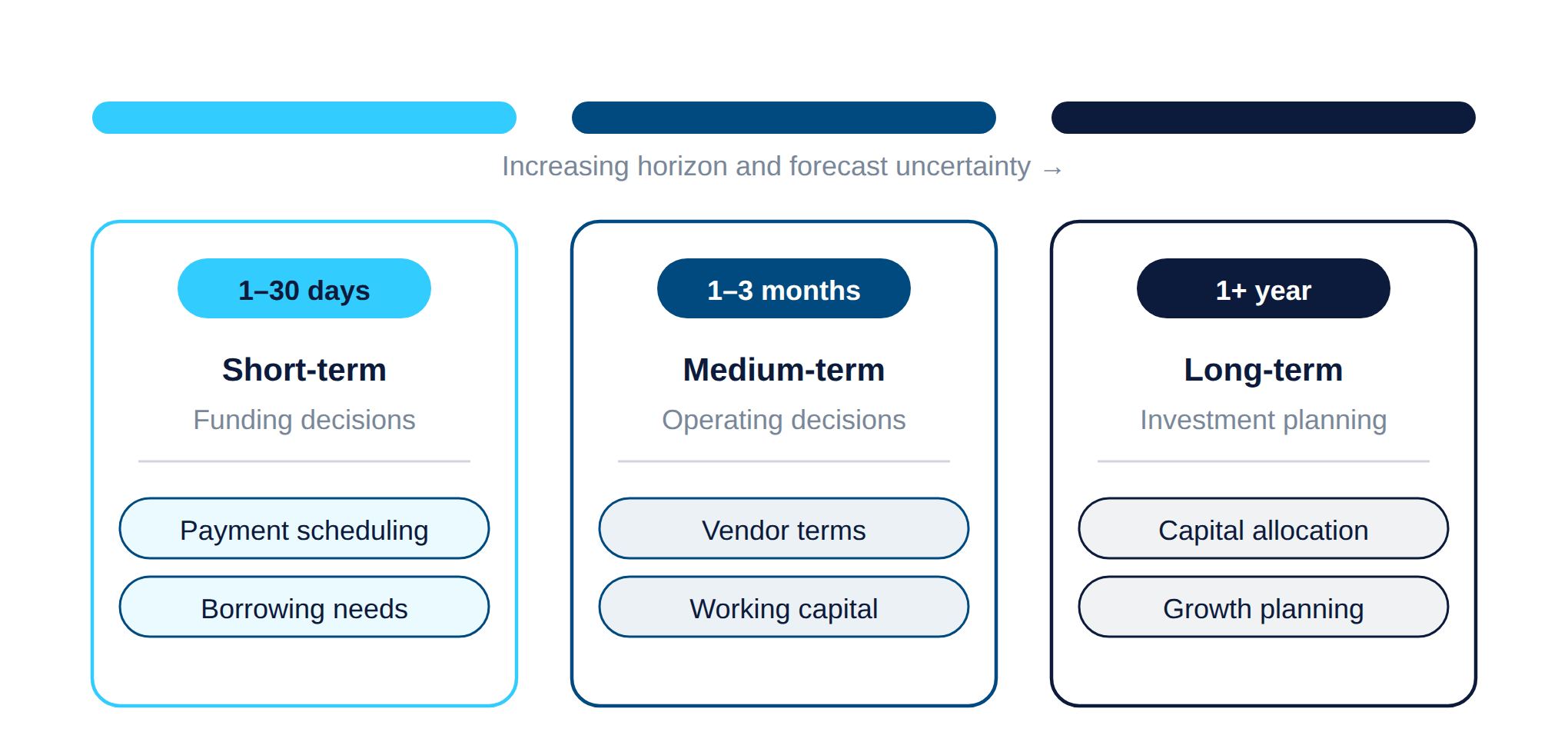
Forecast horizons vary by purpose.
Short-term forecasts, typically covering one to 30 days, support immediate funding decisions, such as payment scheduling and short-term borrowing needs. Medium-term forecasts, often spanning one to three months, inform operating decisions around vendor terms, collections, and working capital management.
Longer-term forecasts, extending to a year or beyond, support investment planning, capital allocation, and growth conversations.
Longer horizons generally carry more uncertainty. As the forecast period extends, assumptions about customer payment timing, market conditions, and operational changes become harder to validate. That is why review cadence and transparent assumptions matter as much as the data itself. A forecast that nobody revisits quickly becomes misleading rather than useful.
How Is a Cash Flow Forecast Calculated?
A basic cash flow forecast uses the following calculation:
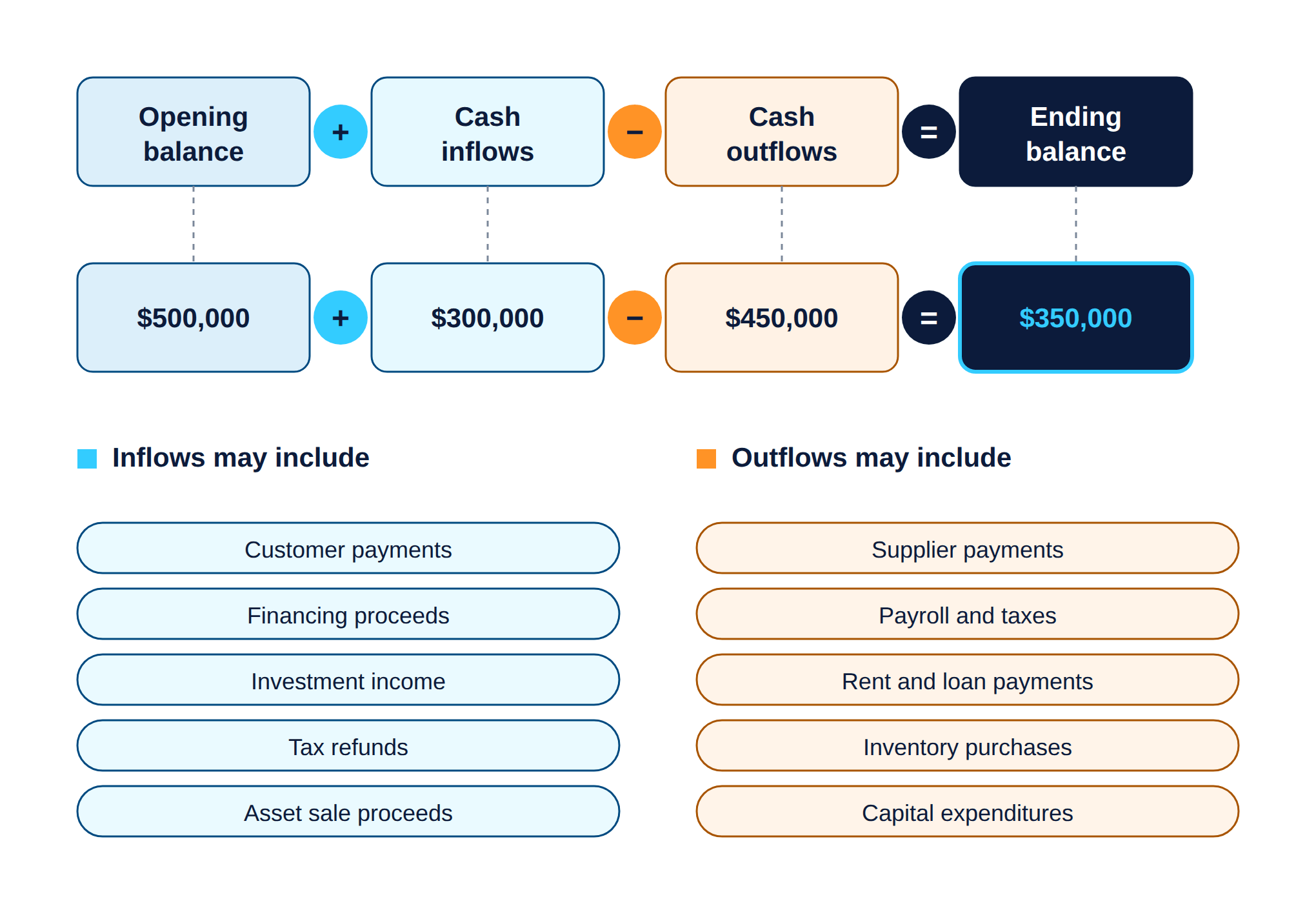
Forecast ending cash balance = Opening cash balance + Expected cash inflows − Expected cash outflows
Expected inflows may include customer payments, financing proceeds, investment income, tax refunds, and proceeds from asset sales. Expected outflows may include supplier payments, payroll, taxes, rent, loan payments, inventory purchases, and capital expenditures.
For example, a company that begins the month with $500,000, expects to collect $300,000, and expects to pay $450,000 would have a forecast ending cash balance of $350,000:
$500,000 + $300,000 − $450,000 = $350,000
ERP data helps keep these values current as invoices, bills, payments, purchase orders, payroll obligations, and other transactions change.
What Are the Direct and Indirect Cash Forecasting Methods?
The direct method forecasts individual cash receipts and payments over a defined period. It is commonly used for short-term liquidity planning because it shows when specific cash movements are expected to occur.
The indirect method begins with projected net income and adjusts for noncash items and changes in working capital. It is generally more useful for longer-term financial planning.
Businesses may use both methods for different purposes. A finance team might use a direct weekly forecast to manage immediate liquidity and an indirect monthly or quarterly forecast to support broader financial planning.
Why Cash Forecasts Need Current Data and Clear Assumptions
A useful cash flow forecast depends on timely inflow and outflow of data from bank balances, customer payment expectations, vendor obligations, payroll schedules, tax liabilities, debt service, and planned capital expenditures. Stale or incomplete data at the input stage weakens every output.
Assumptions are equally important. How quickly do customers pay? Are there seasonal patterns in collections? What are the standard payment terms with key suppliers? Are any large capital purchases planned? Transparent assumptions make forecasts explainable and easier to update when circumstances change.
A profitable business can still experience a cash shortage when the timing of receipts and payments does not align. For example, a manufacturer may need to pay suppliers and employees before collecting payment for finished orders. Similarly, a construction company may incur labor and material costs weeks before reaching a billable project milestone. A current cash flow forecast helps finance teams identify these timing gaps before they affect payroll, supplier relationships, borrowing needs, or planned investments.
How Do ERP Systems Improve Cash Flow Forecasting?
ERP systems improve cash flow forecasting by connecting the financial and operational data that affects future cash. This may include accounting, accounts payable, accounts receivable, banking, payroll, purchasing, sales, inventory, projects, and fixed assets.
When this information is maintained in one connected system, finance teams spend less time exporting, reconciling, and copying data between spreadsheets. They can instead focus on validating assumptions, investigating exceptions, comparing forecasts with actual results, and deciding how to respond to potential liquidity gaps.
The value becomes greater as a business adds entities, currencies, locations, projects, or complex payment arrangements. Connected ERP data reduces the version conflicts and reconciliation work that can arise when separate teams maintain different cash projections.
What ERP Data Is Used in a Cash Flow Forecast?
| ERP Data Source | Information it contributes to the forecast |
|---|---|
|
Bank and cash management |
Current cash balances, transfers, and completed transactions |
|
Accounts receivable |
Open invoices, expected payment dates, customer prepayments, and unapplied payments |
|
Accounts Payable |
Vendor bills, due dates, planned payments, and vendor prepayments |
|
Payroll |
Expected wages, payroll taxes, benefits, and related obligations |
|
Purchasing |
Purchase orders, supplier commitments, and expected payment timing |
|
Inventory Management |
Planned inventory purchases and cash tied up in stock |
|
Project Accouting |
Project costs, milestone billings, retainage, and expected collections |
|
Fixed Assets |
Planned equipment purchases and other capital expenditures |
|
Debt and Financing |
Loan proceeds, principal payments, interest, and other financing activity |
Not every forecast uses every data source. Finance teams should select inputs based on the forecast horizon, business model, materiality, and the decisions the forecast is intended to support.
How Do Connected AP, AR, and Cash Data Reduce Manual Work?
Accounts receivable indicates when customer payments may arrive, while accounts payable shows when vendor obligations are due. Cash management provides the current balances from which the forecast begins. Connecting these records helps finance teams compare expected receipts and payments without manually assembling data from separate exports.
Relevant transactions may include open customer invoices, vendor bills, credit and debit adjustments, customer and vendor prepayments, recurring documents, and unapplied payments. Because each item can affect future cash, missing or outdated transactions can materially change the projected balance.
Acumatica’s cash management software connects these data sources with bank reconciliation, funds transfers, and cash balance tracking. Its cash flow forecast includes released documents by default and can incorporate selected unreleased, recurring, prepaid, and unapplied documents depending on the system configuration. This gives finance teams a more complete view of expected cash movements, including transactions that may not yet be finalized.
AI capabilities are emerging in this space as well. Modern ERP platforms, like Acumatica, now include AI-assisted document recognition for AP processing, which minimizes manual invoice entry and improves the speed at which payables data flows into cash projections. Anomaly detection tools further help finance teams identify unusual transaction patterns that might affect forecast accuracy. These capabilities support the finance team’s judgment rather than replacing it.
For context on how real-time cash visibility works within a connected ERP environment, this short video walkthrough of cash management workflows illustrates what connected data looks like in practice.
Features That Matter When Evaluating Forecasting Software
Cash flow forecasting software should help finance teams keep inputs current, understand how projected balances were calculated, test different assumptions, and compare forecasts with actual results. Important capabilities include:
- Data integration with existing financial systems.
- Cash account visibility across entities and currencies.
- Scenario planning tools.
- Forecast versus actual variance review.
- Workflow automation.
- User permission controls.
- Reporting and export options.
- Multi-entity support.
- Auditability.
- Forecast assumptions and adjustment history.
- Forecast-versus-actual variance reporting.
Software that cannot meet most of these criteria will likely require supplemental tools, which reintroduces the manual coordination problem the new software was meant to solve.
The practical outcomes of well-designed forecasting software include fewer manual updates, faster refresh cycles, cleaner variance analysis, and stronger stakeholder confidence in the numbers being presented. These outcomes matter most to CFOs and controllers who need to present defensible liquidity positions to leadership, boards, or lenders.
Good forecasting software should support both near-term liquidity decisions and longer planning conversations without forcing finance teams into duplicate systems. When short-term cash management and medium-term planning live in separate tools, teams end up maintaining two sets of assumptions, which creates inconsistency and extra work.
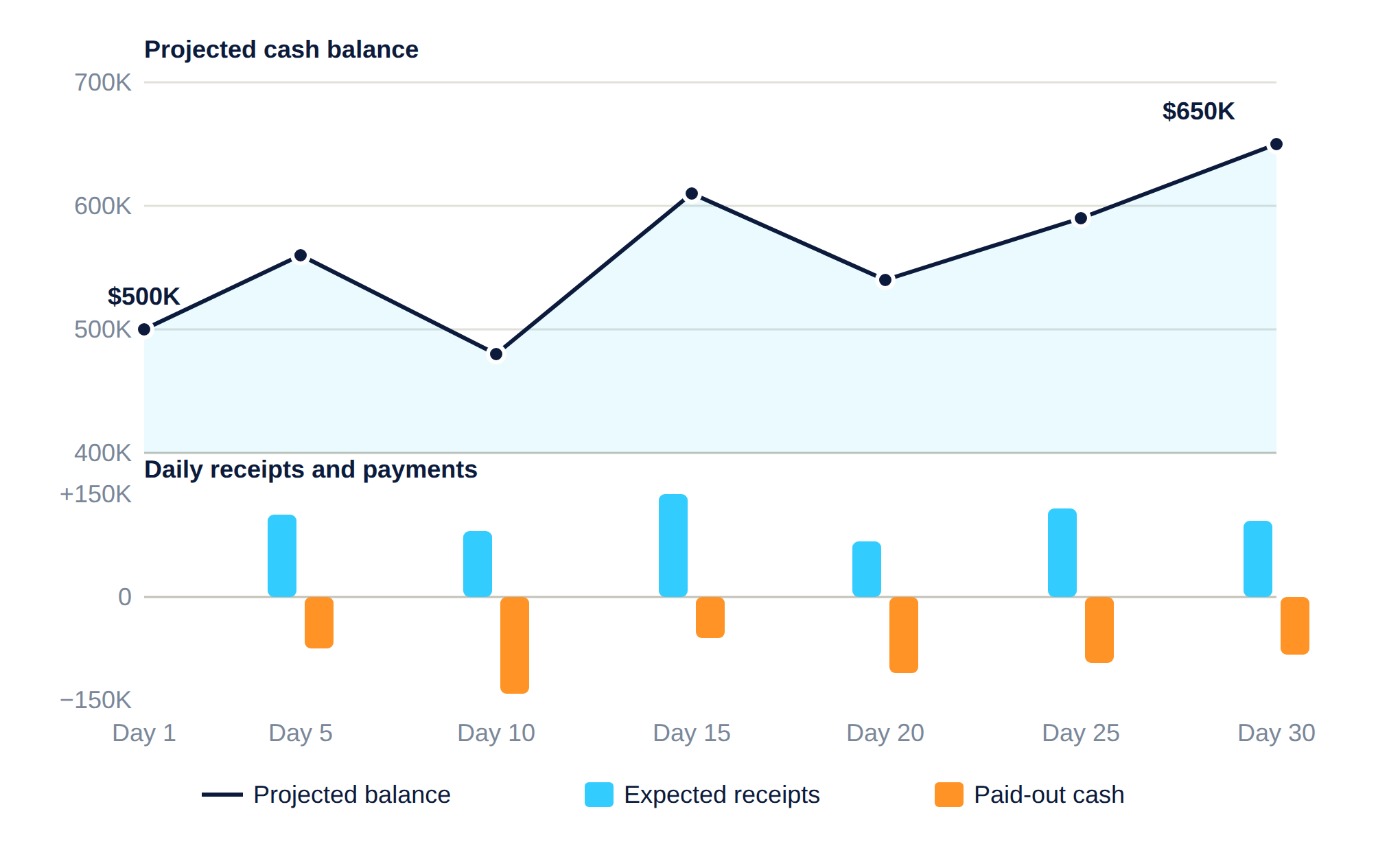
Cash flow 30 day chart
Connecting payment processing directly to the ERP environment can also improve forecast accuracy by reducing the lag between payment activity and recorded cash balances. Read Acumatica’s Solution Brief on unleashing cash flow to learn more about how embedded payments and cash flow connect.
Which Forecasting Features Support Better Decisions Daily?
A useful feature checklist for cash flow forecasting software includes:
- Cash account views: Balances viewable by account, entity, or currency.
- Projected balances: Estimated cash position by date based on expected activity.
- Expected receipts: Customer payments anticipated within the forecast window.
- Expected payments: Outgoing obligations by date, including vendor bills and recurring commitments.
- Recurring cash items: Standing obligations, like payroll, rent, and debt service.
- Manual adjustments: Ability to add or modify items not yet reflected in system data.
- Currency handling: Multi-currency conversion and revaluation support.
- Scenario planning: Side-by-side comparison of optimistic, base, and downside cash assumptions.
- Variance analysis: Comparison of forecast versus actual outcomes over time.
- Report export: Formatted output suitable for stakeholder review or audit.
Acumatica’s built-in cash flow forecast focuses on near-term liquidity. It displays projected cash account balances, expected customer receipts, and anticipated payments within a defined forecast window. Finance teams can also enter manual adjustments for expected cash movements that are not yet represented by an ERP transaction.
Businesses that require advanced long-range modeling, complex statistical forecasting, or specialized treasury workflows should determine whether built-in ERP capabilities are sufficient or whether an integrated FP&A or treasury application is also needed.
What Is a 13-Week Cash Flow Forecast?
A 13-week cash flow forecast is a rolling weekly projection of expected receipts, payments, and cash balances over approximately one quarter. It provides more detail than a monthly forecast and helps businesses identify short-term liquidity gaps, plan payment timing, manage borrowing needs, and prepare for conversations with lenders or investors.
A 13-week forecast should be updated regularly as customer collections, supplier payments, payroll obligations, and operating assumptions change. It is especially useful for businesses experiencing rapid growth, seasonal demand, tight working capital, restructuring, or significant changes in payment timing.
When Small and Mid-Market Teams Should Improve Cash Forecasting
Small and mid-market businesses (SMBs) should evaluate their cash forecasting process when growth, complexity, or reporting demands begin to outpace what their current tools can reliably support. The clearest trigger points include rapid growth across entities or locations, increasingly complex payment terms, inventory or project timing issues that create cash timing gaps, and frequent forecast surprises that leadership cannot easily explain.
Other signals include delayed financial closes, spreadsheet version conflicts between team members, and increased reporting requirements from lenders or investors. When a CFO cannot answer a straightforward question about next month’s cash position without spending hours assembling data, the process has likely become a material bottleneck.
The urgency increases when leadership needs faster, more reliable answers about whether the business can fund payroll, supplier payments, expansion plans, debt service, or seasonal working capital needs. In those situations, the risk of a delayed or inaccurate forecast directly affects operating decisions and financial relationships.
For businesses managing cross-border, multi-currency, or multi-entity operations, the complexity compounds further. Exchange rate movements, intercompany settlements, and jurisdiction-specific obligations all affect cash timing in ways that require structured, connected data to forecast accurately.
Why Spreadsheet Forecasting Becomes Risky as Teams Scale
Spreadsheets can be effective for businesses with straightforward cash flows, limited transaction volumes, and a small number of forecast contributors. The risks increase as the business adds entities, currencies, locations, products, or complex payment arrangements.
Common limitations include stale data exports, manual entry errors, inconsistent formulas, weak audit trails, and limited visibility into who changed an assumption. Separate spreadsheet versions can also make it difficult to determine which forecast is current.
These limitations do not mean businesses must eliminate spreadsheets entirely. They indicate when finance teams should consider using connected ERP data as the governed foundation for forecasting and using spreadsheets only for supplementary analysis.
How Finance Teams Can Reduce Manual Forecasting Work
Finance teams can use the following process to create and maintain an ERP-based cash flow forecast:
- Choose the forecast horizon. Use a daily or weekly forecast for immediate liquidity decisions and a monthly or quarterly forecast for longer-term planning.
- Confirm the opening cash balance. Reconcile bank and cash accounts before using them as the starting point for the forecast.
- Identify expected cash inflows. Review open invoices, anticipated payment dates, recurring receipts, sales activity, and planned financing.
- Identify expected cash outflows. Include vendor payments, payroll, taxes, rent, debt payments, inventory purchases, capital expenditures, and other commitments.
- Document assumptions. Record expected customer payment behavior, supplier terms, seasonal patterns, and one-time events that affect timing.
- Model alternative scenarios. Test the effects of delayed collections, lower sales, unexpected expenses, new hires, or major investments.
- Compare forecasts with actual results. Review forecast variances regularly and use the findings to improve future assumptions.
ERP automation reduces the time required to collect and consolidate inputs, but process ownership remains important. The finance team should establish who maintains the forecast, how often it is updated, and how variances are reviewed.
How Does Acumatica Support Cash Flow Forecasting?
Acumatica Cloud ERP provides a built-in 30-day cash flow forecast that shows projected cash account balances, expected customer receipts, and anticipated payments by date. Because cash management connects with accounts receivable, accounts payable, banking, and other ERP records, finance teams can build the forecast from current transaction data instead of repeatedly consolidating separate spreadsheets.
Depending on the system configuration, forecast calculations can include released documents as well as selected unreleased, recurring, prepaid, and unapplied transactions. Finance teams can also enter manual adjustments for anticipated cash movements that are not yet represented by an ERP transaction.
These capabilities help growing businesses maintain clearer near-term liquidity visibility, investigate potential cash gaps, and make more informed decisions about payments, collections, borrowing, and investment. Acumatica’s financial management software connects cash management, AP, AR, general ledger, reporting, and operational data in one cloud ERP platform.
A note on professional guidance: Cash forecasting processes, assumptions, data sources, internal controls, and reporting practices should be adapted to each company’s accounting policies, industry, and regulatory obligations and reviewed with qualified finance, accounting, tax, treasury, and legal advisors, especially when decisions involve financing arrangements, compliance requirements, audits, multi-entity operations, or material business risk.
Frequently Asked Questions
What is cash flow forecasting, and how does it differ from cash positioning?
Cash flow forecasting projects future cash inflows and outflows over a defined horizon (typically days, weeks, or months) to help finance leaders plan payments, borrowing, and investment. Cash positioning focuses on the current liquidity state: what cash is available right now across accounts. Growing teams need both, but forecasting is what enables proactive decision-making rather than reactive responses.
How do you calculate a cash flow forecast?
A basic cash flow forecast adds expected cash inflows to the opening cash balance and subtracts expected cash outflows. The calculation is: Forecast ending cash = Opening cash + Expected inflows − Expected outflows. Reliable forecasts also account for when each receipt or payment is expected to occur.
How does ERP data improve cash flow forecast accuracy?
ERP software connects cash, accounts receivable, accounts payable, payroll, purchasing, inventory, project, and other operational data used in the forecast. This reduces manual consolidation and helps keep forecast inputs current. ERP data improves the forecasting foundation, but accuracy still depends on realistic assumptions and regular review.
What data should be included in a cash flow forecast?
vendor bills, payroll, taxes, rent, debt payments, inventory purchases, capital expenditures, recurring obligations, and planned financing. The appropriate inputs depend on the business model and forecast horizon.
When should a growing company move beyond spreadsheet-based cash forecasting?
The clearest signals include frequent forecast surprises, spreadsheet version conflicts between team members, delayed financial closes, and leadership requesting faster answers about cash positions than the current process can reliably deliver. Spreadsheets remain useful for lightweight analysis, but they become harder to govern and audit as transaction volumes, entity counts, and reporting requirements grow.
What role does AI play in cash flow forecasting for finance teams?
AI tools can support specific parts of the forecasting workflow, such as surfacing answers to natural-language questions about expected cash positions or overdue receivables, flagging unusual transaction patterns for earlier review, automating AP document capture so invoice data enters the system sooner, and supporting demand forecasting for inventory-driven businesses. AI tools assist finance judgment; they do not replace it, and they do not guarantee improved forecast outcomes.
Can ERP replace dedicated cash flow forecasting software?
ERP forecasting may be sufficient for businesses that need connected transaction data and near-term cash visibility. Organizations requiring advanced long-range planning, statistical modeling, complex scenario analysis, or specialized treasury workflows may still use dedicated forecasting or FP&A software integrated with their ERP.


