
 Canada (English)
 Colombia
 Caribbean and Puerto Rico
 Ecuador
 India
India
 Indonesia
 Ireland
 Malaysia
 Mexico
 Panama
 Peru
Peru
 Philippines
 Singapore
 South Africa
 Sri Lanka
 Thailand
 United Kingdom
 United States
 AcumatiCares


Intro

Last Updated – March 2026
How to Choose and Implement Distribution KPIs
To measure operational performance and improve outcomes, distributors need the right tools: distribution key performance indicators (KPIs). You may already have KPIs set up for your business, but knowing which KPIs will help you prioritize decisions (especially when margins or service levels are under pressure) is challenging—and it’s only half the battle. The other half is implementing these metrics quickly, so they deliver actionable insights you can use to transform and grow your business.
But, as the saying goes, this is easier said than done.
It can be overwhelming to manage your KPIs and to know what to do with the huge amounts of data these metrics return. That’s why today we’re providing informative, easy-to-digest advice on why metrics matter, how to choose the best distribution KPIs for your business, and how Acumatica can support your vital KPI journey.
Why the Right KPIs Matter
In the simplest terms, KPIs are metrics that quantify how well your company is meeting its operational goals. Measuring specific activities that relate directly to improving business performance helps you protect margins, improve cash flow, and increase customer loyalty. Informed decision-making based on facts also improves efficiency while helping you align every department, from finance and sales to warehouse and operations, around the same objectives.
However, more is not always better. Tracking a lot of distribution KPIs can quickly lead to “data overload.” This frustrates rather than simplifies your efforts to streamline your business for the greatest results: happy employees, satisfied customers, and a strong bottom line.
The best course of action is to choose a few goal-aligned metrics that you can easily monitor, and then expand that list when data quality, quantity, and value are stable.
To ensure you’ve chosen the right metrics, make sure they still align with your corporate goals (e.g., expanding in the market, reducing costs, gaining new customers, etc.). The KPIs you track must help you meet these goals.
Let’s look at how you can acquire the most value-filled mix of KPIs for your distribution business.
How to Choose the Right KPI Mix: Strategy First
Selecting and mapping out easy-to-reach, relevant, and tangible metrics is critical to your success. So too is using the metrics and their outcomes to compare your results with your competitors’, which will help you determine your next steps.
Build a Simple KPI Tree
As you build your metrics set, one of the best ways to visualize it is by building a KPI tree. A KPI tree is a diagram that lays out your metric expectations in picture format. It ensures all departments and team members are on the same page. Because KPI trees can get complex, make sure you keep it as simple as possible.
A KPI tree should include four groups/columns, representing different levels of granularity:
-
- Objectives: The overarching corporate goals you want your KPIs to help you achieve
- Strategies: The major actions you plan to take to ensure those corporate goals are achieved
- Tactics: Separate steps that make up the overall strategies
- KPIs: The metrics you need to track to make sure your tactics are working—which means the strategies are working and ultimately means the objective is attainable
Below is an example of a simple KPI tree for distribution:
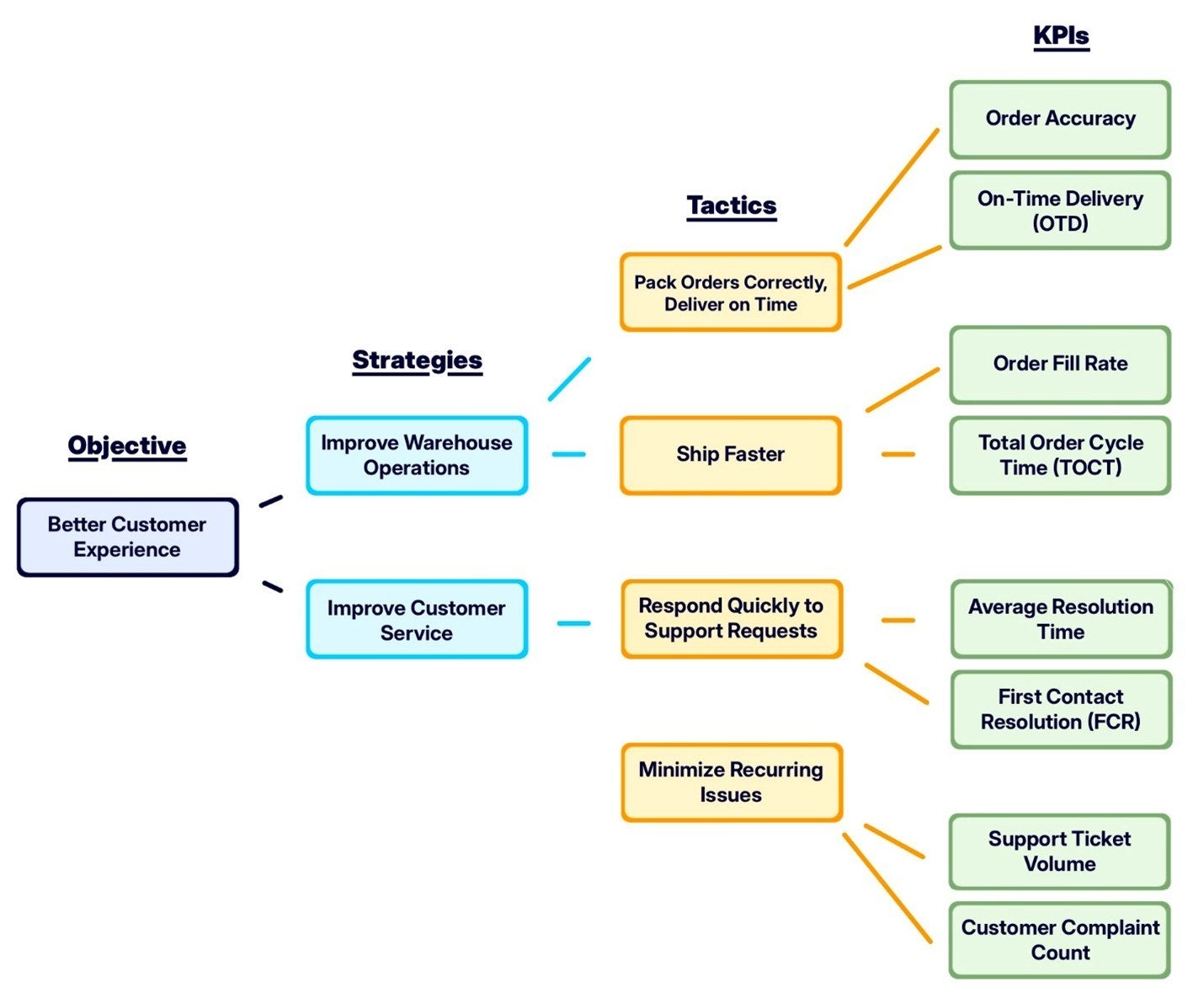
KPI Groups and Priority Metrics
At this point, you may be confident that the KPIs you’re tracking are the best ones for helping you gain real-time insights, but consider the 12 metrics below. Are there any KPIs you could add that could help you focus your attention on issues sooner and respond faster?
Financial Metrics
-
- Inventory Carrying Cost: Helps you see how much it costs for you to hold inventory (e.g., storage and insurance fees), which then helps you reduce costs, optimize inventory to prevent overstocking and stockouts, and improve purchasing and warehousing strategies.
- Days Sales Outstanding (DSO): Acts as an early warning signal about problems in your cash conversion cycle. DSO gives you the average time it takes for your customers to pay for your product. A lower DSO = positive cash flow.
- Cash Conversion Cycle (CCC): Measures the amount of time it takes you to convert inventory into cash and lets you know if you’re operating efficiently. A shorter cycle suggests you’re doing things right and that you’re in a stronger financial position.
- Gross Margin Return on Investment (GMROI): GMROI, a granular KPI, shows you how much gross profit you earn for every dollar you invest in inventory. If you want to optimize your purchasing strategies, GMROI is the way to go.
Sales & Marketing Metrics
-
- Lead Response Time: Measures the average amount of time it takes you to respond to a new lead, helping you pinpoint areas you should address to speed up the process. The shorter the lead response time the better as it greatly increases your chances of making a sale.
- Sales Cycle Length: Provides the length of time it takes for you to close a sale. Knowing this can help you improve revenue forecasting, optimize resource allocation, and, if cycles are short and smooth, improve the customer experience and secure more sales.
- Conversion Rate: Uses Lead Response Time and Sales Cycle Length to show you what percentage of leads turn into buying customers, which is, of course, the center point of profitability.
Inventory & Warehouse Metrics
-
- Inventory Turnover Rate: Helps teams see whether stock levels are keeping pace with demand, serving as an early signal to spot slow‑moving items, adjust purchasing, and free up working capital before it impacts margins.
- Order Accuracy Rate: Often viewed as an operational health signal across picking, packing, and fulfillment. You can use it to catch process breakdowns early, reduce rework, and protect service levels as volume and complexity increase.
- On-Time Delivery (OTD) Rate: Frequently treated as an exception metric. It helps teams quickly identify carrier, warehouse, or planning issues before they affect key customers, with an emphasis on fast response when trends start to slip.
Customer Metrics
-
- Customer Lifetime Value (CLV): Assesses the total amount of revenue your business can expect from a single customer for as long as they remain your customer. It can be used to optimize customer acquisition and retention investments, predict revenue, and tailor marketing and outreach to the correct audiences.
- Net Promoter Score (NPS): Acts as your company’s health gauge based on customer feedback and how likely your customers are to recommend you to others. NPS helps you identify areas where you are succeeding and where you need to make improvements. The higher the score, the higher the probability of customer retention and referrals.
Streamlining Distribution KPIs with Acumatica
To support the mix of KPIs you choose, you’ll need accurate, timely data from a single source. Trying to gather information from multiple spreadsheets and disconnected systems only leads to confusion, unnecessary complexity, and unreliable data.
With an enterprise resource planning (ERP) solution like Acumatica, you have assured data quality in a centralized database that helps you store, organize, and analyze that data. The system does much of the work for you through artificial intelligence, Generic Inquiries, reporting capabilities, and customizable dashboards.
Acumatica Distribution Edition delivers natively supported metrics, including turnover analysis, ABC rank codes to identify fast/slow movers, and dead-stock reports. With personalized dashboards, custom configurations, alerts, and workflows, you can implement an array of KPIs via Acumatica’s intelligent design. You can also:
- Use Acumatica’s built-in functionality (data capture, role-based dashboards, Generic Inquiries) and any needed integrations (e.g., Power BI) to visualize and analyze KPI measurements.
- Apply Acumatica’s trend, target, and variance alerts, standard and fully customizable reports, and collection of built-in Generic Inquiries to translate your data into confident action.
- Use automatic low-stock and late shipment alerts to quickly make corrective, customer-relationship-enhancing decisions.
Securing Distribution Success
Participating in a highly competitive, volatile marketplace requires implementing focused, strategic distribution KPIs that are aligned with your business’s goals and backed by strong data. Fortunately, with Acumatica’s comprehensive business management solution, purpose-built for the distribution industry, you can effectively manage your KPIs to gain real-time visibility as well as alerts, exceptions, and role-based insights that will help you secure a successful future.
To learn more about distribution KPIs and Acumatica, download our complimentary eBook, Distribution Metrics That Really Matter, and contact our experts with any questions.