
 Canada (English)
 Colombia
 Caribbean and Puerto Rico
 Ecuador
 India
India
 Indonesia
 Ireland
 Malaysia
 Mexico
 Panama
 Peru
Peru
 Philippines
 Singapore
 South Africa
 Sri Lanka
 Thailand
 United Kingdom
 United States
 AcumatiCares

Healthcare accounting software is a specialized financial tool designed to manage the unique billing, insurance, and regulatory complexities of medical providers and distributors.
By integrating with a Cloud ERP, organizations can automate compliance reporting, synchronize inventory with billing, and gain a 360-degree view of their financial health.
Why is Specialized Medical Accounting Software Necessary?
Healthcare institutions, whether they are hospitals, walk-in health clinics, nursing homes, extended care facilities, and medical supply and equipment providers, face financial responsibilities that go far beyond standard bookkeeping. Those responsibilities and the regulatory requirements governing them are becoming more and more complex as healthcare needs expand.
The right software addresses the specific friction points of the industry, including HIPAA compliance, complex insurance coding, and the need for rigorous inventory tracking (such as expiration dates and lot numbers).
Common Healthcare Accounting Challenges
Without a unified system, healthcare organizations often struggle with:
- Billing and Coding Complexities: Navigating provider/insurance challenges often leads to rejected claims and preventable revenue loss.
- Siloed Data: A lack of communication between staff members and disconnected software leads to errors in patient or customer data.
- Inefficient Workflows: Manual processes impede the proper gathering of information, such as insurance eligibility or co-pay amounts.
- Compliance Risks: Difficulty adhering to GAAP guidelines or tracking controlled substances can result in significant fines.
- Limited Visibility: Many legacy systems lack the financial reporting capabilities needed to compare real-time income against budgets, making profitability an elusive goal.
On top of all this, some healthcare institutions do not have the financial reporting capabilities needed to easily compare their income and expenses with their budgets. This turns profitability into an elusive goal.
Improving Patient Care and Team Engagement with Healthcare Accounting Software
Healthcare accounting software streamlines daily financial tasks, ensuring accurate management of revenue, payroll, and vendor payments.
By eliminating manual data entry, this software improves data accuracy and frees staff to focus on high-value tasks. It simplifies tax filing, provides real-time reporting, and enhances forecasting capabilities.
Key operational benefits include:
- Enhanced Visibility: Gain insights into costs per patient and overall financial health.
- Better Decision Making: Use data-driven insights to make fiscal decisions that improve patient treatment options.
- Team Engagement: Automated workflows reduce administrative burnout, improving staff satisfaction.
Why Integrate Accounting with Cloud ERP?
So, what exactly is healthcare accounting software, and how can it help alleviate these challenges?
While standalone accounting apps handle basic ledgers, a comprehensive Cloud ERP (Enterprise Resource Planning) solution like Acumatica connects financial data with operational reality. This is critical for medical distributors and retailers who must manage complex inventory alongside their books.
By integrating healthcare accounting software directly into a Cloud ERP, you unlock:
- Advanced Inventory Management: For medical distributors, Acumatica supports matrix items (managing product families by size/style), kitting, and lot/serial tracking. This ensures you can track expiration dates and manage recalls instantly, a critical compliance requirement.
- Automated Compliance: Streamline tax filing and financial reporting while maintaining data security standards required in the healthcare sector.
- Real-Time Data Access: Break down data silos. When a sales order is processed or inventory is received, the accounting impact is recorded instantly, giving CFOs and decision-makers accurate data anytime, anywhere.
- Omnichannel Integration: Connect back-office ERP features with front-end commerce applications. Whether you are selling B2B or D2C, bi-directional synchronization ensures superior order fulfillment and customer experiences.

Healthcare Accounting and ERP
Now, imagine taking the benefits of healthcare accounting software to the next level. That’s what happens when healthcare accounting software is built into a comprehensive cloud-based ERP solution.
A cloud ERP solution helps information flow between all departments and systems in an organization. It acts as a central data repository, giving users access to the same accurate, real-time information anytime, anywhere.
By integrating healthcare accounting software directly into a Cloud ERP, you unlock:
- Advanced Inventory Management: For medical distributors, Acumatica supports matrix items (managing product families by size/style), kitting, and lot/serial tracking. This ensures you can track expiration dates and manage recalls instantly, a critical compliance requirement.
- Automated Compliance: Streamline tax filing and financial reporting while maintaining data security standards required in the healthcare sector.
- Real-Time Data Access: Break down data silos. When a sales order is processed or inventory is received, the accounting impact is recorded instantly, giving CFOs and decision-makers accurate data anytime, anywhere.
- Omnichannel Integration: Connect back-office ERP features with front-end commerce applications. Whether you are selling B2B or D2C, bi-directional synchronization ensures superior order fulfillment and customer experiences.
Success Story: OneMed Healthcare
For years, OneMed Healthcare operated on a custom-built ERP system, which worked well when the company had five offices. But the system became strained when OneMed expanded to 15 offices.
“The program was struggling, and it was not designed to scale,” says Louis Hartanto, Co-Owner and Development Manager at OneMed.
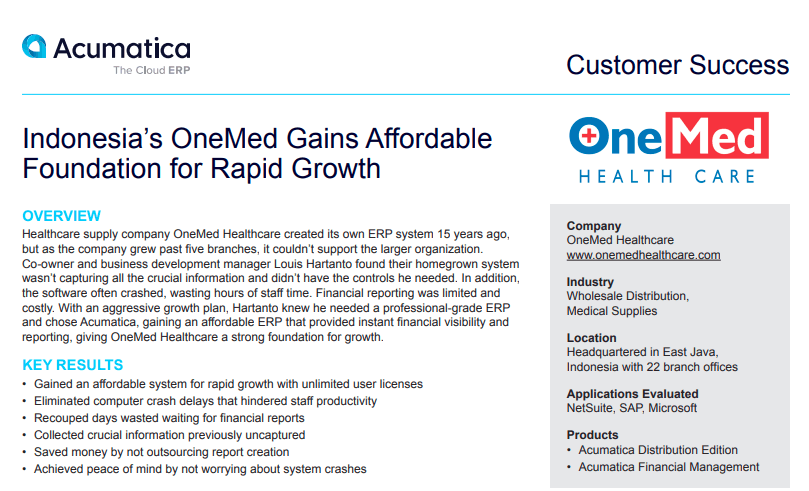
The system was never designed to handle more than 150 concurrent users or ensure high-level security, and Hartanto goes on to say that it had a habit of crashing for hours when “too much was happening inside the program.” As if these technical issues weren’t enough, the software didn’t provide financial reports, dashboards, or a sales order process—which are vital to the operations of an expanding company. All in all, it was a complicated, unproductive ERP solution, and Hartanto turned to Acumatica for help.
Now, OneMed relies on Acumatica’s affordable, mobile, and flexible cloud-based system, which provides full visibility into the company’s financials. OneMed also enjoys:
- Growing without being penalized for adding users to the ERP system.
- Easily managing its 2000+ SKUs and adding new products each year.
- Creating sales orders before invoicing.
- Staying connected through Acumatica’s mobile app.
- Tailoring the Acumatica system to its unique needs.
“We have had no problems; everything is running smoothly. Our staff spends less time inputting data now, keeping our people happy,” says Hartanto. He adds that OneMed is growing, and he believes “Acumatica will speed up our business process and make us more efficient, benefitting our business as well as the clients we serve.”
For any growing healthcare institution relying on manual accounting processes and multiple, aging systems for financial, sales, human resources, and inventory needs (and more), the importance of healthcare accounting software built into a cloud ERP solution cannot be understated.