 Canada (English)
 Colombia
 Caribbean and Puerto Rico
 Ecuador
 India
India
 Indonesia
 Ireland
 Malaysia
 Mexico
 Panama
 Peru
Peru
 Philippines
 Singapore
 South Africa
 Sri Lanka
 Thailand
 United Kingdom
 United States
AI-powered capabilities that adapt to your business and evolve with your needs

-
English
-
English
-
 AcumatiCares



Product
AI-Powered Cloud ERP Solution
Put practical, responsible AI to work across your business with an AI-powered ERP designed to enhance human expertise, automate routine work, and surface insights you can act on. Acumatica transforms ERP from a system of record into a system of intelligence.
Anticipate change and act with confidence
Acumatica delivers practical artificial intelligence directly within business workflows. From detecting anomalies and surfacing trends to automating repetitive tasks and coordinating cross-departmental processes, AI helps teams identify issues sooner, reduce manual work, and make more informed decisions.
Built for flexibility
click icon to learn more
Product highlights
Growth demands a smarter foundation. Acumatica delivers intelligent capabilities across every module, built to scale with every milestone.
Advise
Assist
Automate
Orchestrate
MCP
Advise
Spot risks and opportunities before they escalate
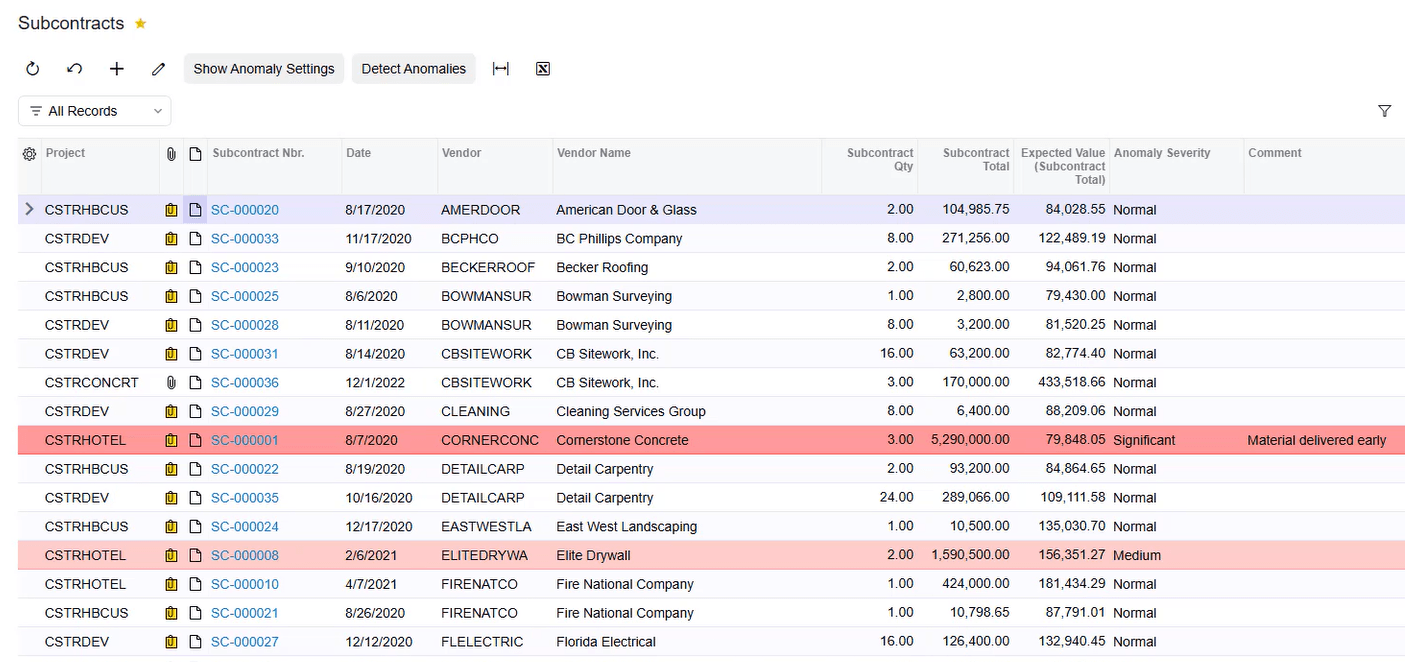
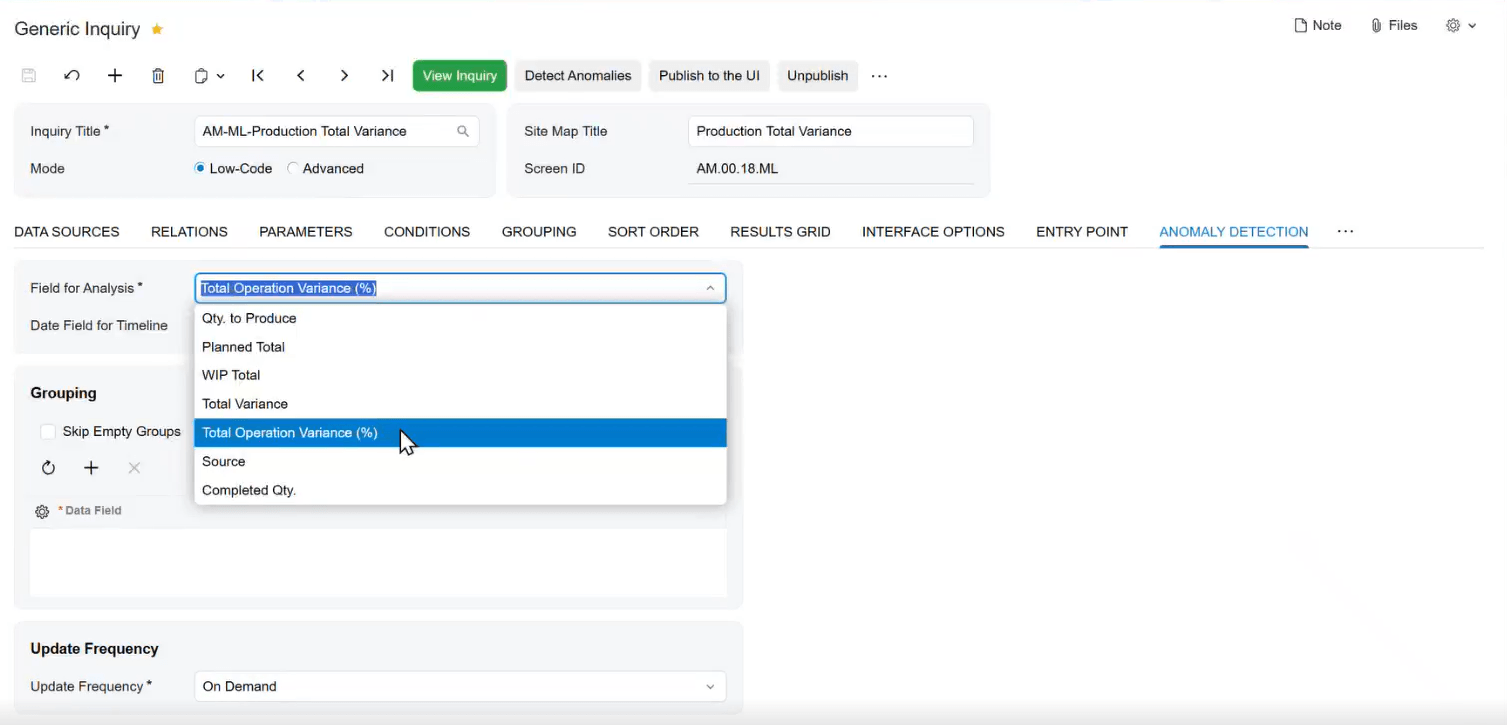
AI Anomaly Detection monitors financial and operational data for unusual patterns across vendors, items, customers, and other business activity. Exceptions are ranked by severity so teams can focus on the issues that matter most, while predictive insights help surface changes in customer behavior, demand, and supply chain performance.
Dashboards, inquiries, and automated scheduling make those insights available within the workflows where teams already work.
Examples in action:
- Anomaly detection flags an unexpected spike in a vendor’s invoice amounts, helping your finance team investigate before payment.
- Highlights inventory items at risk of stockout based on seasonal demand patterns, giving operations time to reorder.
- Surfaces project budget overruns or subcontractor billing irregularities
Assist
Amplify every employee with AI that works alongside your teams
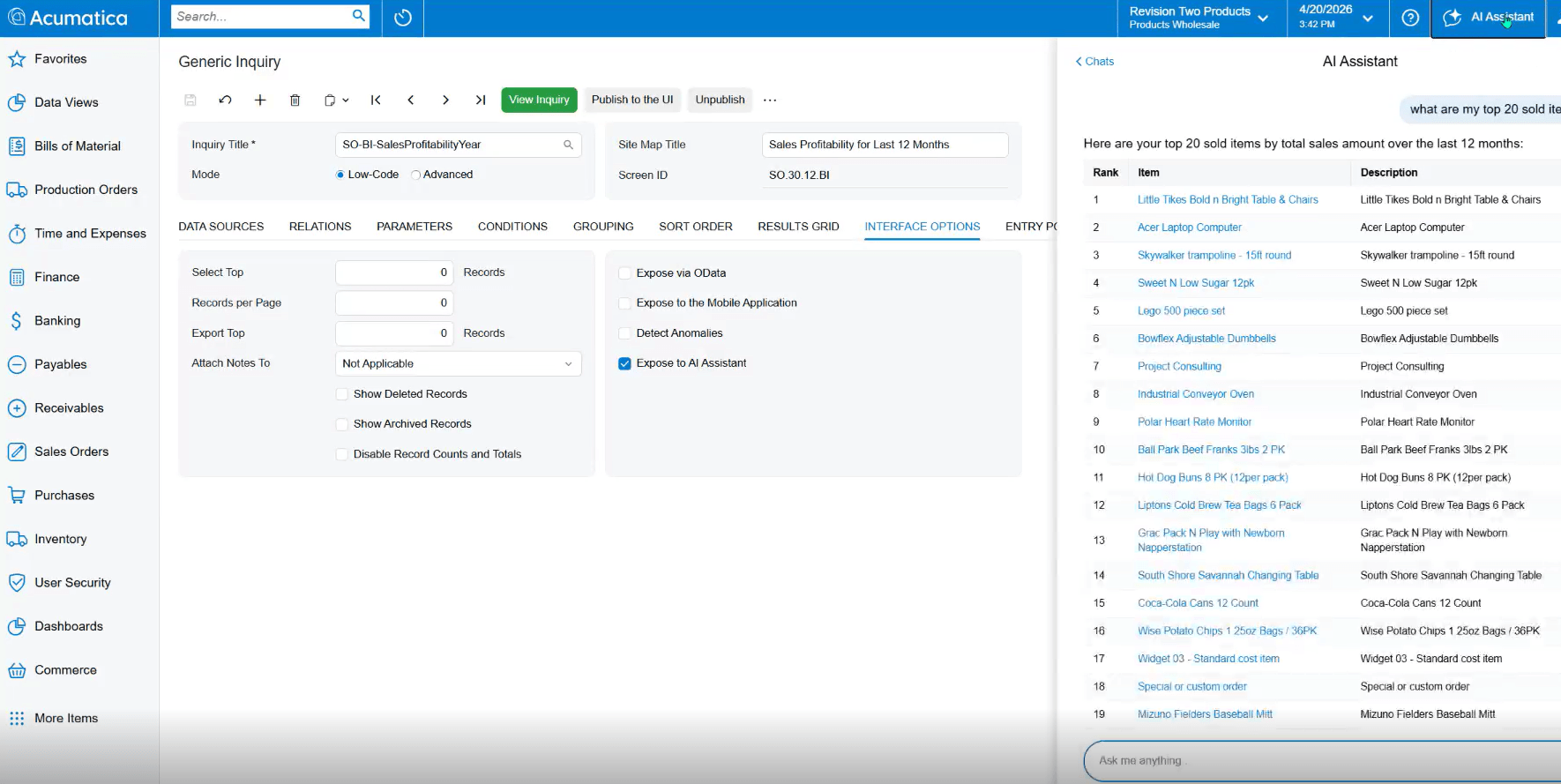
The Acumatica AI Assistant helps employees ask questions about business data in plain language and receive answers without building reports or relying on IT. It can work with Generic Inquiries, understand the screen or record a user is viewing, and present results as tables, charts, pivot tables, or home-screen widgets.
Persistent conversations preserve context across follow-up questions, while inherited security helps ensure users only see information they are authorized to access.
Examples in action:
- The AI Assistant answers a project manager’s question about budget status in plain language, without building a report.
- AI Assistant recognizes what record or screen a user has open and answers questions about it directly, without needing extra context.
- A user turns a frequent AI Assistant question into a home-screen widget, so the answer is always one click away.
- AI-powered product help guides a new employee through an unfamiliar process directly within the screen they are using.
Automate
Transform work through automation that scales with your growth
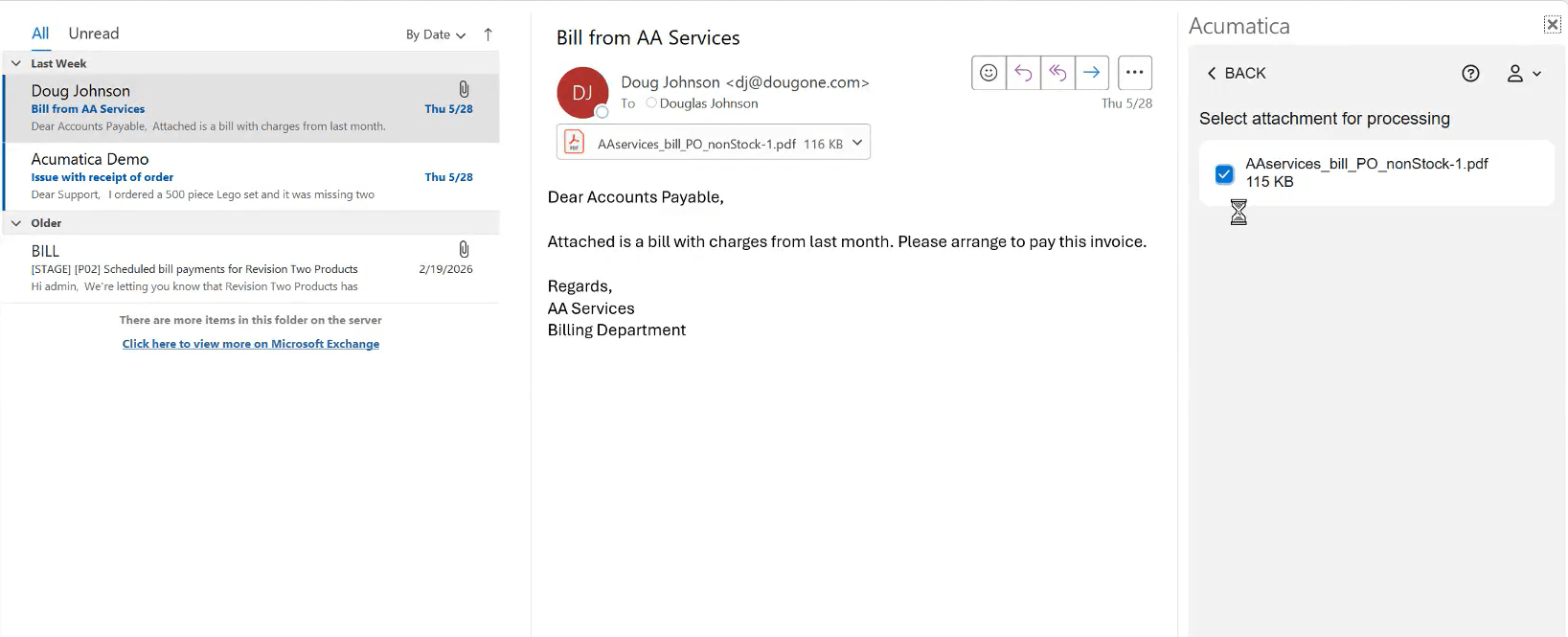
Automate repetitive business tasks with AI that can read records, apply instructions, and write results back into Acumatica workflows. Document recognition can create bills from vendor invoices, expense automation can capture receipt data, and AI agents can classify files or summarize lengthy support conversations.
Organizations can connect preferred AI model providers while using field-level masking, reusable instructions, and usage tracking to help maintain control over sensitive data and AI operations.
Examples in action:
- AP document recognition reads incoming vendor invoices, extracts key details, and creates bills automatically for review and approval.
- Expense receipt recognition captures receipt data from a photo in the mobile app, using your own configured instructions and field mappings, connected to the LLM provider you already use.
- AI Automation can update the detail lines of a record directly — for example, applying a discount or adding a free item across matching sales order lines.
- The file tagging agent classifies and organizes attachments automatically, so the right documents are easy to find.
- The case summaries agent condenses long support email threads into a clear overview, so service reps resolve issues faster.
Orchestrate
Orchestrate outcomes across your business, not just individual tasks
Use intelligent workflows and agents to coordinate processes that span teams and departments, not just individual tasks. Acumatica is developing AI-driven workflows for processes such as financial close, where reconciliations, accruals, approvals, and reporting must be coordinated across multiple steps and users.
Agents can monitor changing business conditions, surface exceptions, and route issues to the people who need to act.
Examples in action:
- AI workflows to expedite the financial month-end close.
- Coordinate reconciliations, accruals, approvals, and reporting.
MCP
Build AI on a secure, connected, adaptable platform
Build AI on a foundation of role-based security, governed data access, open APIs, and flexible model connectivity. Acumatica supports data masking and inherited permissions while allowing organizations to connect AI models and tools that fit their business requirements.
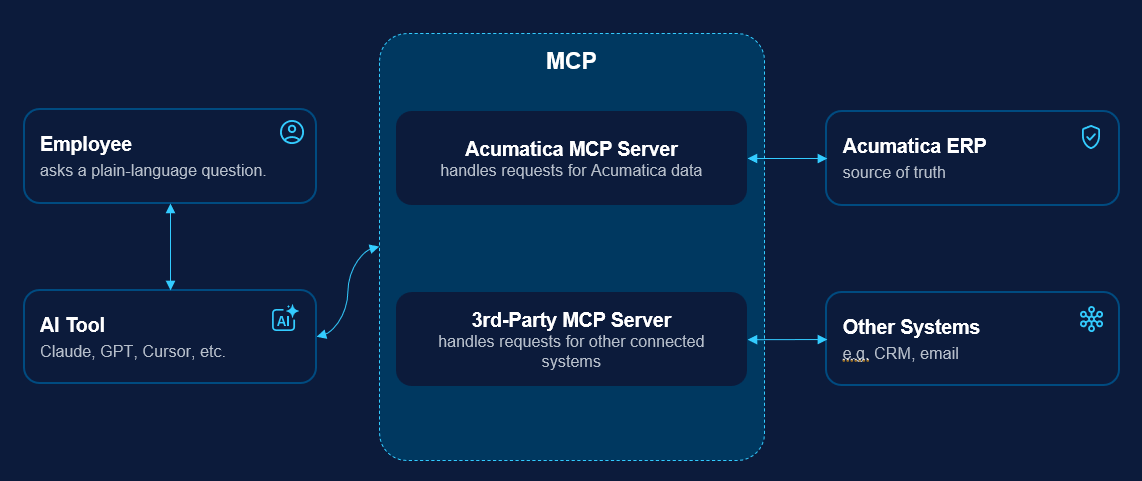
Through Model Context Protocol (MCP), authorized AI tools can securely access permitted business information while respecting existing Acumatica security policies and governance.
Examples in action:
- Connect Claude, Gemini, Cursor, or other MCP-compatible AI tools to Acumatica using secure, standardized connections.
- Keep sensitive information protected through role-based permissions, inherited security, field-level masking, and governed data access.
- Choose the AI models that best fit your business while maintaining centralized governance and auditability.
- Extend AI across your organization using open APIs, MCP, reusable instructions, and enterprise-grade governance.
- Expose published Generic Inquiries as callable tools, so connected AI agents can query exactly the data you choose to give them.
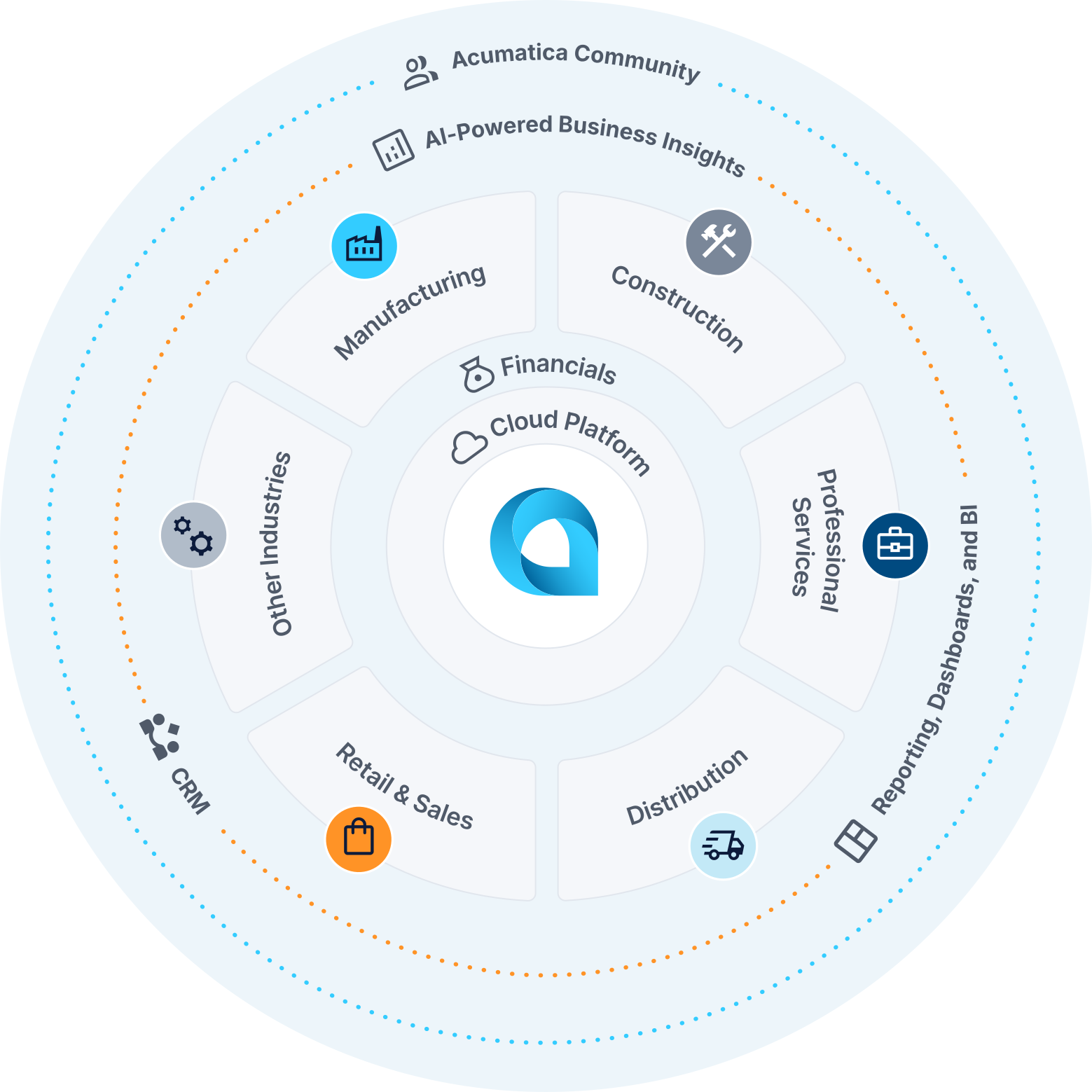
Why Acumatica for Artificial Intelligence?
Put practical AI to work with a platform built to deliver insights, automate workflows, and help growing businesses make better decisions.
A platform for the intelligent business era
Learn more
Empower everyone with unlimited users
Learn more
Build your AI strategy on a foundation of trust
Learn more
Build your perfect demo
Choose the AI-powered experiences that matter most to your business
Acumatica Overview
AI Strategy Video
AI Anomaly Detection
AI Assistant
Security
Reporting, Analytics, and BI
AI-centric knowledge center
Your toolkit to support every step of your AI journey
What's new
Integrations
Resources
ROI calculator

What’s new for AI in 2026 R2?
Put practical AI to work inside ERP workflows while strengthening the governed data foundation behind it. Across the platform, new capabilities make business data faster to access, easier to analyze and report on, and safer to extend to approved AI tools — all under the access rights your team already relies on.
- Use AI Assistant to answer complex business questions and support ongoing decision-making.
- Build AI agents that use broader ERP context to take defined actions on eligible records.
- Connect external AI tools to approved, read-only ERP data through MCP servers.
- Scale AI use with clear oversight of sensitive data, access, and consumption.
- Use faster, more flexible Generic Inquiries across reporting, integrations, and AI tools.
- Also in this release: AI-unit consumption threshold warnings, experimental AI-powered expense receipt recognition, and Generic Inquiry AI-description processing status.

Marketplace Solutions for AI and Automation
Extend Acumatica with AI integrations and tools from leading technology providers. AI Studio also enables partners and teams to build additional AI capabilities for industry and business-specific use cases while maintaining control over data, technology choices, and usage.

Resources for Artificial Intelligence
Explore solution briefs, analyst reports, guides, and product videos to learn how practical AI can automate workflows, improve decision-making, and create more value from business data.

ERP ROI calculator
Estimate the value an ERP system can bring to your operations with our benefits calculator.
FAQ
What is AI-powered ERP?
AI-powered ERP combines traditional ERP capabilities with Artificial Intelligence to help businesses analyze data, identify patterns, automate routine work, and support faster decision-making. Because AI works with connected operational and financial information, employees can gain insights and take action within the same business workflows they already use.
How does Acumatica use AI in everyday business processes?
Acumatica applies AI across financial, operational, customer, project, inventory, and other business workflows. Capabilities include anomaly detection, document recognition, expense automation, conversational data analysis, file classification, case summarization, and other tools designed to reduce manual work and surface useful information.
Can employees ask questions about Acumatica data using AI?
Yes. Acumatica’s AI Assistant allows employees to ask questions about business data in plain language and receive answers based on information they are authorized to access. Results can be presented in formats such as tables, charts, pivot tables, and dashboard widgets.
How can AI help automate ERP tasks?
AI can automate repetitive tasks such as extracting information from vendor invoices, capturing receipt data, classifying files, and summarizing lengthy customer-service conversations. These capabilities help reduce manual data entry and allow employees to spend more time reviewing exceptions and making decisions.
How does Acumatica protect business data when using AI?
Acumatica applies existing role-based permissions and security policies to AI-enabled workflows. Data masking, governed access, usage controls, and model connectivity options help organizations manage how sensitive information is accessed and used with AI tools.
Can Acumatica connect with external AI models and tools?
Yes. Acumatica supports connections with external AI technologies through open APIs and Model Context Protocol (MCP). Organizations can connect compatible AI tools and models while maintaining Acumatica permissions, governance, and data-access controls.
Building the future of business, together.
See how AI-powered ERP can help your teams uncover insights, automate routine work, and act faster across the business.